To mirror your iPhone to a TV, put both on the same Wi-Fi network, open Control Center, tap Screen Mirroring and choose your Apple TV 4K or AirPlay 2 smart TV. Type the code on your iPhone if the TV shows one. To stop, tap Screen Mirroring again and then Stop Mirroring. If the TV has no AirPlay, an HDMI adapter or cable can do the job on iPhones that support wired video, which iPhone 16e, iPhone 17e and iPhone Air do not.
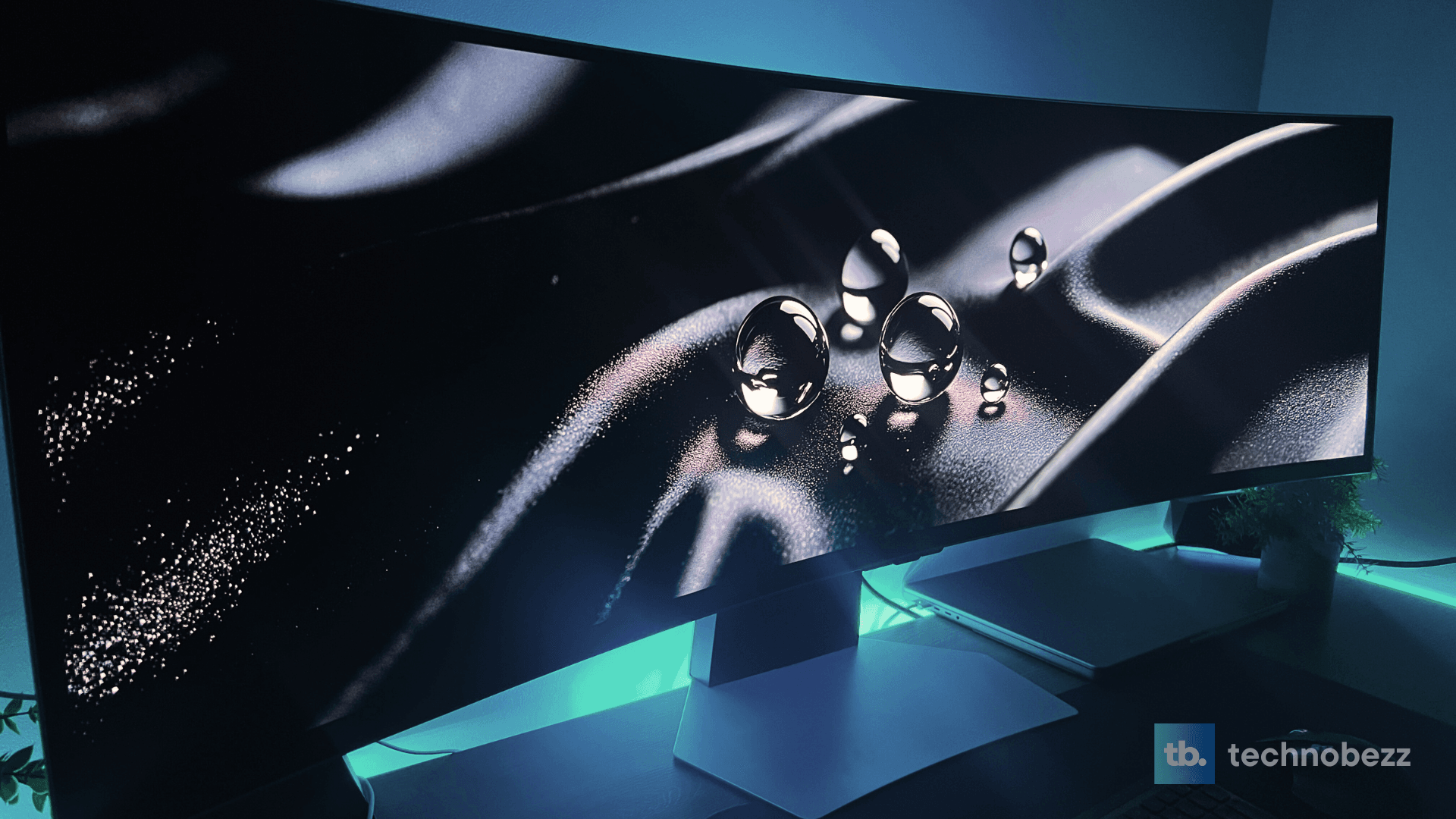
On our iPhone 17 Pro with iOS 26.6, the Screen Mirroring button sat in Control Center, and tapping it listed one AirPlay screen, a Samsung Odyssey monitor. A TV appears in that list only once AirPlay is on in its own settings.
The short version
- Mirror: same Wi-Fi, open Control Center, tap Screen Mirroring, pick your TV, type the code if it asks.
- TV not listed: turn AirPlay on in the TV's own settings first.
- Stop: Control Center, Screen Mirroring, Stop Mirroring.
- No AirPlay: plug in an Apple TV 4K or a Roku with AirPlay, or use an HDMI adapter or cable if your iPhone supports wired video (not iPhone 16e, 17e or Air).
- Black video: protected video can go black while mirroring, so play it from the TV's own app instead.
Ways to mirror an iPhone to a TV
The route depends on whether your TV has AirPlay and, for a cable, on whether your iPhone supports wired video. Every wireless route ends in the same Screen Mirroring list, and every wired route needs an adapter or cable that fits your iPhone's port.
| What you are connecting to | First, on the TV | On your iPhone | Good to know |
|---|---|---|---|
| AirPlay 2 smart TV | Turn AirPlay on in the TV's settings | Control Center > Screen Mirroring > your TV | Same Wi-Fi network; type the code if one appears |
| Apple TV 4K | AirPlay switched on in Settings | Control Center > Screen Mirroring > Apple TV | Shows an onscreen password the first time |
| Roku with AirPlay | Settings > Apple AirPlay and HomeKit > On | Control Center > Screen Mirroring > the Roku | Home on the Roku remote stops it |
| Hotel TV with AirPlay | Find the AirPlay QR code on the TV | Scan it with Camera and follow the prompts | Not offered in every country or region |
| Any TV with HDMI, Lightning iPhone | Switch to the HDMI input | Lightning Digital AV Adapter and an HDMI cable | Up to 1080p |
| Any TV with HDMI, USB-C iPhone | Switch to the HDMI input | USB-C to HDMI adapter or cable | Up to 4K at 60Hz with HDMI 2.0; not iPhone 16e, 17e or Air |
What your TV needs for screen mirroring
An iPhone mirrors over AirPlay, so the screen on the other end has to be an AirPlay receiver. Apple's words are an Apple TV 4K or an AirPlay 2-enabled smart TV, and both devices must be on the same Wi-Fi network. A TV's separate "screen mirroring" feature for Android phones is not what an iPhone uses.
Apple's iPhone guide still points to a list of AirPlay 2 TVs on its Home accessories page, but that page now lists AirPlay receivers and speakers and no TV category at all. So the reliable check is the TV itself: if its settings have an AirPlay menu, it is an AirPlay receiver. The makers' own lists help too. Samsung names select models from 2018 to 2025 plus its Smart Monitors, so check the model of your Samsung TV if the menu below is missing.
LG lists models from 2018 onward in a table on its support site and says AirPlay needs iOS 12.4 or newer on the iPhone. Vizio's Apple page says "Your VIZIO TV has AirPlay 2 built in", so look for AirPlay in the TV's menu. One of Sony's BRAVIA help guides says that TV supports AirPlay 2 and needs an internet connection for AirPlay, so check your own model's help guide.
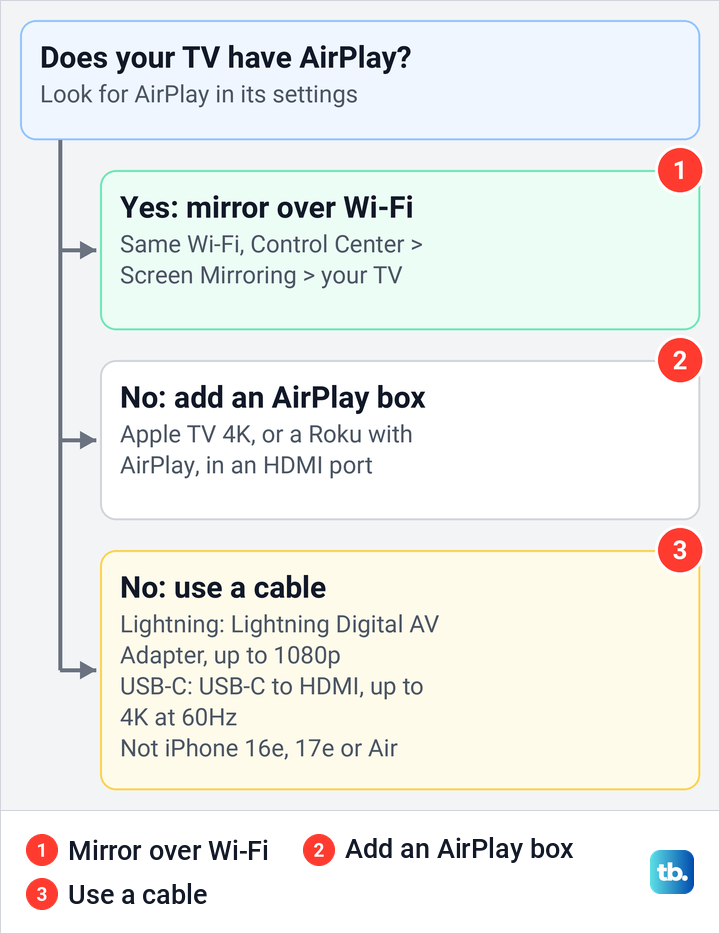
A TV without AirPlay can still show your iPhone. Plug an Apple TV 4K or a Roku device that supports AirPlay into one of its HDMI ports and mirror to that, or connect the iPhone with a cable, as the HDMI section below explains. A Chromecast is different: Google's help shows an iPhone sending video from apps that have a Cast button, which is not the same as mirroring the whole screen.
A Mac can be the big screen too, and our guide to using AirPlay on a Mac covers that side. Screen Mirroring is also not the same feature as iPhone Mirroring, which puts your phone in a window you control from a Mac.
Turn on AirPlay on your TV
If AirPlay is off at the TV end, the TV never appears in your iPhone's list. Each maker puts AirPlay in a different menu. The paths below are the ones each maker prints on its own support pages. Sony's and Vizio's pages print no menu path for switching AirPlay on, so the Sony row is a compatibility note only.
| Your TV or device | Where AirPlay is | What else is there |
|---|---|---|
| Samsung TV or Smart Monitor | Settings (All Settings) > General, or Connection on newer models > Apple AirPlay Settings | Require Code (first time or every time, or your own code) and Reset Paired Devices |
| LG TV | Input button > Home Dashboard > AirPlay > AirPlay and HomeKit settings > AirPlay On | An AirPlay passcode shows on the TV when you connect |
| Roku TV or Roku streaming device | Settings > Apple AirPlay and HomeKit > AirPlay On | Press Home on the Roku remote to stop |
| Amazon Fire TV Smart TV | Settings > Display & Sounds > AirPlay & HomeKit | AirPlay is not on every Fire TV Smart TV |
| Apple TV 4K | Settings > AirPlay and Apple Home > AirPlay | Allow Access and Require Password |
| Sony BRAVIA | No menu path printed; check that your model's help guide lists AirPlay 2 | The guide for one BRAVIA model says AirPlay needs an internet connection |
On a Roku, ignore the separate Screen mirroring setting. Roku says that one is for Android and Windows devices, while Apple devices use AirPlay. Our walkthrough on turning on AirPlay on a Roku TV has the Roku screens step by step.
Mirror your iPhone screen from Control Center
Once AirPlay is on at the TV end, the rest happens on the iPhone. These are Apple's steps for an iPhone and a smart TV or Apple TV 4K, and Apple's guide for iOS 27 gives the same ones.
- 1.Connect your iPhone and the TV to the same Wi-Fi network.
- 2.Open Control Center by swiping down from the top-right corner, or up from the bottom on an iPhone with a Home button.
- 3.Tap Screen Mirroring, the button with two overlapping rectangles.
- 4.Choose your TV from the list.
- 5.If an AirPlay code appears on the TV, type it on your iPhone.
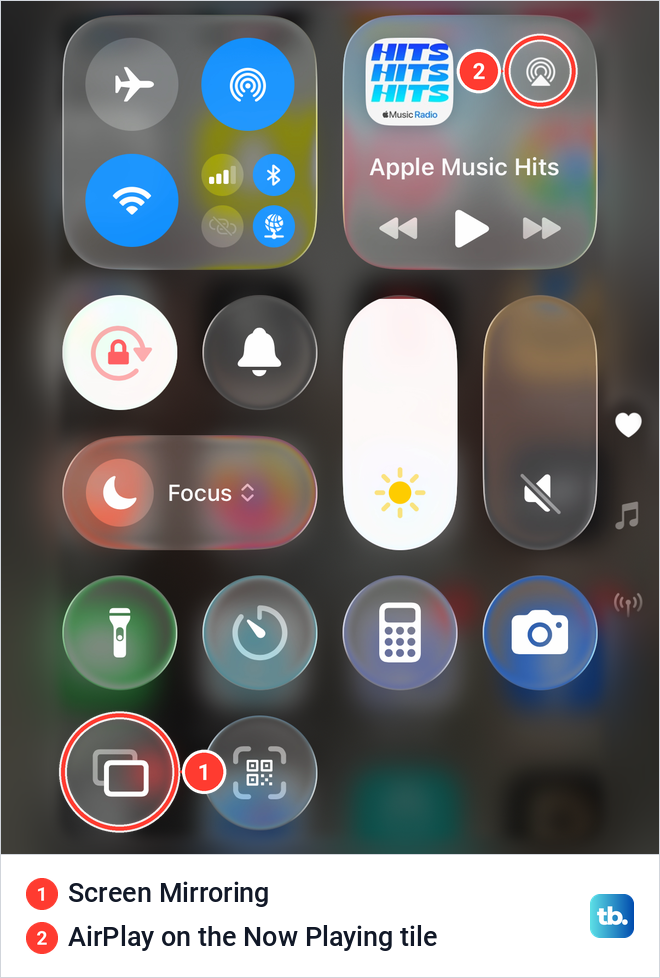
On our iPhone, Screen Mirroring was the button with two overlapping rectangles near the bottom of Control Center, as marked below. The Now Playing tile at the top right has its own AirPlay button, which sends what is playing rather than the whole screen.
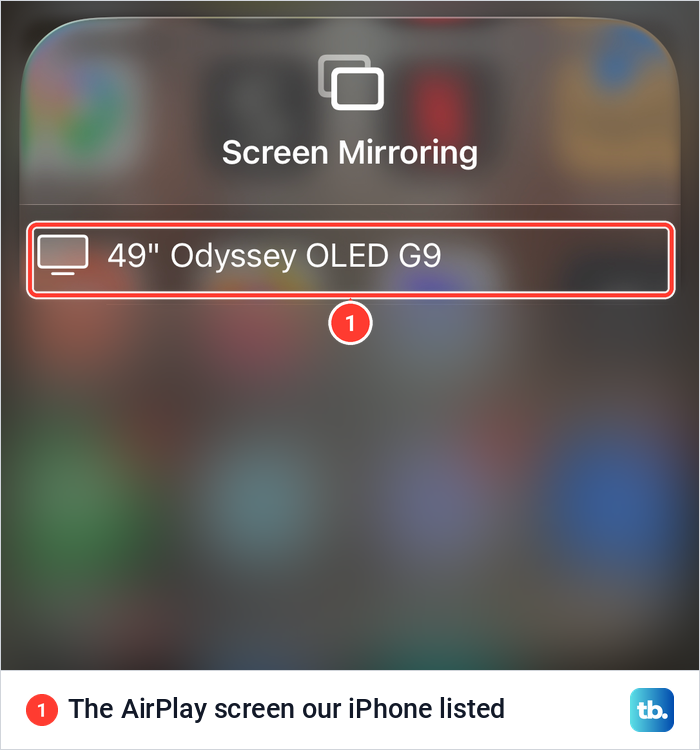
Tapping Screen Mirroring opened a panel titled Screen Mirroring that lists AirPlay screens. Ours listed one, a Samsung 49-inch Odyssey OLED G9 monitor, with a screen icon beside its name. That agrees with Samsung, which says AirPlay 2 also works with its Smart Monitors.
If you don't see Screen Mirroring at all, add it back. Tap the + button at the top left of Control Center, as Apple describes, then tap Add a Control at the bottom. On our iPhone the controls gallery opened with a Search Controls field at the top, and Screen Mirroring sat among the system controls.
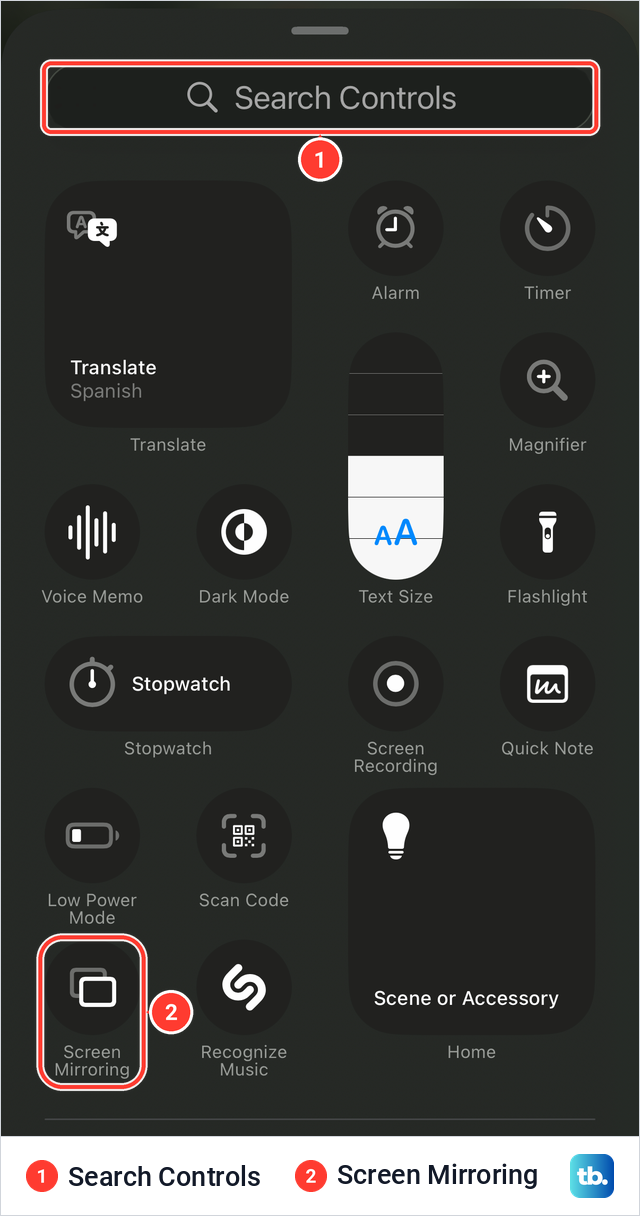
Tap the tile once to add it. When you finish, close Control Center by swiping up from the bottom center of the screen, as Apple describes.
Enter the AirPlay code on your iPhone
When the TV shows an AirPlay code, you read it off the TV and type it on your iPhone, as Apple says, not the other way round. LG calls it an AirPlay password shown on the TV, and Samsung says you may see a code on the screen to enter into your phone.
Whether it asks again next time is the TV's choice, not the iPhone's. Samsung's Apple AirPlay Settings has a Require Code option that asks the first time you connect an iOS device or every time, and it lets you set your own code. Reset Paired Devices in the same menu clears every iPhone the TV remembers.
An Apple TV shows an onscreen password the first time you use AirPlay with it, Apple says, and its deployment guide adds that later connections don't need a passcode unless onscreen code settings are on. Require Password under Allow Access is different: it asks everyone for a password you set.
Send one video to the TV with the AirPlay button
Screen Mirroring copies everything on your screen. The AirPlay button inside a video app sends just that video. Play the video, tap the AirPlay button and choose your TV, as Apple describes.
In Photos the button sits one step deeper. Apple says to tap the Share button first, then AirPlay. With an Apple TV 4K and an iPhone that supports 4K HDR video, Apple notes that videos from Photos stream in full 4K HDR.
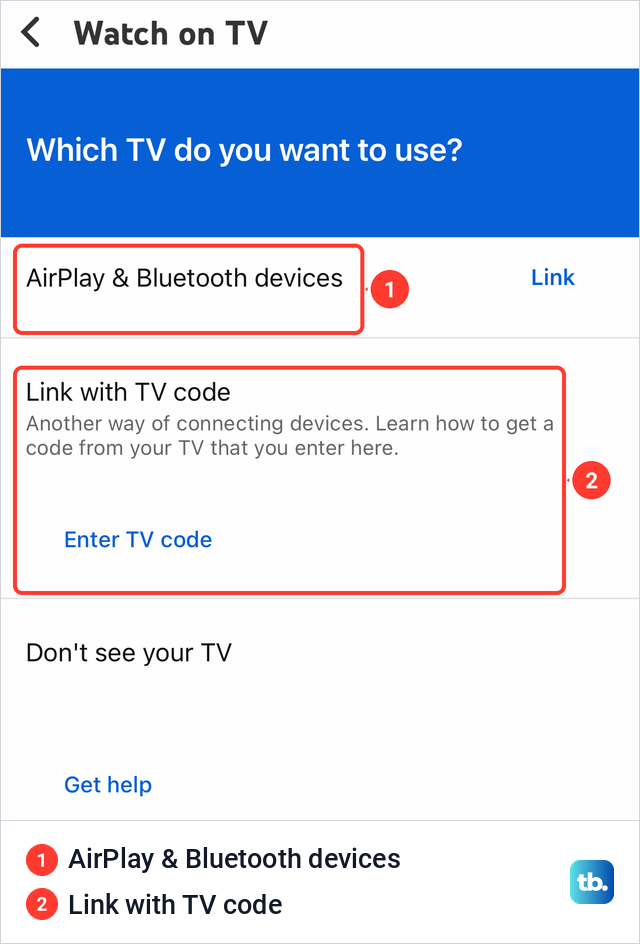
Some apps do the same job from their own menus. In the YouTube app on our iPhone, the gear on the You tab opened Settings, where Watch on TV sat under Video and audio preferences. That page asked "Which TV do you want to use?" and offered AirPlay & Bluetooth devices and Link with TV code, which it describes as another way of connecting devices, using a code from your TV.
Not every video app plays along. Apple says some video apps might not support AirPlay, and if one won't, check the App Store on your Apple TV to see if that app is available there instead.
How to stop screen mirroring or turn off AirPlay
Stop the way you started. To end mirroring, open Control Center, tap Screen Mirroring, then tap Stop Mirroring.
For a single video, tap the AirPlay button in the app you are streaming from, then tap your iPhone in the list. Apple's pages word this last tap three ways: your iPhone in the list, Turn Off AirPlay, or Play on iPhone in its Apple TV guide. Pick whichever your screen shows.
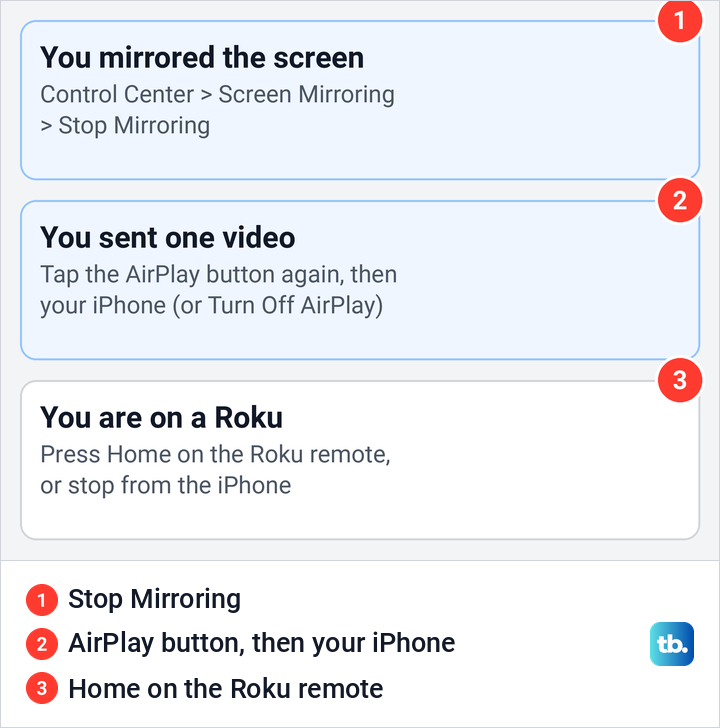
Roku adds one more way: press Home on the Roku remote. Stopping from the iPhone works the same way on every TV, so it is the one to remember.
Mirror your iPhone to an Apple TV
The steps are the same as for a smart TV. The first time, the Apple TV shows an onscreen password that you type on the iPhone. If the Apple TV is missing from the list, check Settings > AirPlay and Apple Home on the Apple TV, where Apple's tvOS 26 guide has an AirPlay switch. Older Apple TV software calls the same menu AirPlay and HomeKit.
Allow Access in that menu decides who can connect: Everyone, Anyone on the Same Network, or Only People Sharing This Home. Require Password adds a password of your choice. To see which devices can use AirPlay with it, Apple's path is Settings > Remotes and Devices > Remote App and Devices, where Forget This Device removes one.
An Apple TV can also work without a shared Wi-Fi network. Apple's deployment guide says devices can find it peer to peer, ideally within 25 to 30 feet, when Allow Access is set to Everyone. With Anyone on the Same Network, only devices on that network can connect. The same Apple TV menu has a Peer-to-Peer Wireless switch, which Apple says can be turned off to save energy, so leave it on for this route.
For automatic AirPlay suggestions to your Apple TV, Apple says to sign in to the same iCloud account on both. If the Apple TV still refuses, our fixes for when AirPlay is not working on Apple TV go deeper into its settings.
Mirror your iPhone to a TV with an HDMI cable
A cable works with any TV that has an HDMI port, with no Wi-Fi and no AirPlay. The adapter depends on the port on the bottom of your iPhone, so check which iPhone you have before you buy one.
A Lightning iPhone uses Apple's Lightning Digital AV Adapter and a separate HDMI cable. Apple's store page says it mirrors your screen to an HDMI TV in up to 1080p HD.
A USB-C iPhone can send video out of its port on iPhone 15 models, iPhone 16 models except iPhone 16e, iPhone 17 models except iPhone 17e, and iPhone 18 Pro models. Apple says those models drive a USB-C display at up to 4K and 60Hz, and a USB-C to HDMI adapter or cable that supports HDMI 2.0 does the same for a TV. Apple's USB-C Digital AV Multiport Adapter adds HDR10 or Dolby Vision on an HDR TV.
Apple also says the USB-C cable that comes with the iPhone supports charging and USB 2 speeds, so use a USB 3.1 or faster cable for a USB-C display. iPhone 16e and iPhone 17e mirror over AirPlay instead. Apple's iPhone Air spec page lists its USB-C port for charging and USB 2 only, with AirPlay for mirroring, so an iPhone Air uses AirPlay too.
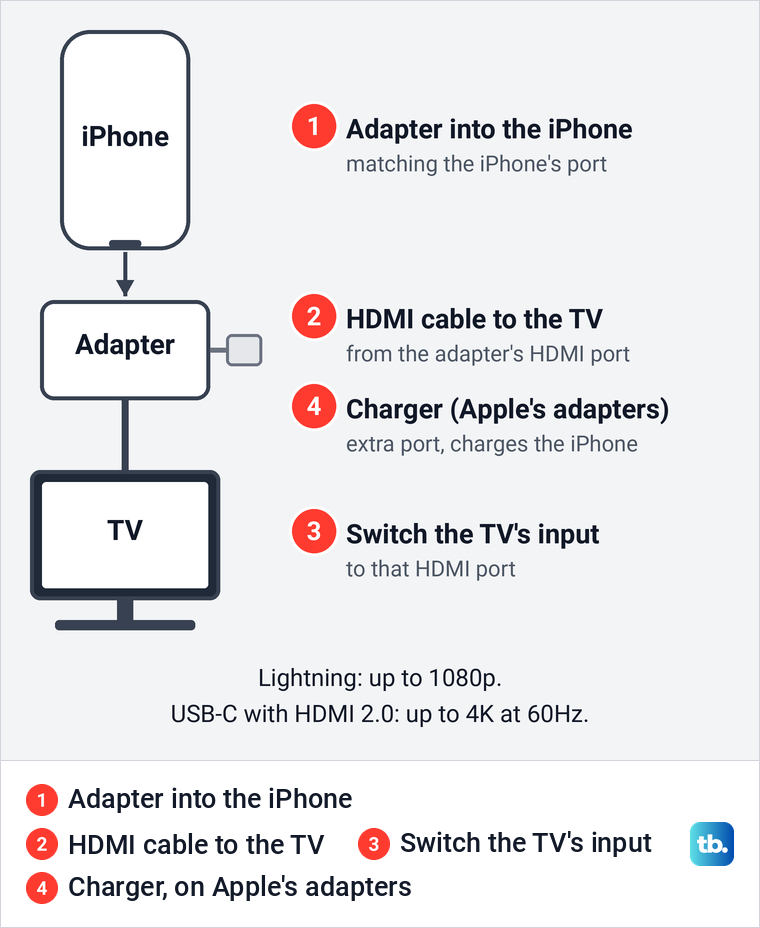
Apple's steps are short. Plug the adapter into the iPhone's charging port, connect an HDMI cable to the adapter and the TV, and switch the TV to that HDMI input if it doesn't change by itself. Apple's adapters have an extra port so you can charge the iPhone while it is connected.
Apple notes that a connected display mirrors the iPhone's screen, except when a video app offers its own second-screen experience. With a USB-C display connected, Apple says you switch between SDR and HDR (standard and high dynamic range) in Settings > Display & Brightness, where the connected display is listed.
Why video goes black or plays only sound on the TV
Protected video can show as a black picture while its sound keeps playing. Apple's developer documentation says that while the screen is mirrored, the system blacks out video protected with FairPlay Streaming but still plays its audio. It also says apps can tell they are being mirrored, and a media app may pause playback and explain why.
Netflix goes further. Its help pages say AirPlay with iPhone is not supported and that an error can appear if you try to watch with Screen Mirroring or AirPlay turned on.
Netflix's own routes are the Netflix app on the TV, a video cable adapter that works with your iPhone, or casting on a Standard or Premium plan. Netflix lists casting only for Chromecast (3rd gen or older, without a physical remote), Google Nest Hub displays and select cast-enabled Vizio and Compal TVs. That error is about mirroring itself, and for other Netflix errors on a phone or TV, see our Netflix troubleshooting guide.
Cables have a rule of their own. Apple says movies, TV shows and some streaming apps need HDCP (High-Bandwidth Digital Content Protection), and a non-HDCP connection such as Apple's VGA adapter triggers an alert asking for an HDCP-compatible device.
Your TV is not in the Screen Mirroring list
Work through these in order, starting at the TV. Check that AirPlay is switched on in the TV's own settings, using the table above. Then check that the iPhone and the TV are on the same Wi-Fi network, and LG adds that both should be on the same 2.4 GHz or 5 GHz network.
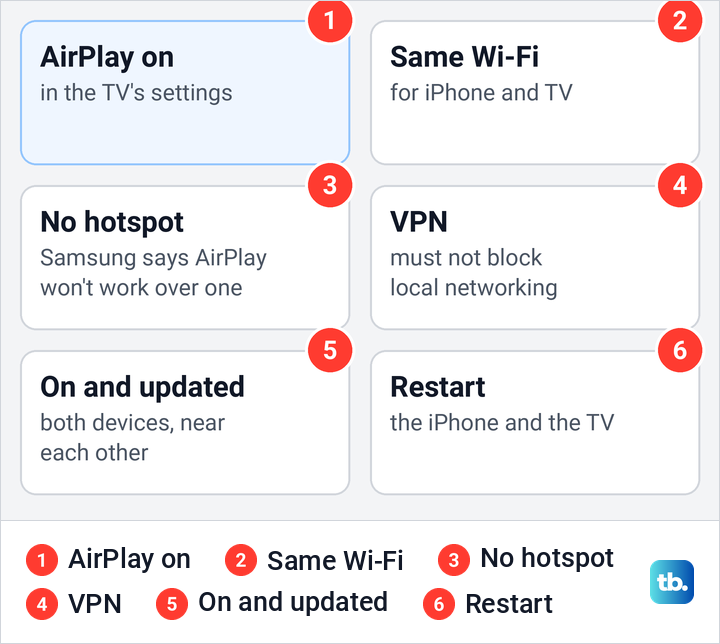
A phone hotspot is a trap. Samsung says most mobile hotspots do not allow devices to talk to each other, so AirPlay will not work over one. If the TV is online but Wi-Fi is not working on your iPhone, fix that first.
If you use a VPN on your iPhone, Apple says its configuration must not prevent local networking, so pause it while you mirror if the TV stays hidden. Apple's checklist also says both devices should be on and near each other, and that a TV set up in the Home app can have AirPlay restricted in the Home app under More > Home Settings > Speakers & TV.
Apple's next step is to update the software on your iPhone and on the TV. Last, restart your iPhone and the TV, then open the Screen Mirroring list again.
No sound or a cropped picture on the TV
If the picture arrives without sound, Apple says to make sure the volume is turned up and not muted on both the iPhone and the TV or receiver. On a cable, use a Digital AV adapter with an HDMI port, because Apple says a VGA adapter doesn't carry audio. If a Samsung TV stays silent with every source, our fixes for no sound on a Samsung TV start at the TV end.
On an Apple TV, a picture with its edges cut off is what AirPlay Display Underscan fixes, in Settings > AirPlay and Apple Home. If you see black bars around the image instead, Apple says to turn that setting off.
Use AirPlay on a hotel TV
Some hotel rooms have TVs that support AirPlay, and Apple's steps for them skip the Wi-Fi hunt. Open Camera on your iPhone, turn on the room's TV and find its AirPlay QR code. Scan the code, then follow the onscreen instructions to join the hotel Wi-Fi if you haven't already and connect to the TV.
Apple notes that AirPlay in hotels isn't available in all countries or regions. Stop the same way as at home, from Screen Mirroring or the AirPlay button.
Choose when your iPhone connects to a TV by itself
Your iPhone can also offer or start AirPlay on its own when you play something. The setting lives in Settings > General > AirPlay & Continuity > Automatically AirPlay. Older guides call the row AirPlay & Handoff, but on our iPhone 17 Pro with iOS 26.6 it read AirPlay & Continuity, after AirDrop and before Picture in Picture.
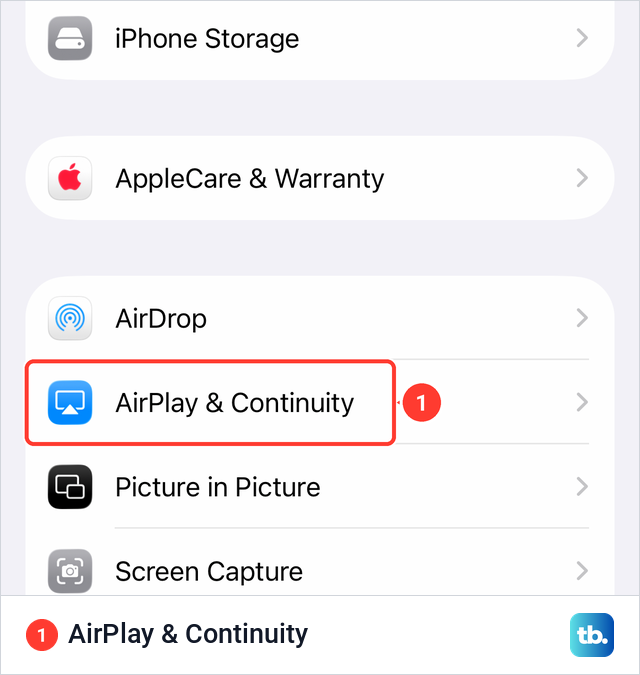
The AirPlay & Continuity page on our iPhone held Automatically AirPlay, Transfer to HomePod, Keep Audio with Headphones, Handoff and Continuity Camera. There was no switch for receiving AirPlay on the iPhone itself, so there is nothing to turn on there before you mirror to a TV.
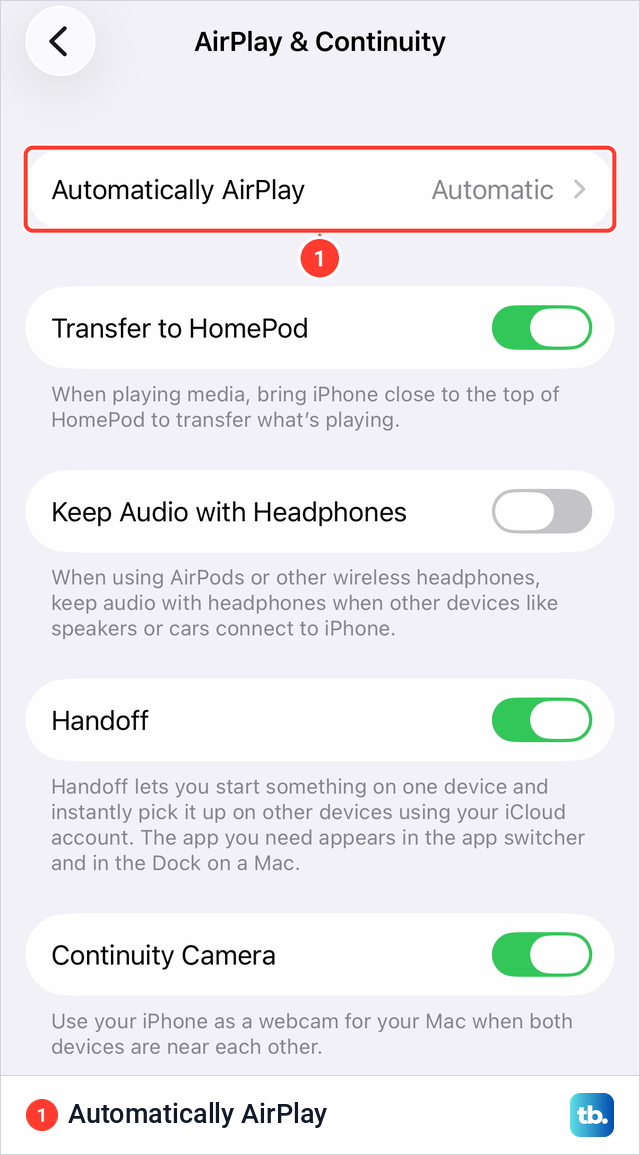
Tapping Automatically AirPlay showed three choices, and ours was set to Automatic. Apple describes Never as choosing a device for AirPlay manually, Ask as getting suggested AirPlay connection notifications, and Automatic as getting both suggested and automatic connections.
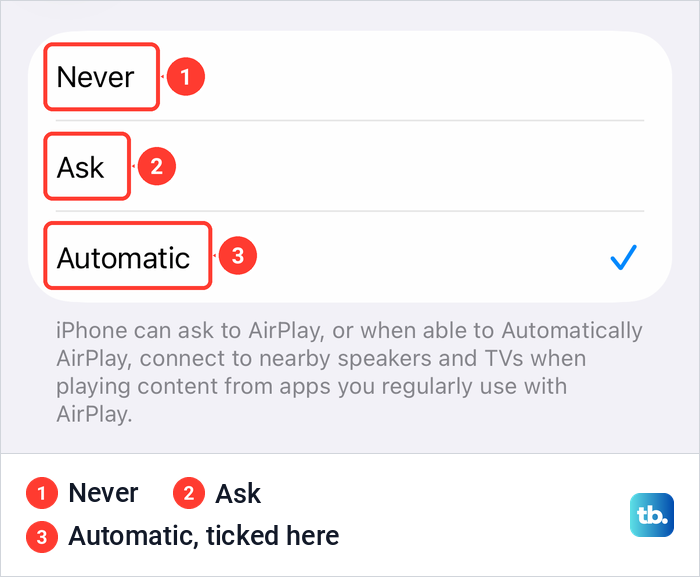
Pick Never if your iPhone keeps jumping to a TV in another room. Pick Ask if you like the suggestion but want to tap it yourself.
How we tested this guide
We tested on our iPhone 17 Pro with iOS 26.6. We opened Control Center and its Screen Mirroring list, which showed a Samsung Odyssey monitor, and the controls gallery where Screen Mirroring can be added back. We also read Settings > General > AirPlay & Continuity with its Automatically AirPlay choices, and the Watch on TV page in the YouTube app.
The rest of the steps come from Apple's support pages. Each TV menu comes from that maker's own support page, and the Netflix lines from Netflix's help pages.
Frequently Asked Questions
Can I mirror my iPhone to a TV without Wi-Fi?
Yes, with a cable. Use the Lightning Digital AV Adapter on a Lightning iPhone, or a USB-C to HDMI adapter on a USB-C iPhone with video out. An Apple TV can also take a direct peer-to-peer AirPlay connection without a shared Wi-Fi network when its Allow Access is set to Everyone, Apple says.
Why does Netflix go black when I mirror my iPhone?
Netflix says it does not support AirPlay or Screen Mirroring from iPhone, and Apple's system blacks out protected video while mirroring. Use the Netflix app on the TV, or a video cable adapter that works with your iPhone.
Can I mirror my iPhone to a TV that isn't a smart TV?
Yes. Plug an Apple TV 4K or a Roku device with AirPlay into its HDMI port and mirror to that, or connect the iPhone directly with an HDMI adapter.
Why does my TV ask for a code every time?
The TV decides, not the iPhone. On a Samsung TV, set Require Code in Apple AirPlay Settings to first time only, and on an Apple TV check whether Require Password is on under Allow Access.
Why is there no sound on the TV when I mirror?
Turn the volume up and unmute it on both the iPhone and the TV. If you use a cable, a VGA adapter carries no sound, so switch to a Digital AV adapter with HDMI.
Can I mirror an iPhone 15 or later with a USB-C cable?
Yes on iPhone 15 models, iPhone 16 models except 16e, iPhone 17 models except 17e and iPhone Air, and iPhone 18 Pro models. Use a USB-C to HDMI adapter or cable that supports HDMI 2.0, or a USB-C display with a USB 3.1 cable.
Can I screen mirror to a Fire TV or Chromecast?
Amazon says only some Fire TV Smart TVs have AirPlay, under Settings > Display & Sounds > AirPlay & HomeKit. Amazon's AirPlay page covers only Fire TV Smart TVs, so if a Fire TV Stick has no AirPlay & HomeKit setting, use an Apple TV, a Roku with AirPlay or a cable. A Chromecast takes video from iPhone apps that have a Cast button rather than a mirrored screen.
Can I record my screen while mirroring?
No. Apple says you can't record your screen and use Screen Mirroring at the same time, so stop mirroring first when you want to record your iPhone screen.