

If your Samsung TV has a picture but no sound, turn the volume up on the remote and check the volume on any soundbar or cable box, then open Settings > All Settings > Sound > Sound Output and choose the TV's own speakers. Next, run Samsung's Sound Test under Support > Device Care > Self Diagnosis. A normal result sends you to the app, Sound Output, the connection or the device you were using, while a failed one points to the TV itself.
Most of the work is finding where the sound stops. A TV that lost sound everywhere, a soundbar that went quiet while the TV speakers still work, one silent HDMI input and one silent app are different problems with different fixes. Use the table below to jump to your case.
The short version
- Turn the volume up on the Samsung remote, then turn up the soundbar or cable box with its own remote too.
- In Sound > Sound Output, choose the TV's own speakers to rule out an external device.
- Run Support > Device Care > Self Diagnosis > Sound Test. A normal result sends you to your external devices and connections.
- For a silent HDMI soundbar, check the ARC or eARC ports at both ends, the bar's D.IN source and Anynet+ (HDMI-CEC).
- Try a cold boot with Power and then Reset Sound before any factory reset.
Find where the sound stops
Before you change a setting, notice what exactly is silent. The table matches what you hear to the check that narrows it down. Each row is a starting point, not proof that a part has failed.
| What you hear | Check next | What the result points to |
|---|---|---|
| Nothing from any app or input | Every volume, Sound Output set to the TV speakers, then the Sound Test | The TV's own sound if the test also fails |
| The Sound Test is normal but your show is silent | Another app and another HDMI input | The app, the source device or the selected output |
| The TV speakers work but the soundbar is silent | Soundbar power and volume, the ARC ports, D.IN and Anynet+ | The soundbar, its connection or the TV's output settings |
| One HDMI device is silent | That device's volume, the cable and another port | The source device, the cable or the port |
| A Bluetooth speaker is silent | Bluetooth Speaker List, pairing and distance | The Bluetooth link |
| Only Netflix or one app is silent | Another title, then restart the app | The app or that title |
If no row fits, work down the sections below in order. The diagram shows the same branches as a path, starting with the two checks that apply to everyone.
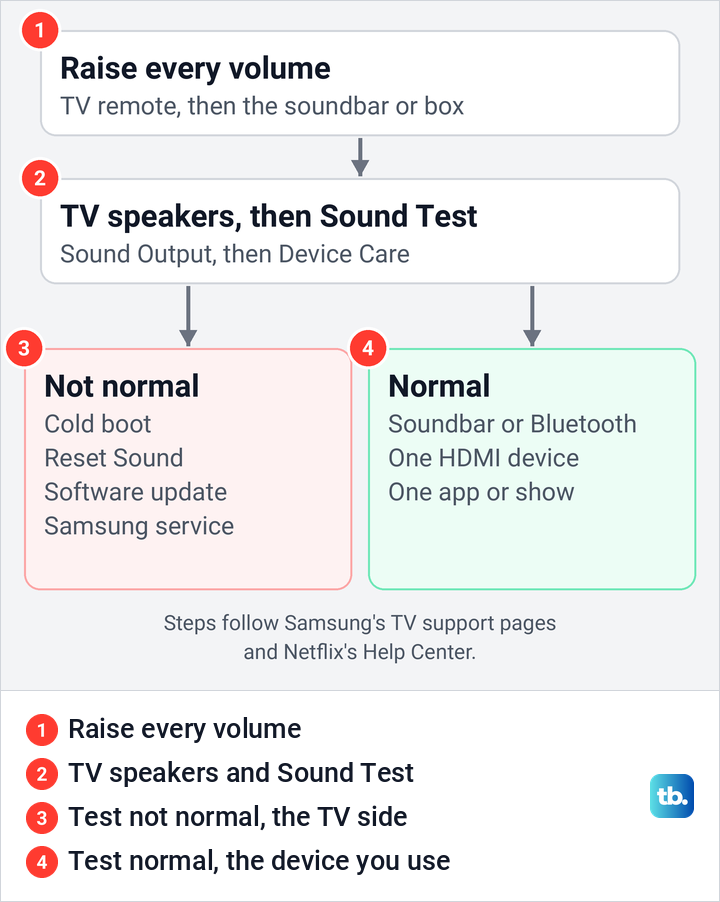
Check the volume on every device
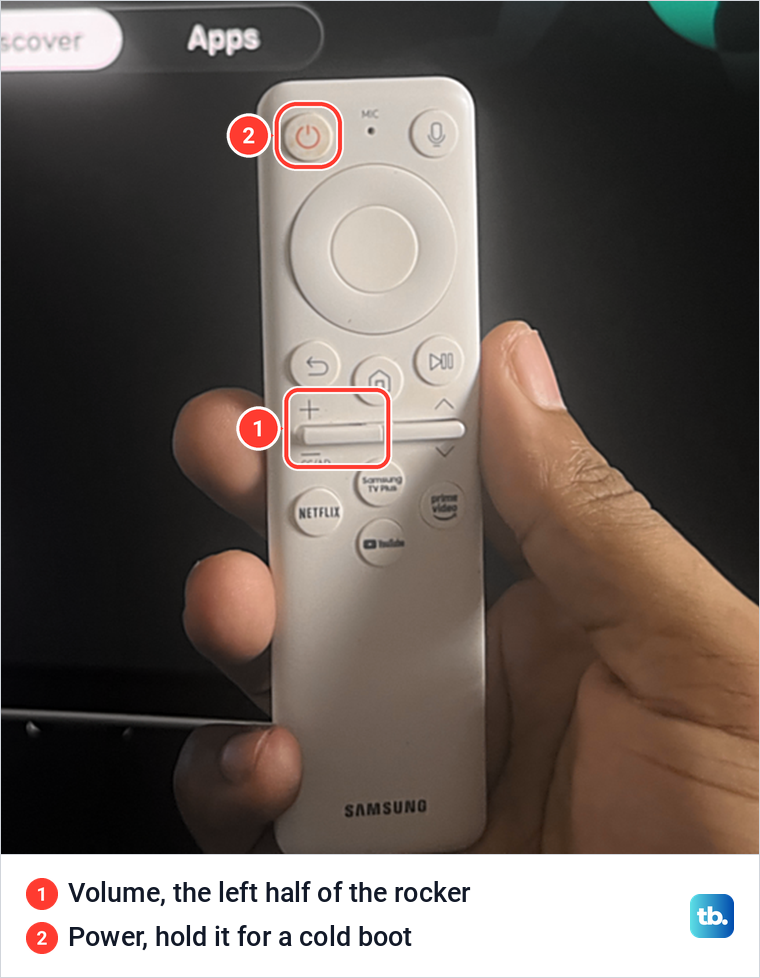
Start with the simplest check. Push the volume control up on your remote, or press VOL+ if it has a separate button, and if the sound comes through a cable box, soundbar or receiver that came with its own remote, turn that remote's volume up as well. On the Samsung remote in our photo, volume is the left half of the long rocker under the Home button, with a plus sign above it and a minus sign below.
The photos here come from our Samsung Odyssey OLED G9, a smart monitor that runs the same Tizen software as Samsung's smart TVs. The steps for Samsung TVs follow Samsung's own TV support pages, and the Netflix steps follow Netflix's Help Center.
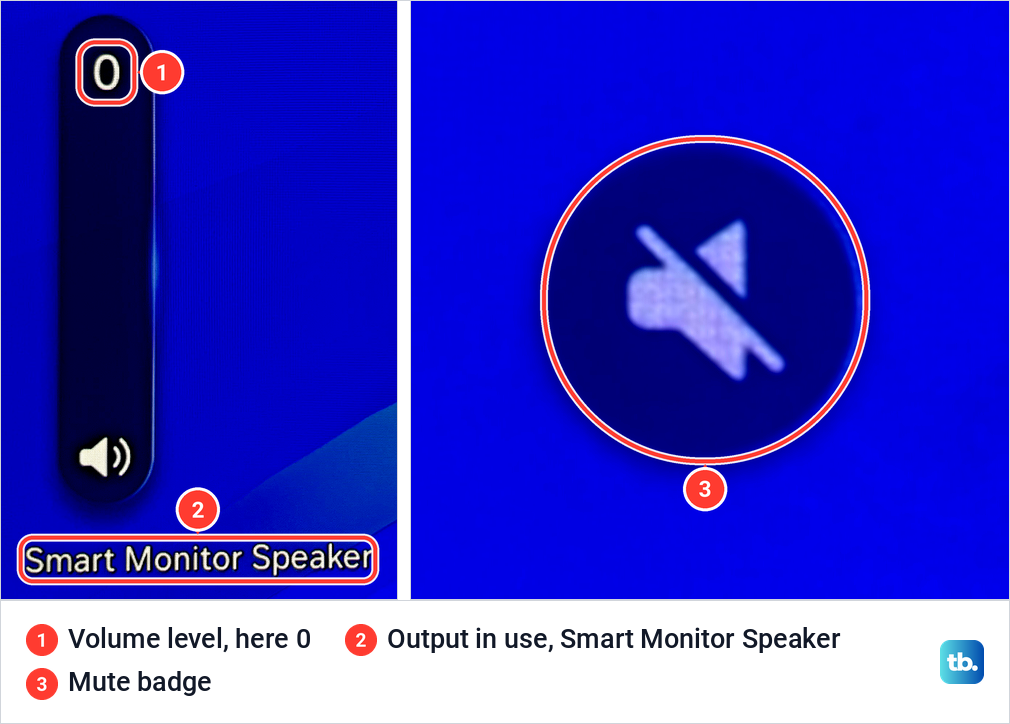
Rule out mute as well. Samsung's Smart Remote instructions say that pressing the volume button, rather than moving it up or down, mutes the TV, so a stray press can leave it silent. On our monitor, mute shows as a round badge with a crossed-out speaker. The volume bar shows the level with the output in use named under it, here 0 on Smart Monitor Speaker, which is as silent as mute.
If the volume buttons seem to do nothing, check where the sound is going before you blame the remote. When Sound Output is set to external speakers only, Samsung says the Volume and Mute buttons on the remote and some Sound functions are disabled, so the soundbar's or receiver's own volume is the one to raise. Our guide to Samsung TV volume buttons that do not work covers that problem in more depth.
If no button gets any response at all, menus included, the remote itself needs attention, and our guide to a Samsung remote that is not responding covers that. If the remote works and the sound stays off, move on to Sound Output.
Select the right Sound Output
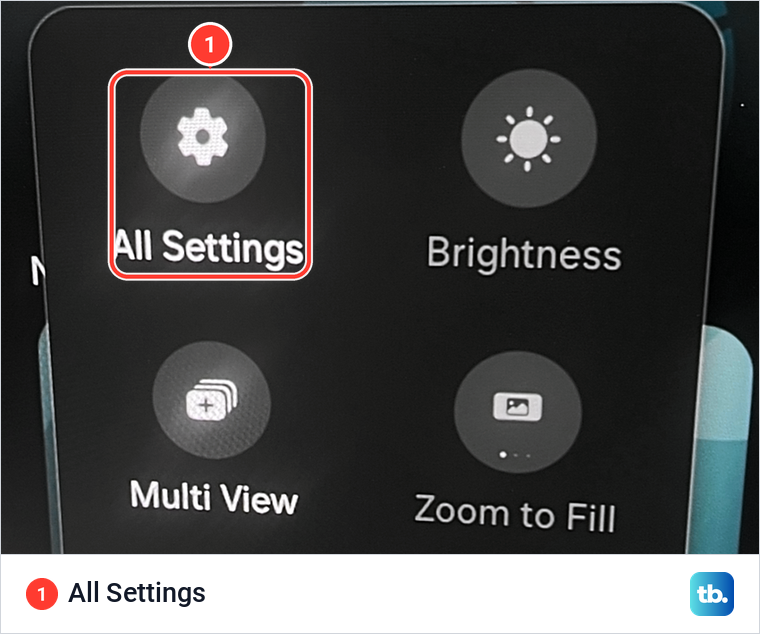
Sound Output decides where the TV sends its sound, so a TV still pointed at a soundbar that is off or unplugged stays silent. Samsung's path is Settings > All Settings > Sound > Sound Output, where you choose the device you want the sound from. On our monitor, pressing Settings opens a quick panel first, with All Settings as its first tile.
To find out whether the TV can play sound at all, choose its own speakers first. On our monitor, the Sound menu has only three rows, and Sound Output is the first. Samsung's TV troubleshooting steps call that item TV Speaker, and our monitor shows the same item as Smart Monitor Speaker. On our screen it was selected, above Bluetooth Speaker List, under the line "Select an audio device from the list to play Smart Monitor sound."
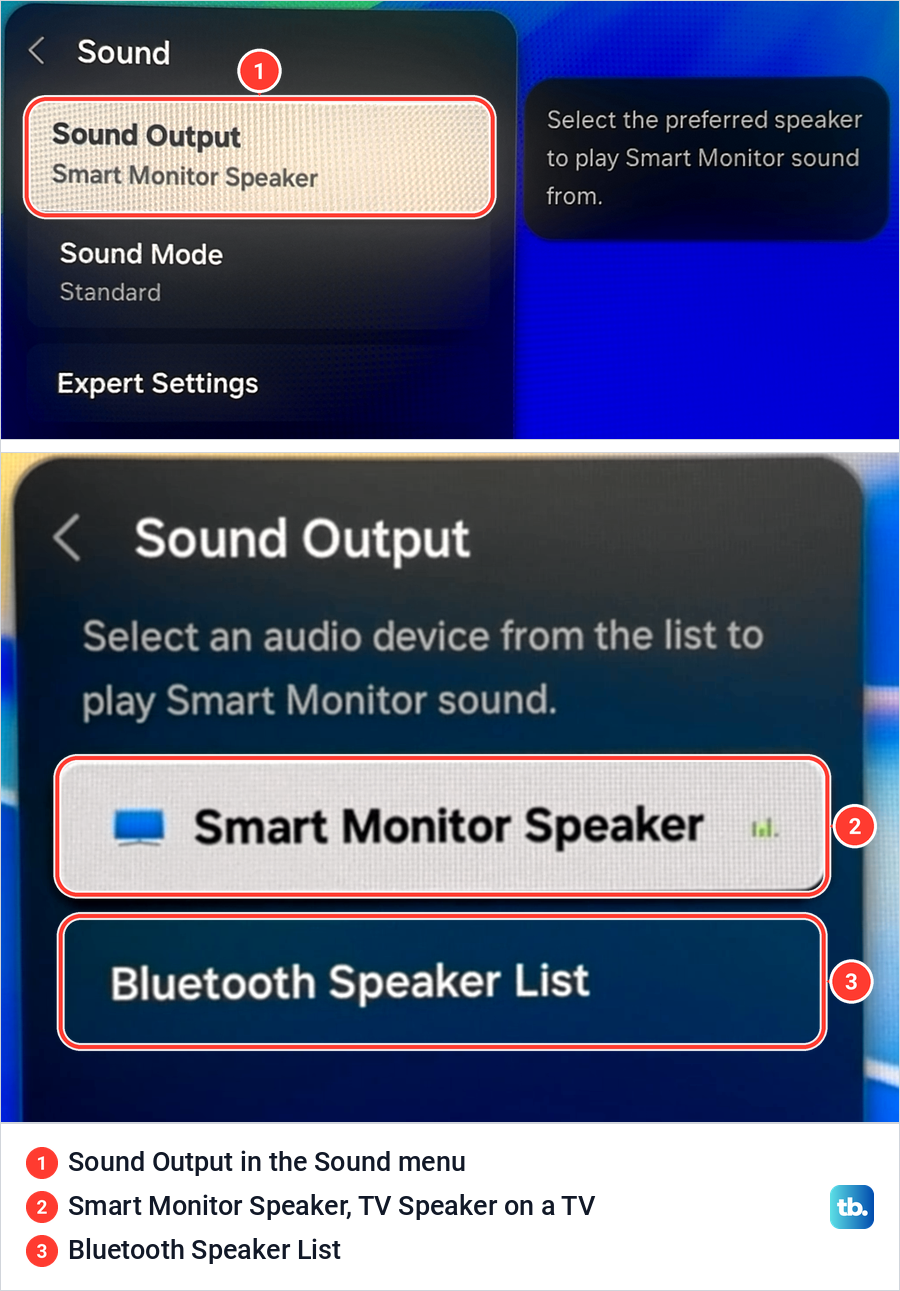
If sound comes back from the TV speakers, the TV's built-in speaker path works, and the next checks are the output you normally use. Switch Sound Output back to that device, for example Soundbar (HDMI) in Samsung's steps, although menu names vary by model, then check its connection and the device itself in the matching section below. If the TV speakers are silent too, run the Sound Test next.
Run the built-in Sound Test
The Sound Test is Samsung's own check for the TV's speakers. Samsung says it plays a melody to help determine if there is an issue with the TV speakers, and that if the melody plays without issue, there may be an issue with a connected external device. Samsung's current path is Settings > All Settings > Support > Device Care > Self Diagnosis > Sound Test, and then you follow the instructions on screen.
On older models, Samsung's steps open Device Care or Support straight from the Home menu and name the button Start Sound Test. Labels move between model years, so if a step does not match your screen, check the model of your Samsung TV and use its e-Manual.
On our monitor, Self Diagnosis listed 15 tests with its counter at 0 of 15 before we started, and Sound Test sat third in the top row. We ran Sound Test and then the SW Version test. The counter moved to 2 of 15, with Normal 2, Action required 0 and a blue tick on the Sound Test tile.
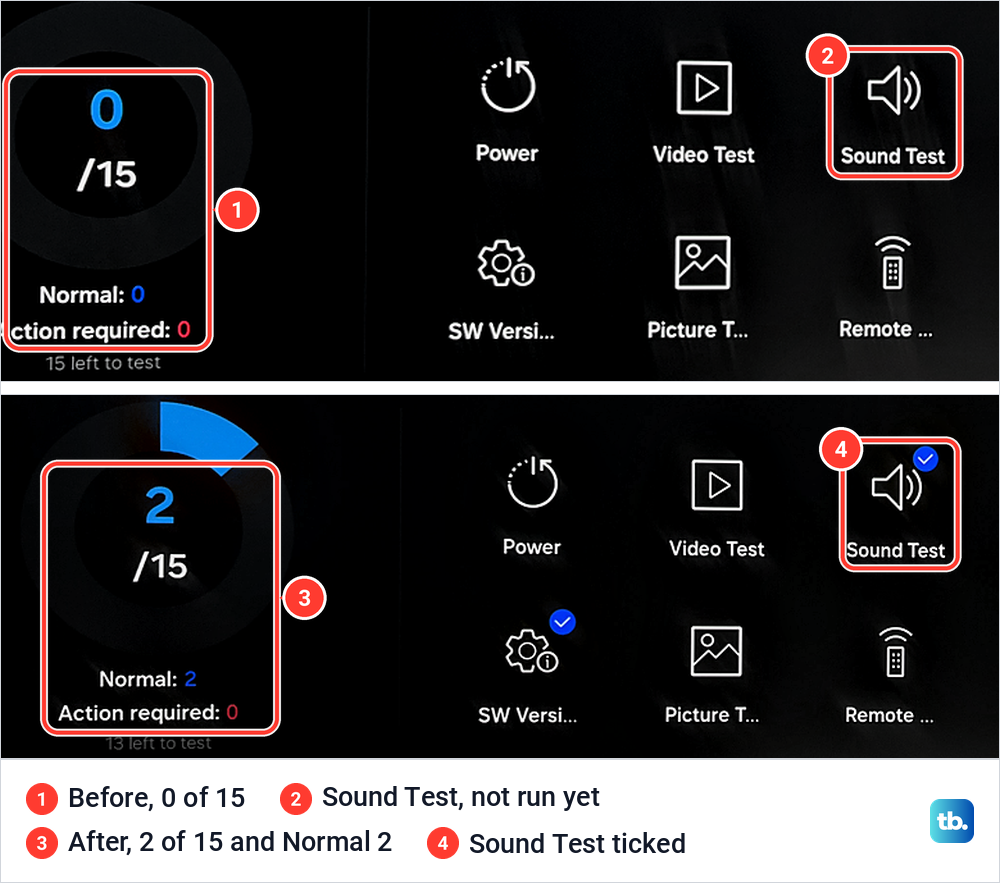
The result screen on our monitor read "The test results are normal. If the problem continues, check your external devices and connections." If yours reads the same, skip to the section for the device you use.
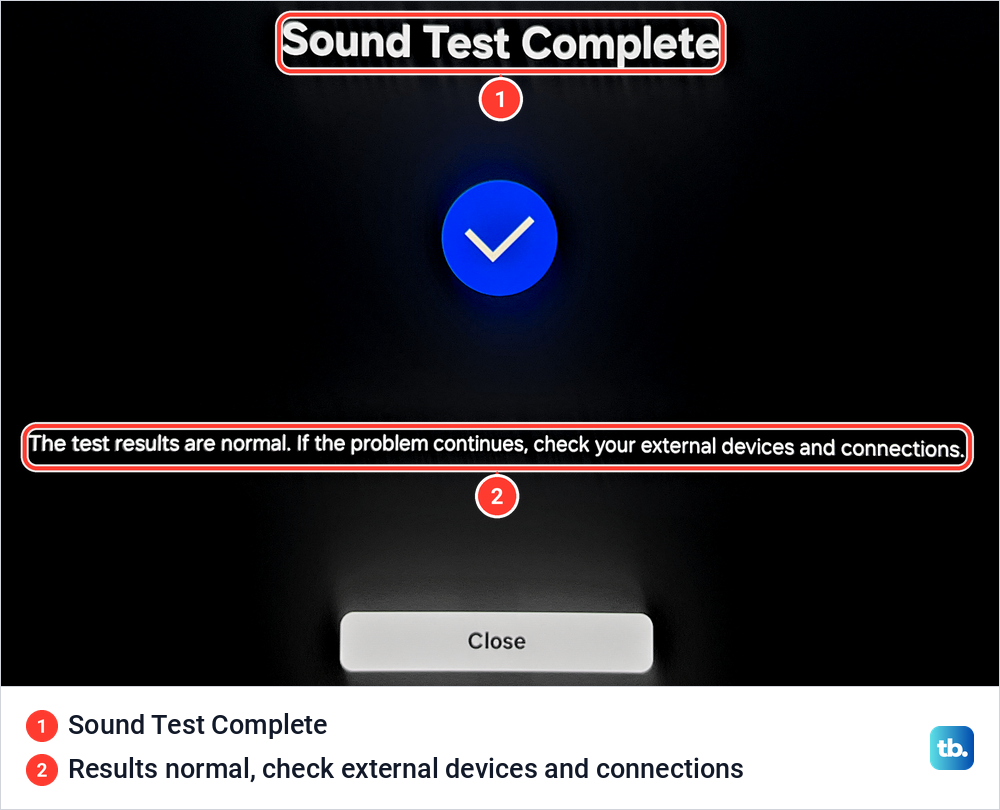
If the melody is missing or sounds wrong, Samsung's older Sound Test page asks you to answer Yes when it checks whether you still hear a problem. That page also says to reset the sound settings if the test reveals a problem, so go to the cold boot and Reset Sound steps in the next section before you contact Samsung.
Restart the TV and reset the sound settings
A cold boot is the quickest of the bigger steps. Samsung's instruction is to press and hold Power on the remote until the TV turns off and back on, which Samsung says drains the charge and resets the main board, and it should only take about 5 seconds. Our guide shows how to restart your Samsung TV properly, including what to do without a remote.
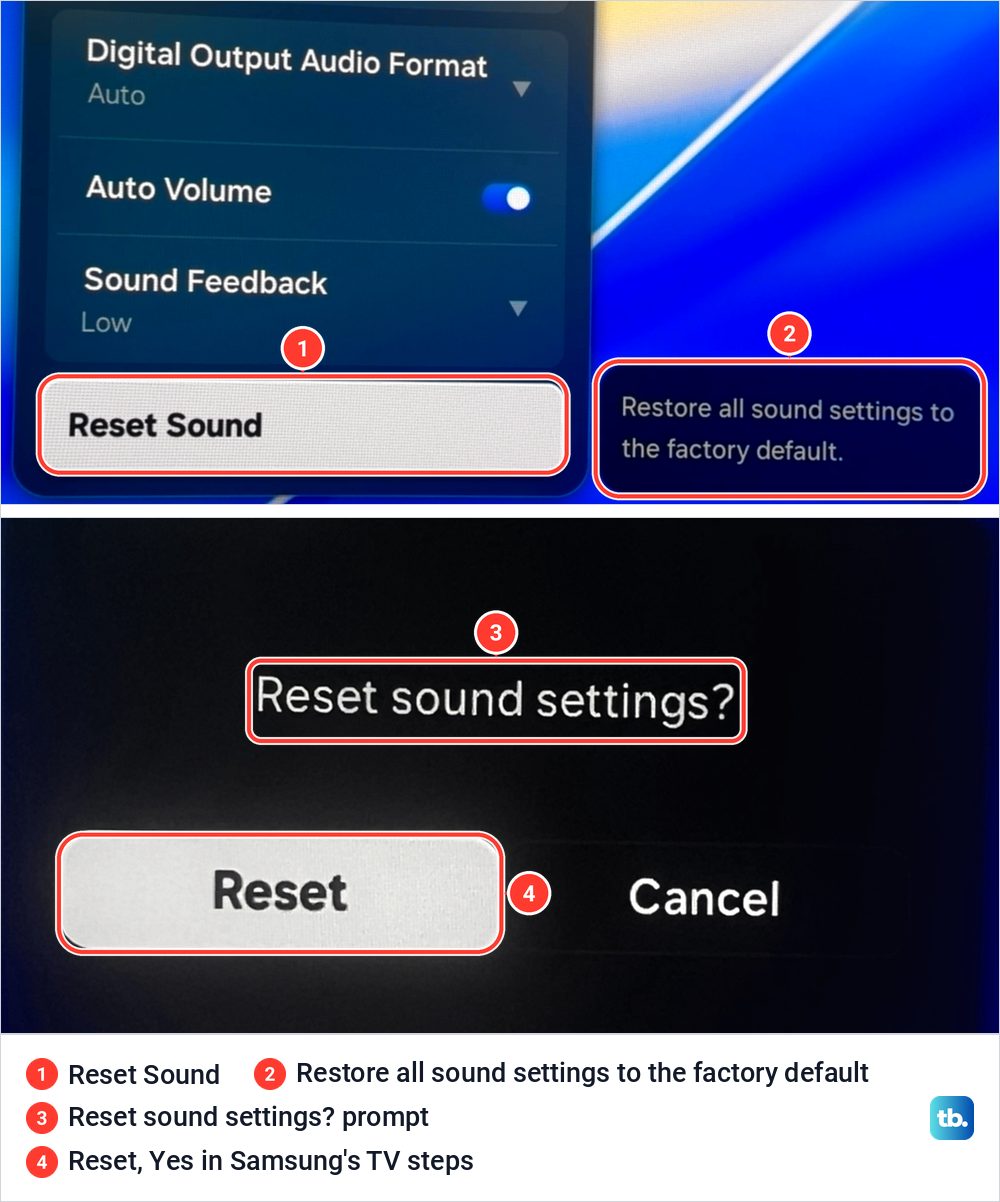
If you changed sound settings before the TV went quiet, or the Sound Test failed, reset only the sound. Samsung's steps are Settings > All Settings > Sound > Expert Settings > Reset Sound, then Yes to confirm, and Samsung describes it as resetting the current sound settings to their defaults. That makes it a much smaller step than a factory reset.
On our monitor, Reset Sound is the last item in Sound's Expert Settings, with the help text "Restore all sound settings to the factory default". Selecting it brings up "Reset sound settings?" with Reset and Cancel, so the confirm button on our screen is Reset where Samsung's TV steps say Yes. If you use a soundbar, check Sound Output and Digital Output Audio Format again afterwards, since a reset can return sound settings to their defaults.
When one HDMI device or cable box is silent
If apps on the TV play sound but your cable box, game console or streaming stick does not, the problem sits between that device and the TV. Start with the device itself, since Samsung's steps say to turn up a separate remote's volume as well as the TV's. Then change the HDMI input on your Samsung TV to another source and play something you know has sound.
Samsung's steps for HDMI sound that cuts out are to reconnect the cable at both ends, try a new cable, and move the device to a different HDMI port on the TV. If the sound fails on one port but not on another, Samsung says to request service. If a different device on the same cables works, Samsung says the original device is the cause and to contact its maker.
For a cable or satellite box, Samsung says to contact your provider rather than the box's maker, since a weak signal can drop the sound. Samsung also notes that a faulty HDMI port that drops sound typically drops the picture too. If the picture cuts out as well, our guide to Samsung TV HDMI connection problems covers the cable and port checks in full.
Some Samsung TVs also have an HDMI Cable Test under Support > Device Care > Self Diagnosis > Signal Information. Samsung says it is designed only for devices that carry a video signal, which excludes soundbars and home theater systems, and for cables under 2 meters. So it can check the cable from a cable box or console, but not the cable to your soundbar.
Get sound back from an HDMI soundbar
A soundbar or receiver on HDMI takes the TV's sound through the port marked ARC or eARC. Check that the HDMI cable is firmly connected to the ARC/eARC ports on both the TV and the soundbar, and that both are switched on. On a Samsung soundbar, press Source on its remote to select D.IN, and the bar switches to TV ARC or TV eARC after a few seconds.
Then select Sound > Sound Output > Soundbar (HDMI) on the TV. If there is still no sound, turn on Anynet+ (HDMI-CEC) in External Device Manager. Samsung's TV pages put External Device Manager under Connection or General depending on the model, and our monitor shows the same item under General & Privacy, where Anynet+ was on.
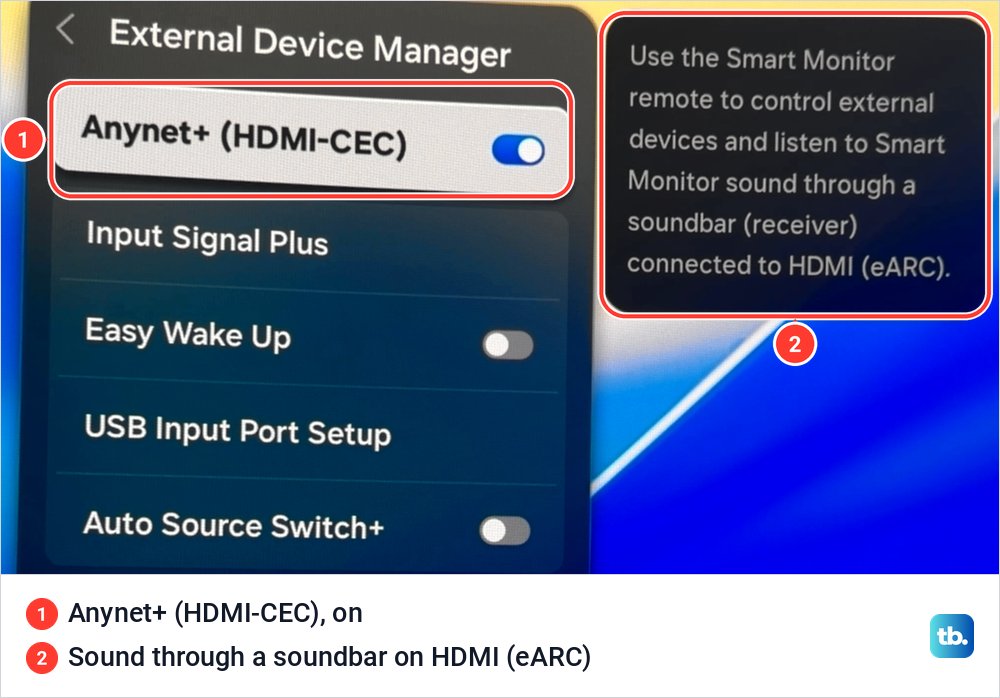
Samsung says HDMI eARC Mode is off by default. Turn on Anynet+ first, then set eARC Mode to Auto in Settings > All Settings > Sound > Expert Settings, but only if your soundbar supports eARC, and otherwise leave it Off.
Use an eARC-compatible HDMI cable, such as an HEAC or HEC cable. If the bar is still silent, start from scratch, with every other HDMI device disconnected and only the TV and soundbar switched on, then update the TV's software and the soundbar's firmware.
Check the digital audio format
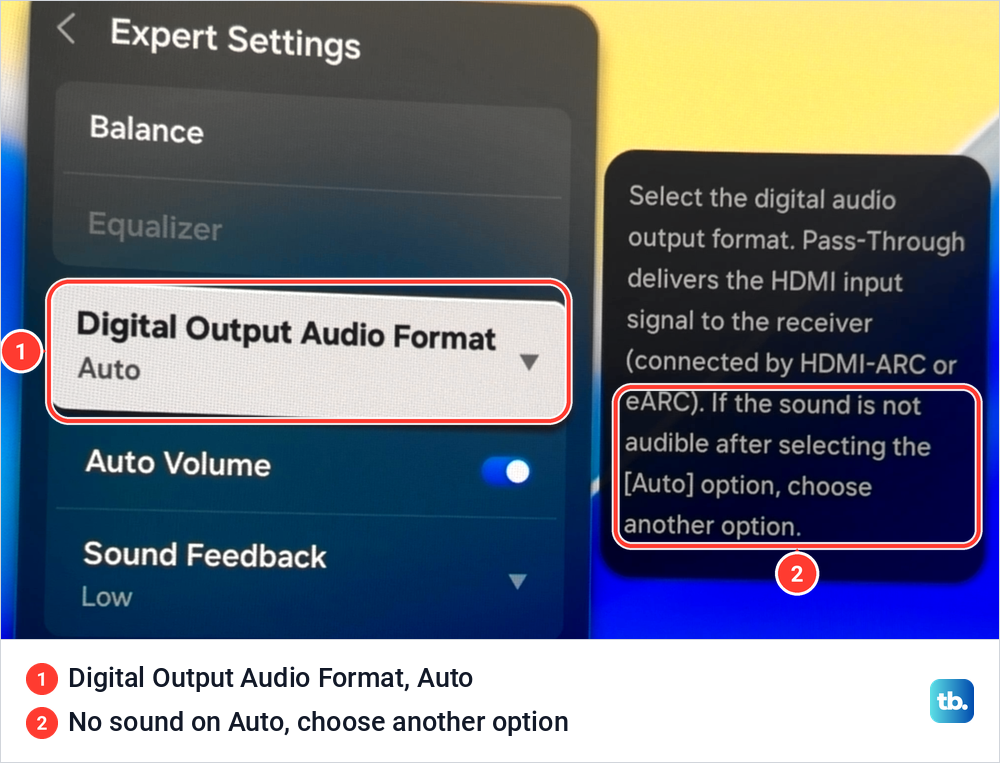
Digital Output Audio Format sets the format the TV sends to a soundbar, receiver or home theater system. Samsung's steps for a silent HDMI soundbar end by setting it to Auto. On our monitor it read Auto under Sound > Expert Settings, and its help text gives Samsung's own fallback: "If the sound is not audible after selecting the [Auto] option, choose another option."
Samsung's list of formats for TVs includes PCM, Dolby Digital, Auto and Pass-through. When we opened the list on our monitor, it offered only PCM, Auto, which was ticked, and Pass-Through, which was greyed out. There was no Dolby Digital option, so the list on your screen may not match Samsung's.
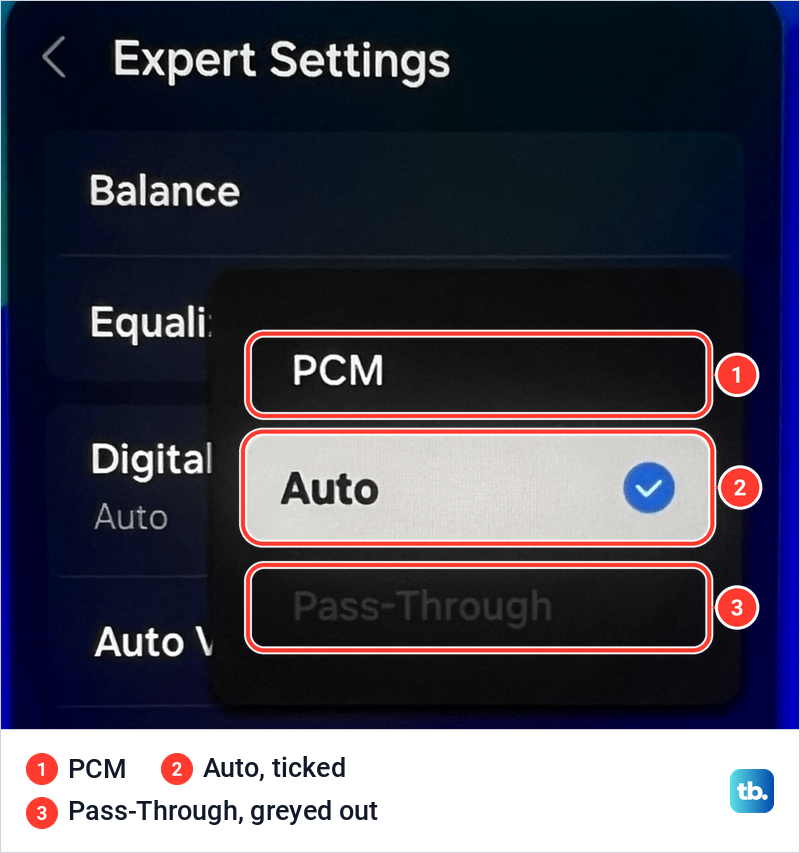
Samsung recommends PCM if your system struggles with higher settings, and says it outputs only left and right channels, so you lose surround sound while it is selected. Note the setting you had before you change it, and put it back if PCM makes no difference.
This setting only matters when the sound leaves the TV for another device. If you are not using a soundbar, home theater system or headphones, you do not need to change it, so leave it alone when the problem is the TV's own speakers.
Fix a Bluetooth speaker or optical connection
For a Bluetooth speaker or soundbar, Samsung's checks are that the speaker is on and in pairing mode, then selected under Sound > Sound Output > Bluetooth Speaker List, where you choose it and select Pair and connect. On our monitor, Bluetooth Speaker List sits right below the built-in speaker in Sound Output. Opening it started a scan, with the line "Scanning for Bluetooth devices in pairing mode", and listed two audio devices that were already paired, each marked Paired.
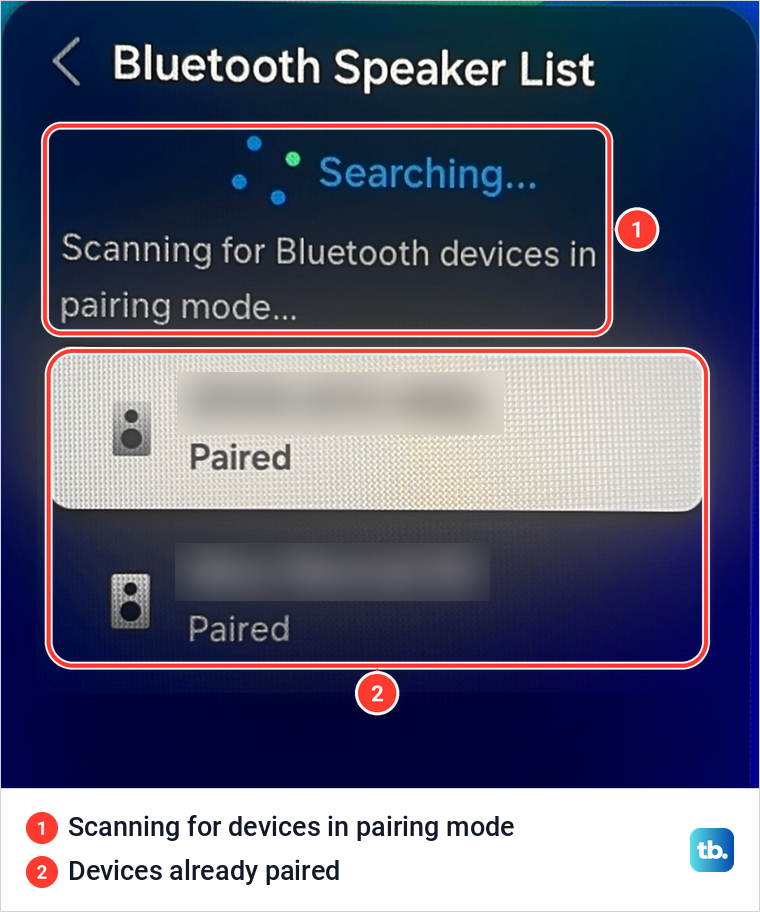
A TV and a Bluetooth device may disconnect depending on the distance between them, so keep the speaker as close to the TV as possible with no obstacles, and keep the wireless router away from it. Samsung also says Bluetooth is usually a last resort for TV audio, and suggests optical or HDMI ARC when your speaker supports them.
For an optical cable, select the optical output in Sound Output first. Netflix's steps for sound through a soundbar or receiver say to check that any HDMI or optical connector is plugged in correctly, then to try reversing the ends of the cable or using another one.
When only one app or show is silent
If one app is silent while other apps and inputs play sound through the same output, the app is the first place to look. First try another show in the same app, then restart the silent Samsung TV app before you change anything TV-wide. If it stays silent, you can clear the app cache on a Samsung TV for that app alone.
Samsung's order for an app that misbehaves is a cold boot, a software update, deleting the app and installing it again, and lastly Reset Smart Hub. Samsung warns that reinstalling signs you out of that app, and that Reset Smart Hub signs you out of your Samsung account and all of your apps. Our guide shows how to delete and reinstall a Samsung TV app when it comes to that.
For Netflix, Netflix says video with no sound usually means a problem with the audio settings on your device or the way your speaker system is set up. Its steps for a smart TV are to restart the TV, check that any HDMI or optical connector to a soundbar or receiver is plugged in correctly, and then check the TV's own audio settings.
If Netflix plays through a box or console connected directly to the TV, such as an Xbox or a TiVo box, Netflix's steps for those devices add one more check. If surround sound (5.1) is selected in the Netflix app's audio options, try Stereo instead, and if that brings the sound back, Netflix says your equipment may not be surround sound compatible. If the app also freezes or will not load, follow the fixes for Netflix not working on a Samsung TV.
Update the software or contact Samsung
Samsung says checking for updates is typically only needed when the issue started with the previous software update. If that matches what happened, open Settings > All Settings > Support > Software Update and select Update Now. Samsung says new updates download and install, and the TV restarts automatically when the update is finished.
Samsung also says to update the software on your external device, so update a soundbar's firmware too. It warns that video and audio settings might reset to their defaults after an update, and that a greyed-out Software Update means a streaming app is running in the background, so switch to the TV source first. On our monitor, Software Update sits in Support, three rows below Device Care.
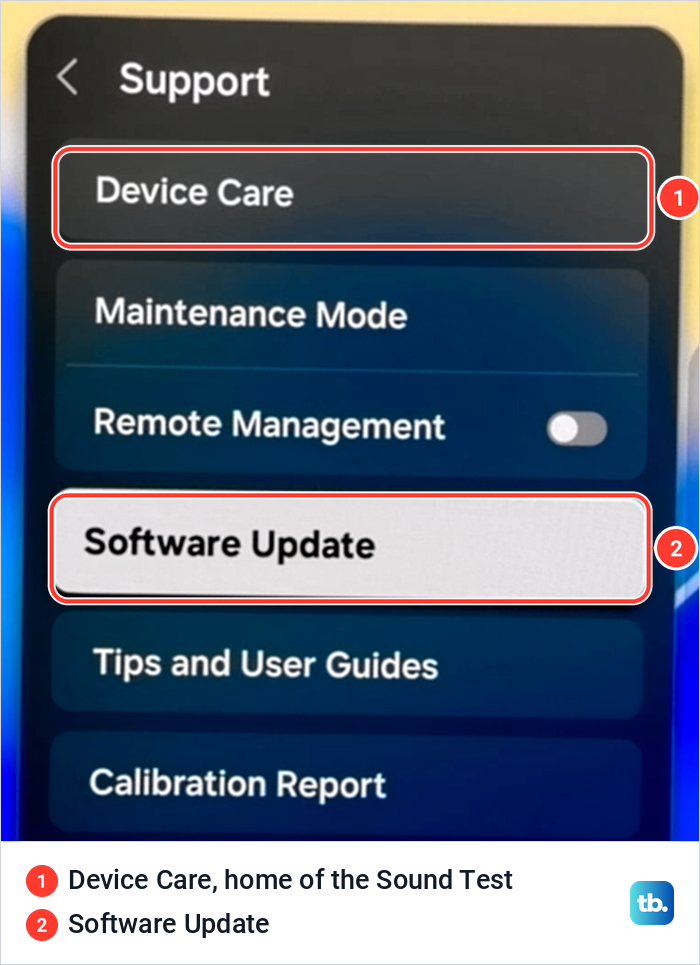
If the Sound Test still fails, Samsung's US page sends you to its Support Center to request service. Samsung's older Sound Test page adds that a software update or factory reset may be required if the same problem continues. A factory reset returns every setting to its default, not only the sound, so read what happens when you factory reset a Samsung TV before you choose it over a service request.
How we tested this guide
We tested this on a Samsung Odyssey OLED G9 smart monitor, which runs the same Tizen software as Samsung TVs, checking Sound Output, stopping at the Reset Sound prompt.
Frequently Asked Questions
Why is my Samsung TV silent when the volume is up?
Sound Output may still point to a soundbar, receiver or Bluetooth speaker that is off, unplugged or turned down, so the TV's own volume level is not what you hear. Switch Sound Output to the TV's own speakers and run the Sound Test.
Where is the Sound Test on a Samsung TV?
On current models it is Settings > All Settings > Support > Device Care > Self Diagnosis > Sound Test. Older models open Device Care or Support from the Home menu and call the button Start Sound Test.
What does a normal Sound Test mean if my show is still silent?
It points away from the TV's speakers. On our monitor the normal result read "If the problem continues, check your external devices and connections", so compare another app and another input, then check the soundbar or source device.
Why does my soundbar have no sound from my Samsung TV?
Check that the cable is in the ARC or eARC port at both ends, that the bar is on D.IN, and that Sound Output is set to the soundbar. Then turn on Anynet+ (HDMI-CEC), and set HDMI eARC Mode to Auto only if both devices support eARC.
Should Digital Output Audio Format be Auto or PCM?
Samsung's soundbar steps set it to Auto, and the on-screen help says to choose another option if Auto gives no sound. PCM is the option Samsung recommends when your system struggles with higher settings, but it carries only left and right channels.
Why does only Netflix have no sound on my Samsung TV?
Try another title, and if other apps are fine, restart the Netflix app before you change any TV settings. If Netflix plays through a box or console connected to the TV, Netflix's steps for those devices say to try Stereo when surround sound (5.1) is selected.
Will a factory reset fix no sound on a Samsung TV?
Samsung's Sound Test page mentions a software update or a factory reset only if the same problem continues after the test. Try a cold boot and Reset Sound first, since a factory reset returns every setting to its default and Samsung's next step for a failing Sound Test is a service request.