

The Monday edition of NYT Connections arrives with puzzle #939, serving up a grid that rewards art history knowledge and digital literacy. Today's challenge particularly favors gallery regulars and social media natives who can spot sneaky homophone patterns.
What Makes Connections Tick
For newcomers, NYT Connections presents 16 words that must be sorted into four thematic groups of four. The twist?
You're limited to four mistakes, and the color-coded difficulty system (yellow being easiest, purple being trickiest) means surface-level connections often mislead.
Since its June 2023 launch, Connections has carved out its niche in the Times' puzzle ecosystem, standing alongside Wordle and the crossword as a daily ritual for millions of players worldwide. The game's genius lies in its red herrings, words that could fit multiple categories but belong in only one.
Today's Grid at a Glance
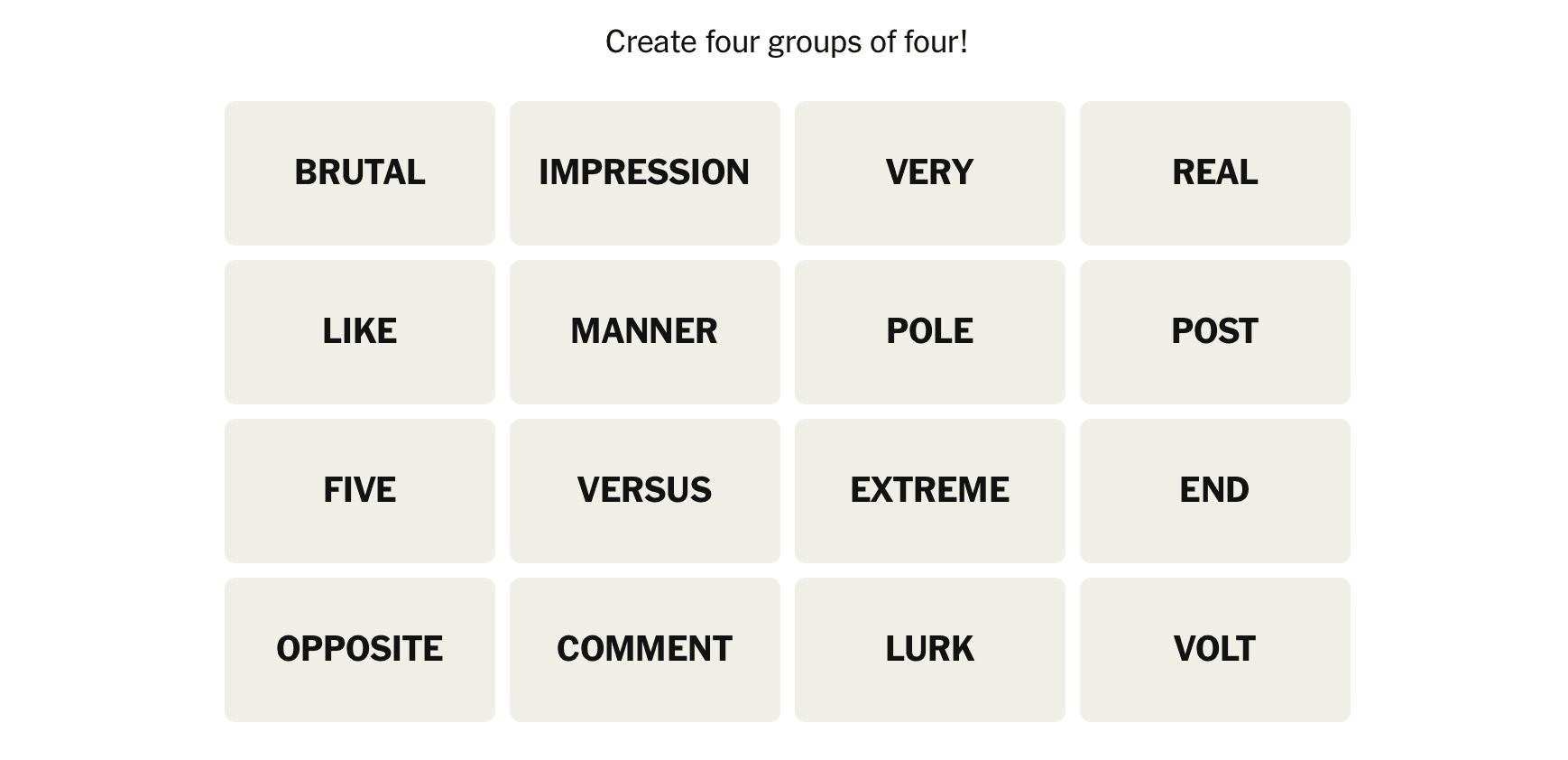
Here are the 16 words staring back at you in puzzle #939:
BRUTAL | IMPRESSION | VERY | REAL
LIKE | MANNER | POLE | POST
FIVE | VERSUS | EXTREME | END
OPPOSITE | COMMENT | LURK | VOLT
A seemingly random collection that somehow connects into four perfect categories.
Strategic Hints (No Spoilers Yet)
Yellow Category Nudge: Think about common actions on digital platforms where you interact with content.
Green Category Clue: These words all describe positions or concepts at the maximum distance or contrast.
Blue Category Hint: Consider artistic styles that end with a particular suffix, often associated with specific periods or philosophies.
Purple Category Teaser: Look for words where the letter "V" plays a significant role in their meaning or representation.
The Full Solutions
Last chance to solve independently: answers below
-- --
-- --
-- --
-- --
-- --
-- --
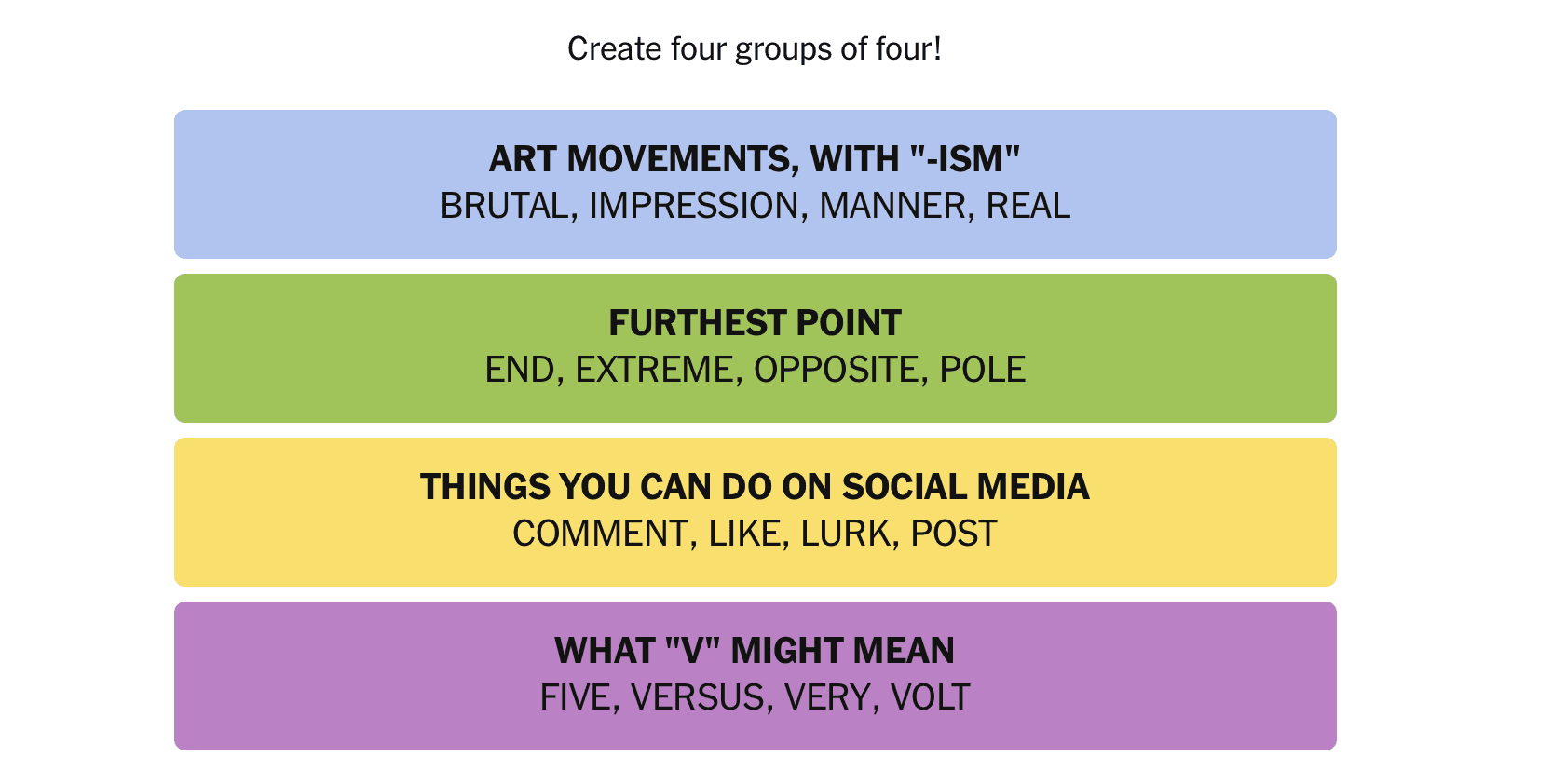
Yellow (Things you can do on social media): COMMENT, LIKE, LURK, POST
This category captures fundamental social media behaviors. COMMENT and LIKE represent active engagement, POST is content creation, while LURK describes passive observation - the complete spectrum of digital interaction.
Green (Furthest Point): END, EXTREME, OPPOSITE, POLE
These words all describe concepts of maximum distance or contrast. END and EXTREME represent limits, OPPOSITE denotes complete contrast, and POLE refers to geographical or magnetic extremes.
Blue (Art Movements, with "-ISM"): BRUTAL, IMPRESSION, MANNER, REAL
Each word forms an art movement when combined with "-ISM". BRUTAL becomes Brutalism (architectural style), IMPRESSION becomes Impressionism (19th-century painting), MANNER becomes Mannerism (Renaissance art), and REAL becomes Realism (artistic representation).
Purple (What "V" might mean): FIVE, VERSUS, VERY, VOLT
The letter "V" represents each word in different contexts. FIVE uses Roman numeral V, VERSUS abbreviates to "vs.", VERY uses V as an abbreviation for "very" in informal writing, and VOLT uses V as the electrical symbol for voltage.
The Verdict
Puzzle #939 registers as moderate difficulty with a clever linguistic twist. Yellow falls quickly for digital natives, while green requires thinking about spatial and conceptual extremes.
Blue separates art history enthusiasts from casual observers. Purple, predictably, is the streak-ender - that Roman numeral and abbreviation trick won't reveal itself without serious lateral thinking about letter symbolism.
The real trap lies in words like "MANNER" and "REAL" that could easily fit into other categories. MANNER might suggest social behavior rather than art, while REAL could be mistaken for authenticity rather than an artistic movement, creating perfect misdirection for unwary solvers.
Reset and Repeat
Tomorrow's puzzle drops at midnight in your timezone. Until then, reflect on today's performance: did the art movements category stump you, or did you spot the "-ISM" pattern immediately?
The beauty lies not in perfection but in training your brain to spot these hidden patterns.
For now, puzzle #939 is solved. See you at midnight for round #940.