
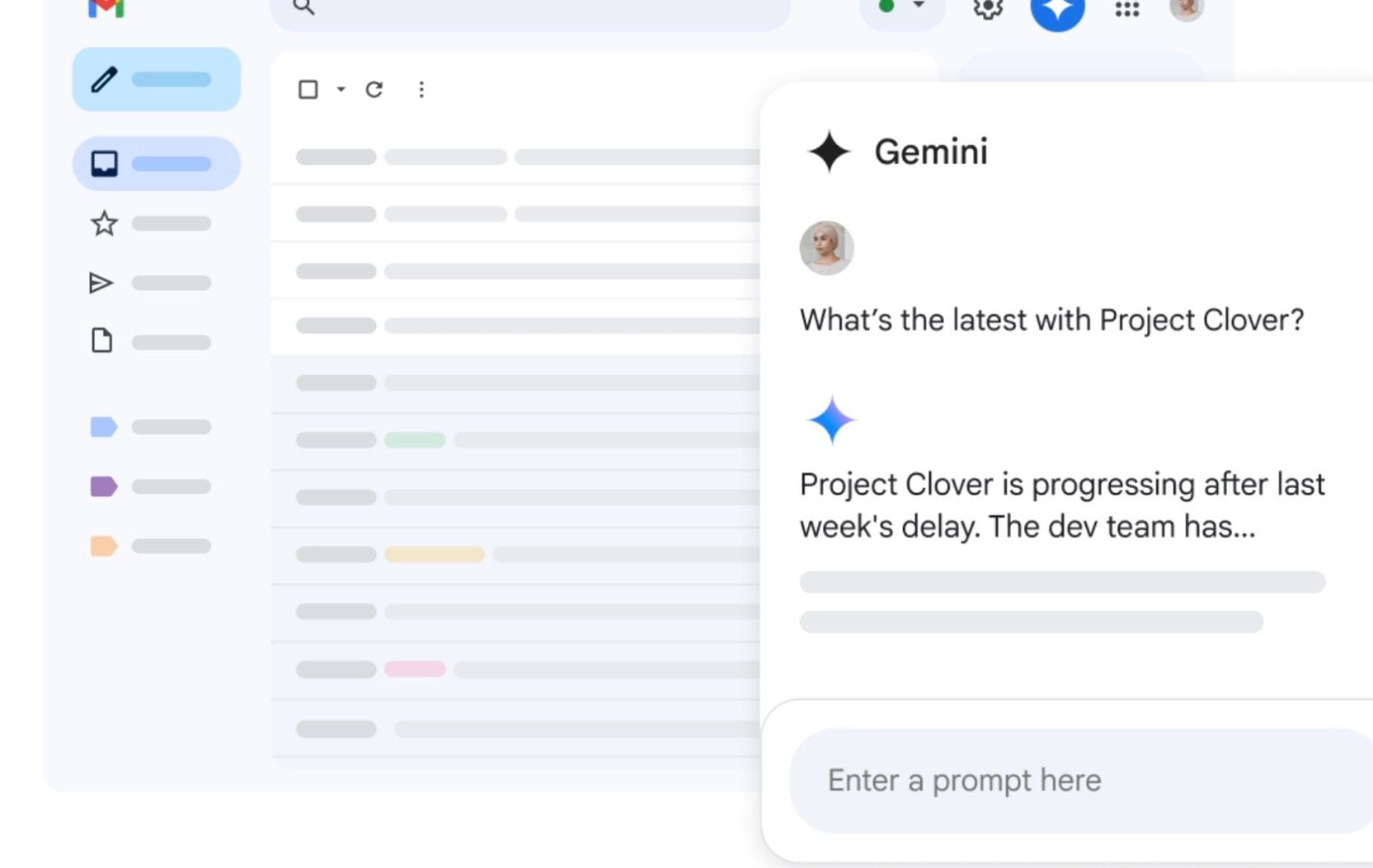
Google integrated its Gemini 3 AI model directly into Gmail on Thursday, marking the service's most significant overhaul since its 2004 launch. The update transforms the email platform into an AI assistant capable of summarizing threads, drafting messages, and answering natural language questions about inbox contents.
Gmail's 3 billion users gain access to AI Overviews that automatically condense lengthy email conversations into key points. The feature mirrors Google Search's AI Overviews, which now serve 1.5 billion monthly users according to company data. Thread summaries appear at the top of email chains with dozens of replies, eliminating manual scrolling through message histories.
All users receive free access to Help Me Write for email drafting and Suggested Replies with personalized tone matching. These tools replace the older Smart Reply system with context-aware responses that adapt to individual writing styles. The basic AI assistance requires no subscription, creating a two-tier experience where power features remain behind paywalls.
Paid Google AI Pro and Ultra subscribers unlock advanced capabilities including natural language Q&A across their entire inbox history. Users can ask questions like "Who was the plumber that gave me a quote for the bathroom renovation last year?" and receive synthesized answers drawn from email archives. The $20 monthly Pro plan and $249.99 Ultra tier also include AI Proofread for grammar and tone refinement.
Google introduced AI Inbox as the platform's largest visual change since launch, currently limited to trusted testers in the United States. Rather than chronological message lists, the feature presents personalized briefings highlighting priorities, action items, and VIP communications. It identifies important contacts through frequency analysis and inferred relationships while filtering promotional clutter.
The AI Inbox includes a "Catch me up" section summarizing recent activity like purchases, deliveries, appointments, and reservations. Google plans broader global rollout later in 2026 after the current testing phase concludes with English-speaking U.S. users. International expansion and additional language support will follow throughout the year.
Gemini 3 powers all new features, representing Google's latest large language model that debuted in late 2025. The technology escalation follows OpenAI CEO Sam Altman's reported "code red" response to Gemini 3's search engine integration. Google positions the update as transforming email from passive message storage into an active "thought partner" for daily tasks.
Privacy safeguards include promises that email content analyzed by AI won't train Gemini models. Google implemented "engineering privacy" barriers to corral inbox information and protect it from external access. The approach addresses concerns about AI scanning personal communications while maintaining targeted advertising that initially sparked privacy debates when Gmail launched.
The Gmail overhaul arrives as Alphabet surpassed Apple in market capitalization on Wednesday for the first time since 2019, driven partly by AI investor enthusiasm. OpenAI reached a $500 billion private valuation while Anthropic announced $350 billion in new funding this week. Google leverages its massive user base against competitors requiring standalone AI tool adoption.
Microsoft's 365 Copilot represents the primary competitive threat, with Google first introducing Duet AI for Workspace at $30 monthly in August 2023 before rebranding to Gemini in 2024. The company reported Gemini provided over 2 billion monthly AI assists within Workspace by April 2025. Automatic email summaries on mobile devices began in May 2025 as precursors to today's broader feature set.
Some AI features enable by default, requiring users to actively opt out rather than choose activation. The default approach reflects Google's strategy of embedding AI directly into existing workflows rather than treating it as optional enhancement. Blake Barnes, Google vice president of product, described the update as "delivering on Gmail proactively having your back" in a Thursday announcement.
Gmail holds approximately 30% global email client market share, typically ranking second behind Apple Mail's default iPhone positioning. Most industry reports estimate 1.8 billion active users though recent projections suggest crossing 2 billion in 2025-2026. The platform's scale provides Google competitive advantage in AI integration against smaller rivals.
The update represents Google's most aggressive attempt to transform productivity software through embedded artificial intelligence. As AI competition intensifies across tech giants, email platform integration marks a strategic battleground for daily user engagement and data access. Future expansions will test whether AI-assisted email management becomes standard expectation or premium differentiation.