

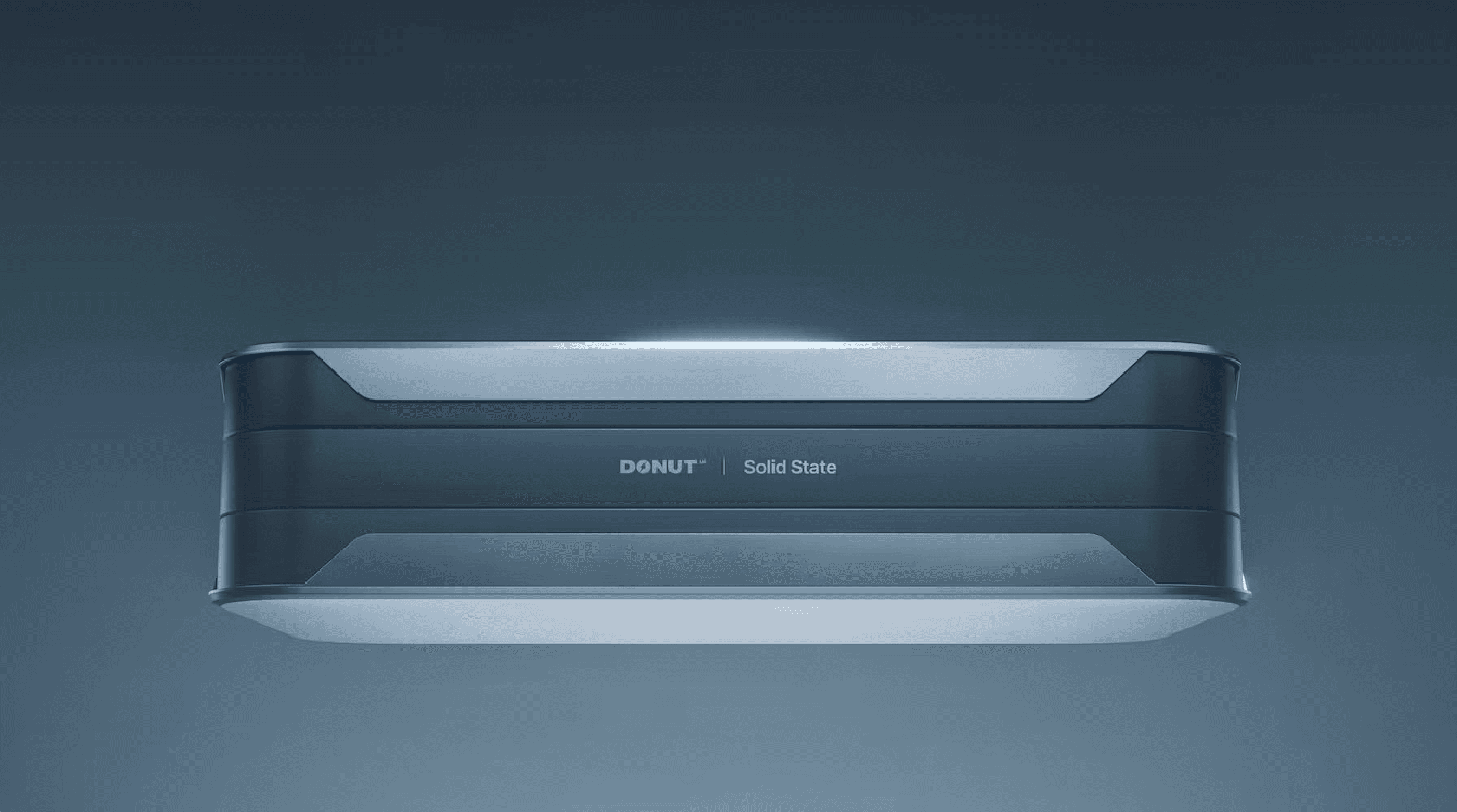
Donut Lab announced production-ready solid-state batteries at CES 2026, claiming the first deployment in Verge Motorcycles' TS Pro electric superbike. The Finnish startup says its cells deliver 400 watt-hours per kilogram energy density, 30 percent higher than conventional lithium-ion packs.
Verge's TS Pro becomes the first production vehicle of any kind equipped with solid-state technology, according to multiple CES reports. The motorcycle offers two battery options: a 20.2 kWh pack for 217 miles range at $30,000, and a 33.3 kWh unit delivering 370 miles for $34,900.
The solid-state cells charge to 80 percent in 10 minutes using 200kW NACS fast charging, adding 186 miles of range. Donut Lab claims the batteries can achieve full charges in five minutes under optimal conditions, though the motorcycle implementation uses more conservative timing.
Performance specifications show 737 pound-feet of torque from the hubless Donut motor, accelerating the 518-pound bike to 60 mph in 3.5 seconds. Top speed reaches 124 mph with 136.8 horsepower output, matching supercar acceleration in a two-wheeled package.
Donut Lab CEO Marko Lehtimäki says production has already begun in Finland with one gigawatt-hour initial capacity. "Our answer on solid-state batteries being ready for use in OEM production vehicles is now, today, not later," he stated during the CES announcement.
The company promises 100,000 charge cycles with minimal capacity fade, though Verge conservatively rates the motorcycle batteries at 10,000 cycles. Both figures dramatically exceed the 1,500-cycle typical lifespan of lithium-ion EV packs.
Thermal performance represents another breakthrough, with the batteries retaining 99 percent capacity from -30° to 100° Celsius. This eliminates active cooling requirements, reducing vehicle weight and complexity according to Watt Electric Vehicle Company CEO Neil Yates.
Manufacturing costs reportedly decreased despite the advanced technology. Lehtimäki says the bill of materials dropped compared to lithium-ion alternatives, with further reductions expected as production scales.
Chemistry details remain undisclosed, but Donut Lab confirms the batteries use abundant, geopolitically safe materials without rare or sensitive elements. The solid electrolyte replaces flammable liquid components, improving safety while enabling higher energy density.
Industry skepticism persists given solid-state technology's history of delayed commercialization. Battery scientist Tom Boetticher noted on LinkedIn that "there is no comparable solid-state cell anywhere in the world that achieves these specifications."
Verge plans first deliveries in Q1 2026, beating automotive giants like Toyota and Mercedes to market. The companies share founding personnel, explaining their close collaboration on the integrated battery-motorcycle system.
If successful, the technology could transform EV economics through extended lifespan and rapid charging. Donut Lab says it can quickly establish U.S. production facilities if American automakers demonstrate sufficient demand.
The Verge TS Pro represents a tangible shift from theoretical solid-state research to commercial deployment. Real-world testing beginning this quarter will determine whether the breakthrough claims withstand practical application.