

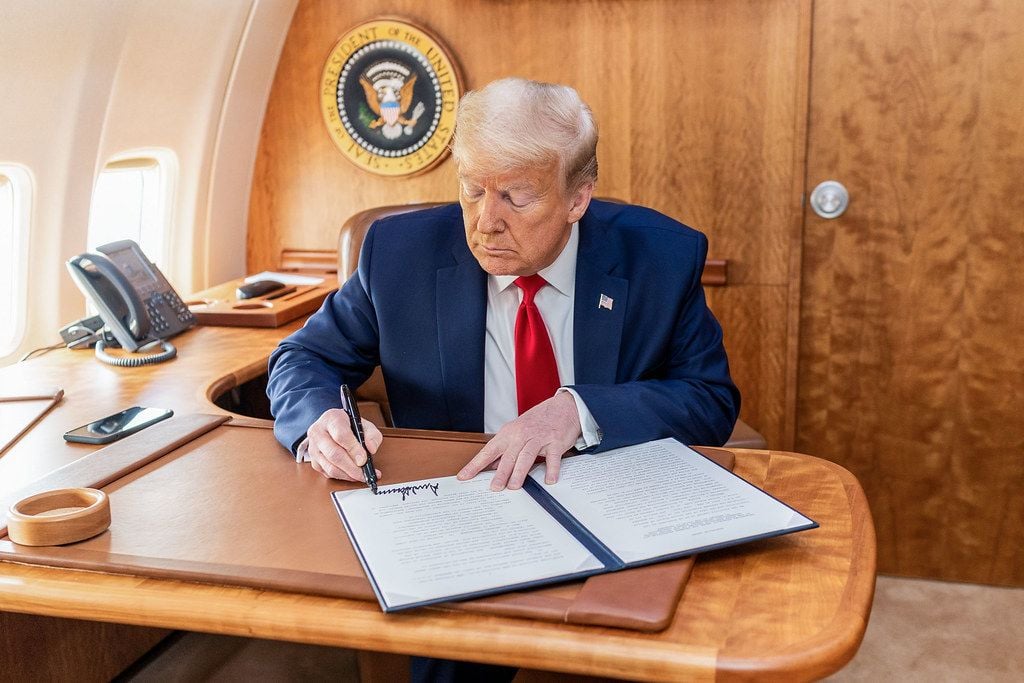
Silicon Valley finally got what it wanted: a single, nationwide rulebook for artificial intelligence. But now that President Trump signed an executive order last week aiming to preempt state AI regulations, tech leaders are discovering that getting what you wish for can be more complicated than expected.
The December 11 executive order, titled "Ensuring a National Policy Framework for Artificial Intelligence," represents a seismic shift in how America approaches AI governance. It directs federal agencies to challenge state AI laws, threatens to withhold broadband funding from non-compliant states, and establishes a litigation task force dedicated to overturning what the administration calls "onerous" state regulations. The goal, according to White House officials, is to prevent a "patchwork of 50 different regulatory regimes" that could stifle innovation and blunt America's competitive edge against China.
"I welcome the consistency of having one single rulebook," said Dorna Moini, CEO of Gavel, an AI and automation suite for lawyers. "But the reality is that the uncertainty isn't reduced. It's whiplash and now there is this chaos as to whether the preemption is going to be valid."
The State of Play
Four states - Colorado, California, Utah, and Texas - have already passed AI laws, with Colorado's 2024 legislation serving as a model for others. These laws require impact assessments, risk management programs, and transparency measures for high-risk AI systems used in employment, housing, healthcare, and lending decisions. California has gone further with its Transparency in Frontier Artificial Intelligence Act, mandating safety protocols and disclosures for advanced AI models.
The executive order doesn't immediately invalidate these laws, but it sets in motion a process that could. Within 90 days, the Commerce Department must identify "onerous" state AI regulations for potential challenge. The Federal Trade Commission is directed to issue policy statements on how existing consumer protection laws apply to AI, with the explicit goal of preempting conflicting state requirements. And perhaps most significantly, the order creates an AI litigation task force within the Justice Department with the "sole responsibility" of challenging state AI laws in court.
"This is a national security issue and we can't let Colorado, as an example, lead the way for setting legislation for the entire country," a senior White House official told POLITICO.
The Business Reality Check
For companies deploying AI, the immediate effect is more uncertainty, not less. While tech giants like Google and OpenAI have lobbied for federal preemption - Google's president of global affairs Kent Walker called for "a unified framework for AI development" on X - the practical reality is that businesses can't simply abandon state compliance.
"Companies should avoid scaling back State-law compliance prematurely and should assume any federal override will be contested until resolved through rulemaking and litigation," advises a Duane Morris analysis of the executive order. The firm notes that even if state laws are narrowed, plaintiffs' lawyers will likely pursue claims under traditional theories like consumer protection, employment discrimination, and privacy statutes.
The compliance headache is particularly acute for small and medium-sized businesses. "The cost of state AI laws on small businesses will stifle profits and undermine the nation's innovation and leadership," argues Michael Richards of the U.S. Chamber of Commerce's Chamber Technology Engagement Center. But consumer advocates counter that the risks of unregulated AI - from discriminatory hiring algorithms to AI-driven scams - demand immediate protections.
"With a human, I can say, 'Hey, explain, how did you come to that conclusion, what factors did you consider?'" said Calli Schroeder, director of the AI & Human Rights Program at EPIC. "With an AI, I can't ask any of that, and I can't find that out. And frankly, half the time the programmers of the AI couldn't answer that question."
The Legal Battles Ahead
States aren't rolling over. Colorado Attorney General Phil Weiser warned last month that his state would sue if the executive order was signed. California state Senator Scott Wiener, who authored the state's AI safety bill, declared: "If the Trump Administration tries to enforce this ridiculous order, we will see them in court."
The legal challenges will likely center on constitutional questions about federalism and the limits of executive power. Unlike traditional preemption efforts grounded in congressional authorization, this executive order relies on agency actions and funding leverage to displace state authority. Legal experts question whether existing statutes provide sufficient authority for agencies to assert preemptive effect, particularly given the Supreme Court's increasing skepticism toward expansive agency interpretations.
Florida Governor Ron DeSantis signaled that the order won't deter his state from advancing AI policies in areas like child safety and consumer protection. "We have a right to do this," DeSantis told a Florida State University roundtable, expressing confidence that state actions would withstand federal challenges.
What Businesses Should Do Now
Despite the regulatory uncertainty, businesses can't afford to wait. AI governance is becoming a compliance imperative, not just a best practice. Here are three concrete steps companies should take immediately:
First, conduct a comprehensive AI use assessment. Inventory every AI tool currently deployed across your organization, from customer service chatbots to hiring algorithms. Identify where AI could provide value but isn't yet being used. This baseline understanding is essential for any compliance strategy.
Second, establish an AI governance framework. Create a cross-functional team that includes leadership from legal, technology, operations, and compliance functions. Develop written policies aligned with existing regulations and emerging standards like the EU AI Act and NIST's AI Risk Management Framework. Don't wait for a law to force compliance - proactive governance can become a competitive advantage.
Third, integrate AI responsibly into operations. This means proper due diligence on vendors, clear contractual terms addressing AI use and liability, and ongoing monitoring of AI systems for bias and accuracy. Employment-related AI use deserves particular attention, as laws in Illinois and New York City already require notification before using AI tools in hiring.
The Bigger Picture
The executive order represents more than just a regulatory shift, it reflects a fundamental tension in how America approaches technological innovation. On one side are those who argue that America must maintain its AI dominance against China at all costs. "We need to win the AI race," the White House official emphasized. On the other are those who worry that framing AI as a national security imperative risks inflating an investment bubble and sidelining legitimate concerns about safety and equity.
"The biggest harm by framing this as a race with China is that it's probably spurring overinvestment," said Raj Gajwani, a former Google executive. "The framing is a politically convenient argument for the industry to extract more concessions from the government."
For now, businesses face a landscape of competing pressures: innovate quickly, but don't run afoul of regulations that might change tomorrow. Comply with state laws that could be challenged in court. Prepare for federal standards that don't yet exist. The only certainty is that AI regulation is coming - the question is what form it will take, and whether businesses will be ready when it arrives.
One thing's for sure: the coming months will see legal battles, political maneuvering, and intense lobbying as America figures out how to govern the most transformative technology of our time. Businesses that start preparing now will be better positioned regardless of which regulatory framework ultimately prevails.