
Today's NYT Strands is live for Sunday, June 7, 2026 (Puzzle #826). Stuck on today's Strands? We've got progressive hints, from gentle nudges to full solutions, so you can solve at your own pace.
How Strands Works (New Players Start Here)
Strands hides themed words inside a 6x8 letter grid. Your mission: find every word connected to the day's theme. Letters link in any direction (horizontal, vertical, diagonal) and words can twist and turn. Every letter gets used exactly once.
The spangram is the key word or phrase that captures the theme and stretches across the entire board, touching opposite edges.
Need a boost? Find any 4+ letter word (even non-theme words) three times, and the game reveals a hint highlighting theme word letters.
Theme Decoder
Today's Theme Prompt: "Herpetology 101"
What It Really Means
Herpetology is the study of reptiles and amphibians. Today's puzzle is a crash course in cold-blooded creatures -- think scaly, slimy, and shelled animals that rely on the environment to regulate their body temperature.
Think About...
- Common reptiles and amphibians you'd find in a zoo or nature preserve
- Creatures with distinctive features like shells, long tongues, or powerful jaws
- Animals that are neither mammals nor birds but rule the swamps, deserts, and forests
Spangram Clues
Orientation: Horizontal across, then diagonally and down
Letter Count: 11 letters
Starting Zone: Third letter of the first row
Progressive Spangram Hints
Hint 1 (Gentle): This word describes the defining biological trait shared by every creature in today's puzzle.
Hint 2 (Warmer): Unlike mammals and birds, these animals can't generate their own internal heat -- their body temperature matches their surroundings.
Hint 3 (Almost There): First letter is C, last letter is D
---
---
---
---
---
COLDBLOODED
Word-by-Word Hints
Solve as many as you can before peeking. Each word includes escalating clues.
Word 1
Vague: A long, legless reptile that moves by slithering
Closer: Found on every continent except Antarctica, some species are venomous while others constrict their prey
Letter Clue: Starts with S, 5 letters total
Answer
SNAKE
Word 2
Vague: A loud amphibian known for its deep, resonant call
Closer: This large frog is named after a male farm animal and can leap impressive distances
Letter Clue: Starts with B, 8 letters total
Answer
BULLFROG
Word 3
Vague: A slow-moving reptile that carries its home on its back
Closer: Known for its long lifespan and protective shell, this creature can be found on land or in water
Letter Clue: Starts with T, 6 letters total
Answer
TURTLE
Word 4
Vague: A lizard famous for its ability to change color
Closer: Its independently rotating eyes and long, sticky tongue make it one of nature's most specialized hunters
Letter Clue: Starts with C, 9 letters total
Answer
CHAMELEON
Word 5
Vague: A large aquatic reptile with powerful jaws and a prehistoric lineage
Closer: Found in tropical rivers and swamps, this apex predator is closely related to birds and is more closely related to dinosaurs than other modern reptiles
Letter Clue: Starts with C, 9 letters total
Answer
CROCODILE
Full Answers
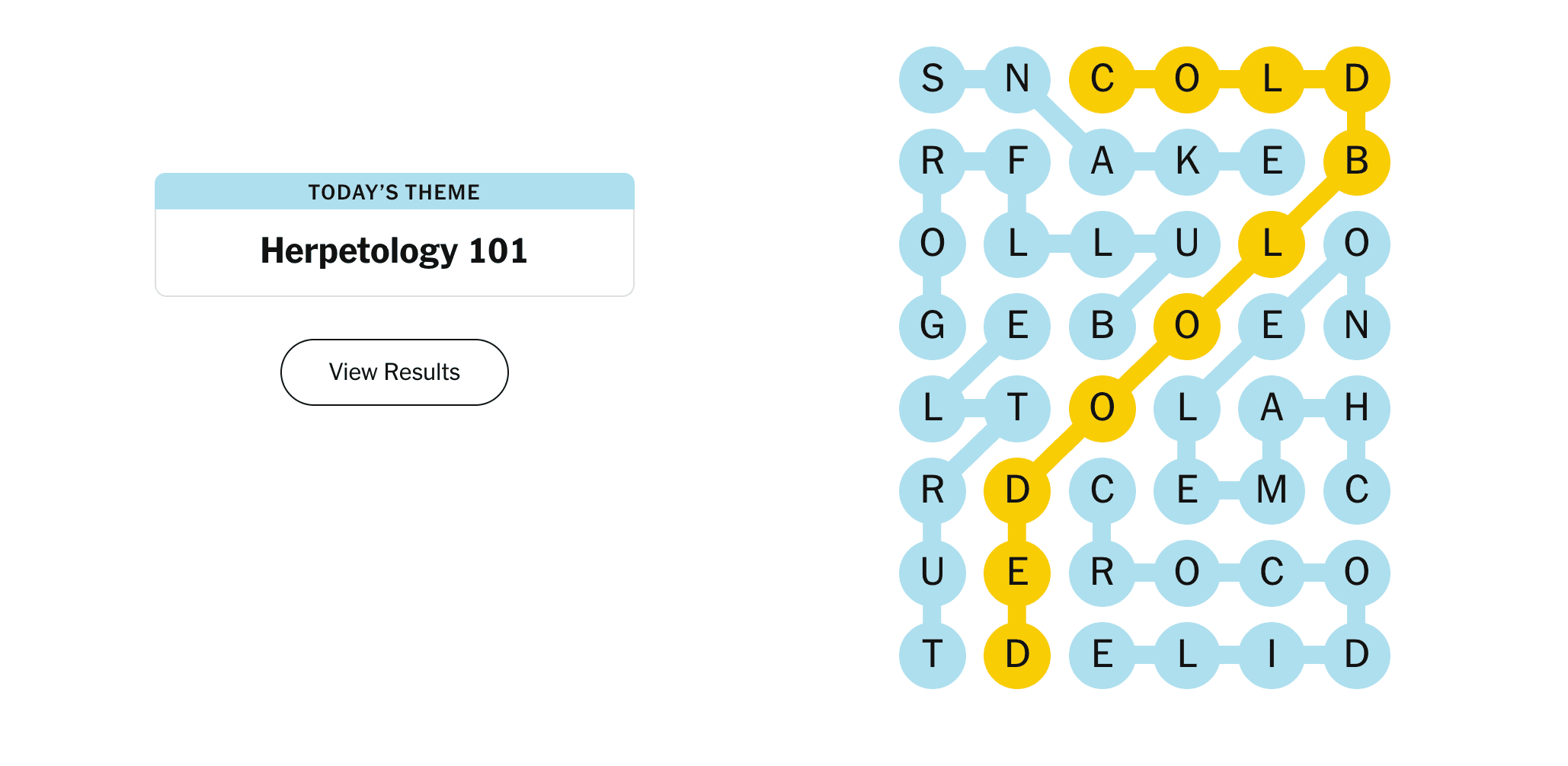
Spangram: COLDBLOODED
Theme Words:
- SNAKE
- BULLFROG
- TURTLE
- CHAMELEON
- CROCODILE
Puzzle Debrief
Difficulty Rating: Moderate
Trickiest Word: BULLFROG (It's the only amphibian in a grid of reptiles, and the compound name -- blending a mammal with an amphibian -- can throw off your search pattern)
Our Take: "Herpetology 101" is a cleverly educational theme that covers five distinct cold-blooded creatures, each with a unique body plan. The spangram COLDBLOODED ties it together nicely, and the diagonal path through the grid adds just enough challenge to keep experienced solvers engaged without frustrating newcomers.