

A single AI announcement erased $25 billion from IBM's market value in one trading session, marking the company's steepest daily decline in over 25 years. The stock plunged 13.2% on Monday after Anthropic revealed its Claude Code tool can modernize legacy COBOL systems in "quarters instead of years," directly challenging one of IBM's most lucrative revenue streams.
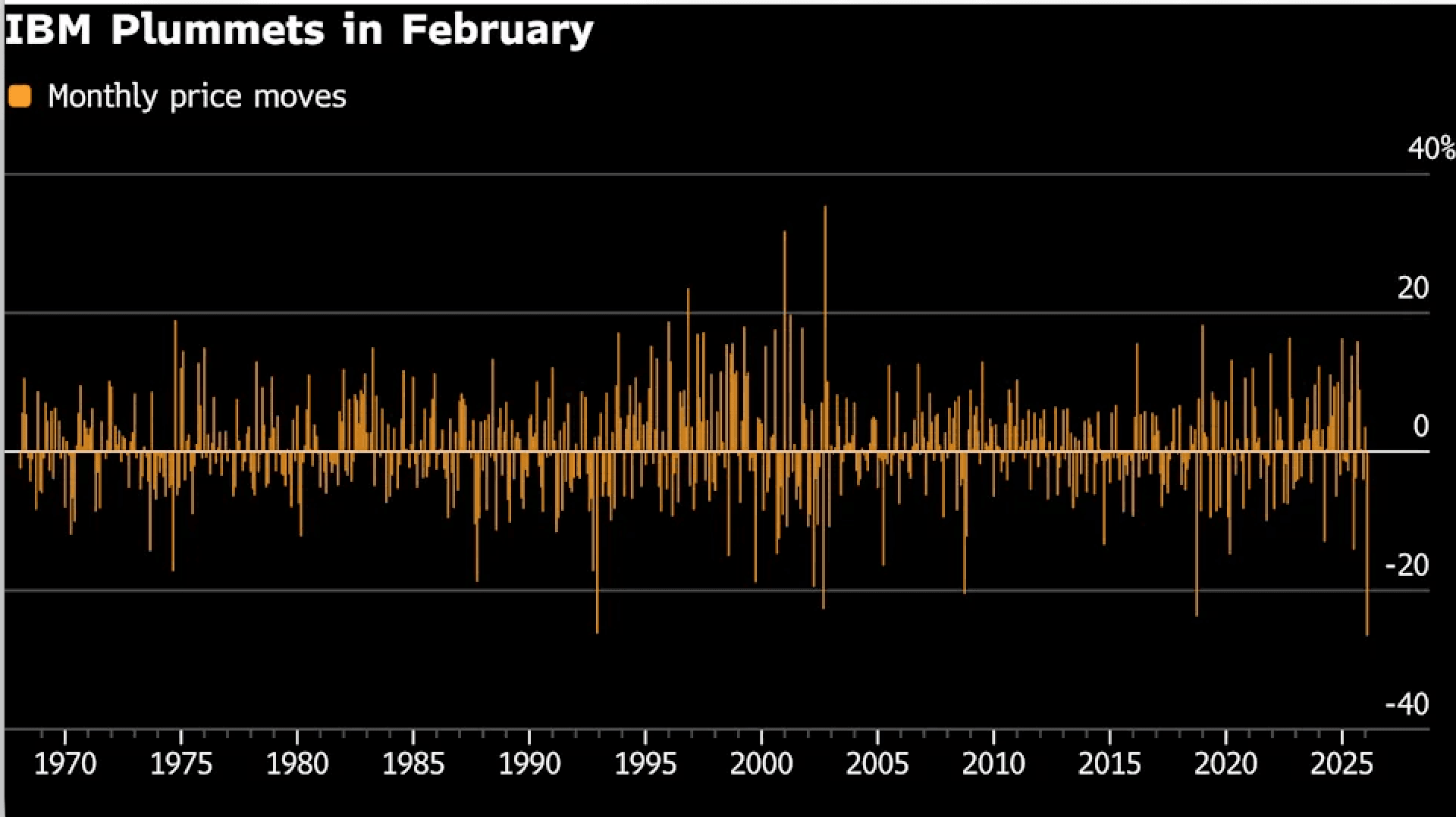
IBM shares closed at $223.35, their worst single-day performance since October 2000 according to Reuters data.
The sell-off reflects investor concerns that AI-powered development tools could disrupt the $5-7 billion annual business IBM maintains through COBOL-related services and infrastructure.
COBOL, a programming language developed in 1959, still processes an estimated $3 trillion in daily commerce and handles roughly 95% of ATM transactions globally. Hundreds of billions of lines of this legacy code run mission-critical systems for banks, insurance companies, airlines, and government agencies worldwide.
Anthropic's Claude Code tool can now read, interpret, and translate COBOL programs into modern languages like Java, Python, and Go while preserving business logic and generating unit tests. According to Anthropic's technical documentation, the AI agent maps program entry points and traces step-by-step paths through interconnected code chunks to automate analysis work that previously required consulting teams spending years mapping workflows.
"With AI, teams can modernize their COBOL codebase in quarters instead of years,"
Anthropic stated in its announcement blog post. The company released a Code Modernization Playbook alongside Monday's announcement detailing how Claude Code automates dependency mapping across thousands of lines of code and documents long-lost workflows.
IBM responded Tuesday by highlighting its own technological strengths while downplaying the threat.
"New AI tools emerge every week, including our own,"
the company said in a statement reshared by Yahoo Finance Executive Editor Brian Sozzi on X.
The tech giant argued that "decades of hardware-software integration cannot be replicated by moving code" alone. IBM emphasized that translating code represents only a fraction of modernization challenges, with data architecture redesign, runtime replacement, transaction processing integrity, and hardware-accelerated performance requiring deep expertise built over decades.
Despite these defenses, investors appear concerned about broader industry trends. A January 2025 Gartner survey found 42% of CIOs planned to reduce spending on legacy modernization consulting over the next two years, citing AI-assisted tools as a primary reason for budget cuts.
IBM itself launched Watsonx Code Assistant for Z two years ago specifically to help clients understand and modernize COBOL applications running on mainframes. CEO Arvind Krishna has repeatedly told investors that generative AI would drive the next wave of consulting demand for the company.
The February sell-off extends IBM's recent struggles, with shares dropping 27% during the month according to Reuters calculations. This puts the company on track for its worst monthly performance since at least 1968.
Other enterprise technology providers also felt pressure during Monday's session as investors reassessed how quickly AI-powered development tools might reduce technical barriers across IT services sectors.