
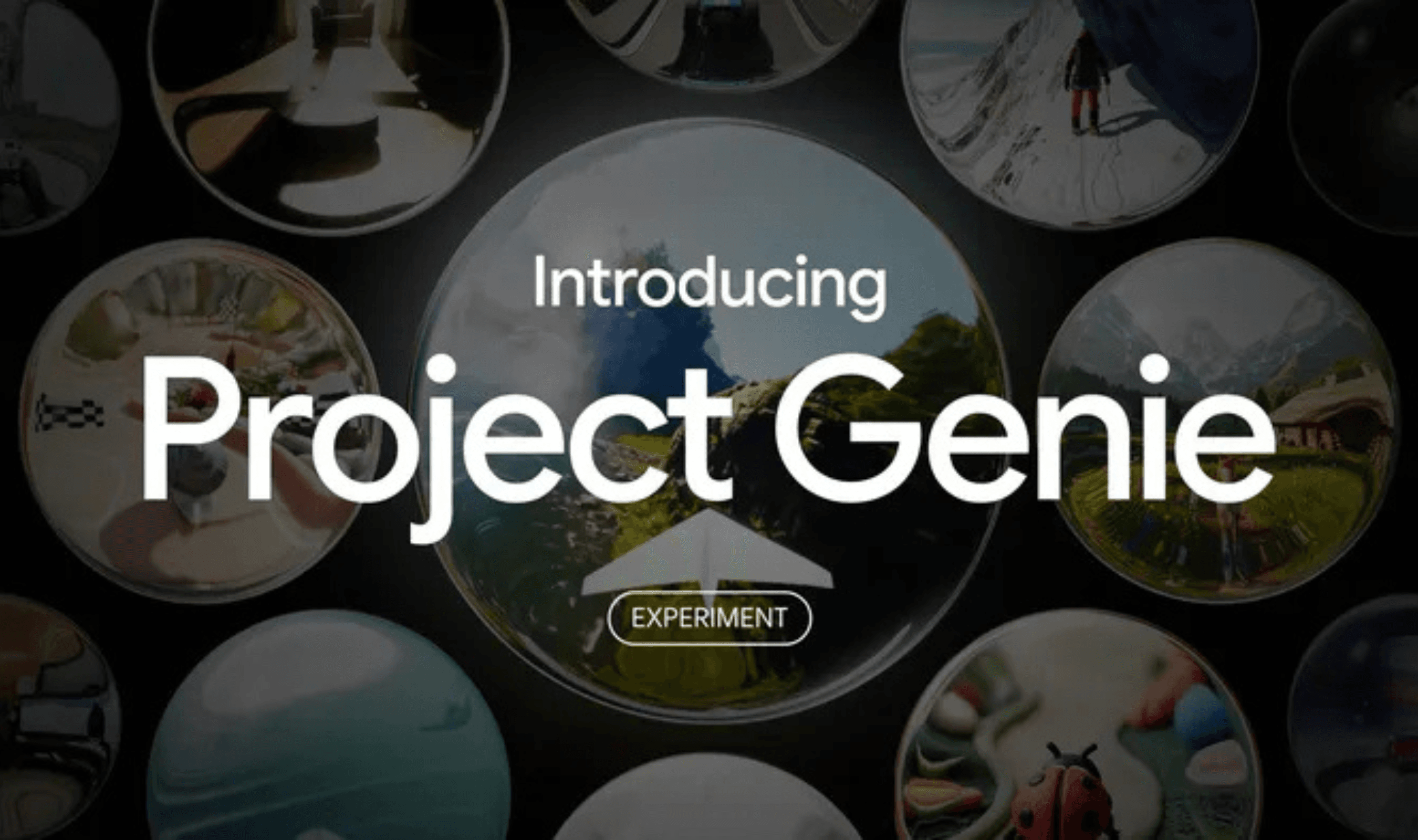
Google launched Project Genie today, an AI experiment that transforms text and image prompts into interactive virtual worlds. The DeepMind research project is now available to Google AI Ultra subscribers in the United States for $250 monthly.
Project Genie builds on the Genie 3 world model first demonstrated in August 2025. The system generates 720p video at up to 24 frames per second, creating explorable environments that respond to keyboard controls. Users can create custom characters and navigate through AI-generated scenes in real time.
Each generated world lasts 60 seconds, with Google stating this duration provides "high quality and consistent" exploration. The company confirmed sessions can extend beyond one minute but found 60 seconds optimal for current capabilities.
The prototype demonstrates what Google calls "world sketching" - generating a still image first, then animating it into an interactive environment. Users can provide reference images or text descriptions, with Nano Banana Pro and Gemini 3 models handling the initial generation.
Google describes Genie 3 environments as "auto-regressive," created frame by frame based on world descriptions and user actions. Environments remain consistent for several minutes, with memory recalling specific interaction changes for up to one minute.
Early testers at The Verge created knockoffs of Nintendo games like Super Mario and The Legend of Zelda. By the end of testing, some of those prompts were reportedly blocked due to "interests of third-party content providers."
Project Genie faces several limitations as a research prototype. Users experience input lag, can only explore each world for 60 seconds, and agents have a limited range of actions. The system cannot render legible text accurately and struggles with multiple models interacting in the same world.
Google acknowledges that "promptable events" capabilities demonstrated in August 2025 - which allow inserting new elements into running simulations - are not yet included. The company also notes testers will encounter worlds that "don't look or behave quite right."
World models represent an emerging frontier in AI research, with companies like WorldLabs raising $230 million and Luma AI securing $900 million in funding over the past year. Google positions Genie as "a key stepping stone on the path to AGI," enabling AI agents to reason and solve problems in evolving environments.
The gaming industry faces growing concerns about AI's impact. A Game Developers Conference report this week found 52 percent of surveyed professionals believe AI is having a negative effect, up from 30 percent last year and 18 percent two years ago.
According to the GDC study, 33 percent of US game developers and 28 percent globally reported at least one layoff in the past two years. Half said their current or most recent employer conducted layoffs in the past 12 months.
One machine learning operations employee quoted in the study stated, "We are intentionally working on a platform that will put all game devs out of work and allow kids to prompt and direct their own content."
Google emphasizes Project Genie is not a game engine and cannot create full game experiences. A company spokesperson told The Register the tool aims to "augment the creative process, enhancing ideation, and speeding up prototyping."
The system operates through a dedicated web app rather than integrating with Gemini's main interface. Google plans to expand access over time, though current availability remains limited to AI Ultra subscribers in the US.
Project Genie joins Google's growing portfolio of experimental AI tools available through Google Labs. The company continues positioning world modeling as critical for developing artificial general intelligence capable of navigating diverse real-world environments.