
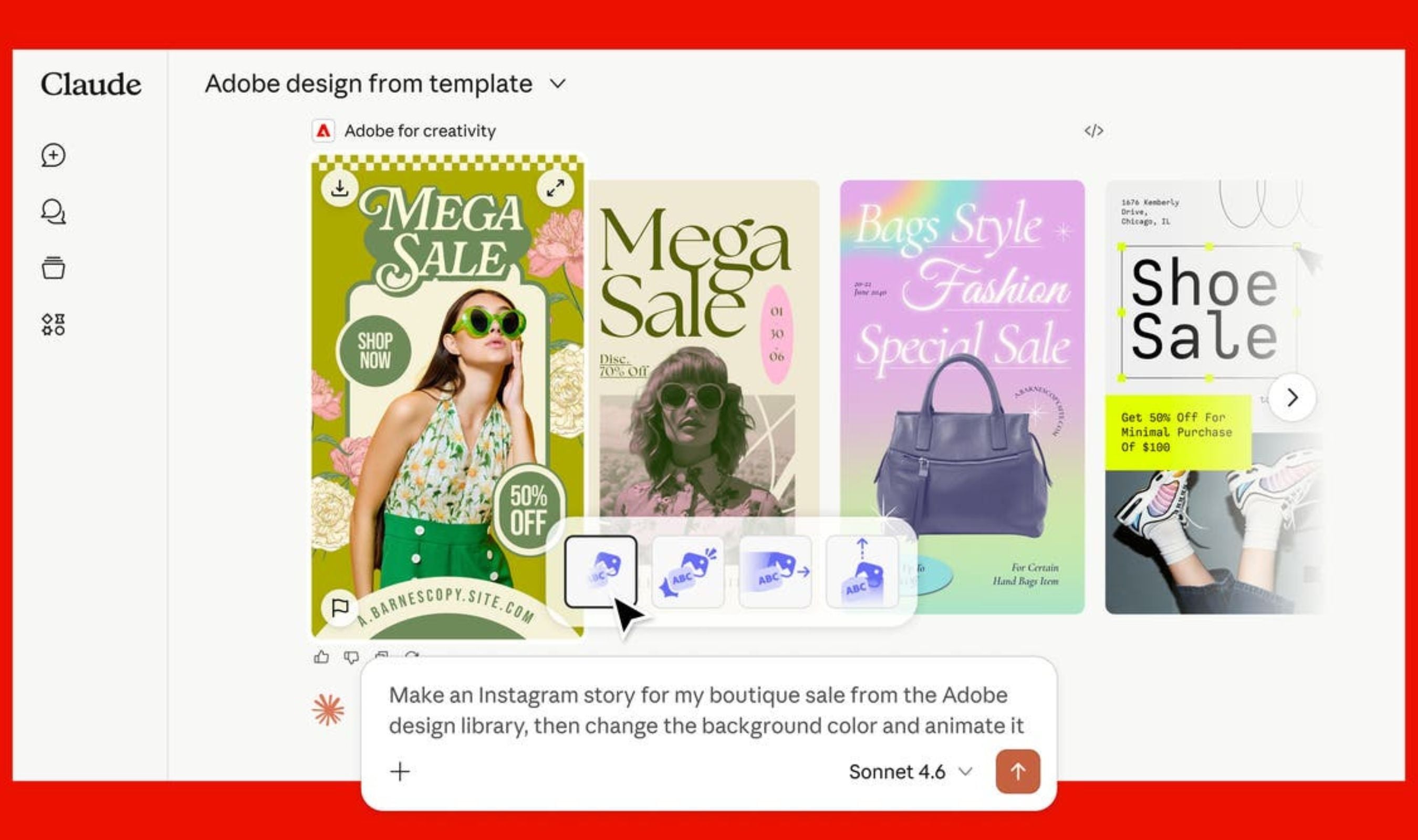
Claude can now control Adobe, Blender, and Ableton through nine new connectors Anthropic released on April 28, turning the AI assistant into an agent that operates inside creative tools rather than alongside them. The connectors let Claude access and manipulate software directly. With Adobe for creativity, users describe an outcome in natural language and Claude orchestrates multi-step workflows across Photoshop, Premiere, Lightroom, Illustrator, Firefly, Express, InDesign, and Adobe Stock.
More than 50 pro-grade tools are available without switching applications.
Anthropic partnered with Blender, Autodesk, Adobe, Ableton, and Splice on the release. Each connector works differently depending on the tool.
Blender's connector offers a natural-language interface to its Python API. Users can analyze and debug 3D scenes, build custom scripts for batch object edits, and add new tools directly to Blender's interface.
Anthropic joined the Blender Development Fund as a patron to support the open-source project. Because the connector is built on MCP (Model Context Protocol), other large language models can also connect to Blender.
Autodesk Fusion subscribers can create and modify 3D models through conversations with Claude. SketchUp turns a chat into a starting point for 3D modeling, letting users describe a room or furniture piece and then open it in SketchUp for refinement.
Resolume Arena and Wire let VJs control live visuals in real time through natural language.
Ableton grounds Claude's answers in official product documentation for Live and Push. Splice lets music producers search its royalty-free sample catalog from within Claude.
Affinity by Canva automates batch image adjustments, layer renaming, and file export.
Adobe's blog post from product management director Deepti Pradeep positions the connector as a bridge: users start in Claude and can continue editing assets in Photoshop or Premiere afterward. The connector is available globally to Claude users.
No Adobe account is required to start, but signing in unlocks higher usage limits, more tools, and cross-session saving.
Available across Claude chat (web and mobile), Cowork desktop, and Claude Desktop, the connectors cannot be installed from iOS or Android apps directly. Users set up on web or desktop first, then run workflows from mobile.
Anthropic is also working with three art and design programs (Rhode Island School of Design, Ringling College of Art and Design, and Goldsmiths, University of London) to integrate Claude and the connectors into curricula. Students and faculty get access, and their feedback will inform future development. The release follows Claude Opus 4.7, Anthropic's latest model for advanced software engineering, and a routines feature added to the redesigned Claude Code experience. Last week, Claude also added connectors for Spotify and other services.