
Just over a year ago, a single Chinese startup proved that the emperor has no clothes in Silicon Valley's AI kingdom. When DeepSeek announced it had built an AI model rivaling ChatGPT for under $6 million, tech markets didn't just wobble - they absolutely cratered. Nvidia alone shed a record-breaking $600 billion in market value in one day, marking the largest single-day loss in U.S. stock market history.
Most people assumed the market would shake it off and go back to business as usual. Instead, things got worse. Much worse.
The spending hasn't just continued - it's accelerated to levels that would make a dot-com era executive blush. According to industry estimates, the Big Four hyperscalers - Microsoft, Amazon, Alphabet, and Meta - are collectively on track to spend over $600 billion on AI infrastructure in 2026 alone. Goldman Sachs projects total AI capital expenditure could hit $700 billion this year. Amazon announced $200 billion in capex guidance for 2026, up 52% from the $131 billion it spent last year. Microsoft has now spent more than $200 billion on AI technology since the beginning of its fiscal 2024.
Let that sink in. Seven hundred billion dollars in a single year. And what are the returns? According to Goldman Sachs' own analysis, all that AI spending delivered near-zero U.S. GDP growth in 2025. That's not a business model; that's the world's most expensive science experiment.
HSBC's latest research paints an even more staggering picture. The bank forecasts that the seven biggest tech companies will allocate 61% of their operating cash flow to capex this year, up from 46% in 2025. For the first time, Big Tech will spend more on AI infrastructure than it returns to shareholders. These companies are literally betting the house.
OpenAI perfectly embodies this disconnect, only now the numbers are even more absurd. The company just raised $120 billion at a $730 billion valuation - the largest private technology fundraise in history, backed by Amazon ($50 billion), SoftBank ($30 billion), and Nvidia ($30 billion). It still has roughly 700 million weekly active users. And 94.5% of them still pay nothing while OpenAI burns through an estimated $14 billion annually in operating costs. The math hasn't improved. It's gotten worse.
Meanwhile, the competition has exploded. Anthropic hit $19 billion in annualized revenue in March 2026 - up from just $1 billion fifteen months earlier. The company is now valued at $380 billion and eyeing an IPO. That's impressive growth, but it also means the market is fragmenting. More players, more spending, thinner margins for everyone.
And DeepSeek? They didn't sit still. The company is preparing to release V4, a multimodal model with picture, video, and text-generating capabilities, built in collaboration with Chinese chipmakers Huawei and Cambricon. They've also deliberately withheld their latest models from U.S. chipmakers including Nvidia. The message is clear: China isn't just competing anymore. It's building its own AI ecosystem entirely independent of American silicon.
Now the smart money is sounding alarms. Benchmark's Bill Gurley, one of Silicon Valley's most respected venture capitalists, publicly warned that an AI "reset" is imminent. "When people get rich quick, a whole bunch of people come in and want to get rich too, and that's why we end up with bubbles," he told CNBC. "I just think we trip and run out of money." Salesforce and ServiceNow stocks have already lost more than 20% of their value since the start of 2026.
The parallels to the late 90s aren't just getting harder to ignore - they're getting worse. Analysts estimate that Big Tech is piling up over $400 billion in new debt by the end of 2026 to finance this AI arms race. Credit default swap spreads are rising on Microsoft, Amazon, Google, and Meta. Between 2026 and 2028, these companies plan to spend roughly $2 trillion on AI infrastructure. That's not investing anymore. That's an addiction.
Then there's the energy problem nobody wants to talk about. All these data centers need power, massive amounts of it. AI data centers are projected to consume 9% of total U.S. electricity by 2030, up from a fraction of that today. The industry is so desperate for power that Microsoft, Google, and Oracle are cutting deals to build nuclear reactors next to their data centers. Nvidia just partnered with AtkinsRealis to explore nuclear-powered AI infrastructure. We're literally splitting atoms to run chatbots.
Nvidia itself tells a fascinating story. The stock has gone nowhere for six months. Its forward P/E ratio recently dropped below the S&P 500's average, something previously unthinkable for the poster child of the AI revolution. Even a $1 trillion revenue forecast couldn't break the stock out of its funk. The market is starting to price in the possibility that the AI spending bonanza might not last forever.
The fundamental problem remains unchanged from a year ago, except it's bigger. Companies are spending like they've already won when they're still figuring out how to make money. The conversion from free users to paying customers remains abysmal. Enterprise adoption is happening, sure, but 85% to 90% of companies now cite ROI concerns about their AI investments, up sharply from just a year ago. The internal justification arguments are falling apart inside organizations.
History keeps rhyming. Just like the dot-com era, not everyone will disappear. Amazon and Google survived the crash and came back stronger. Some of today's AI investments will probably pay off spectacularly. But the gap between the winners and the cautionary tales is getting wider by the day.
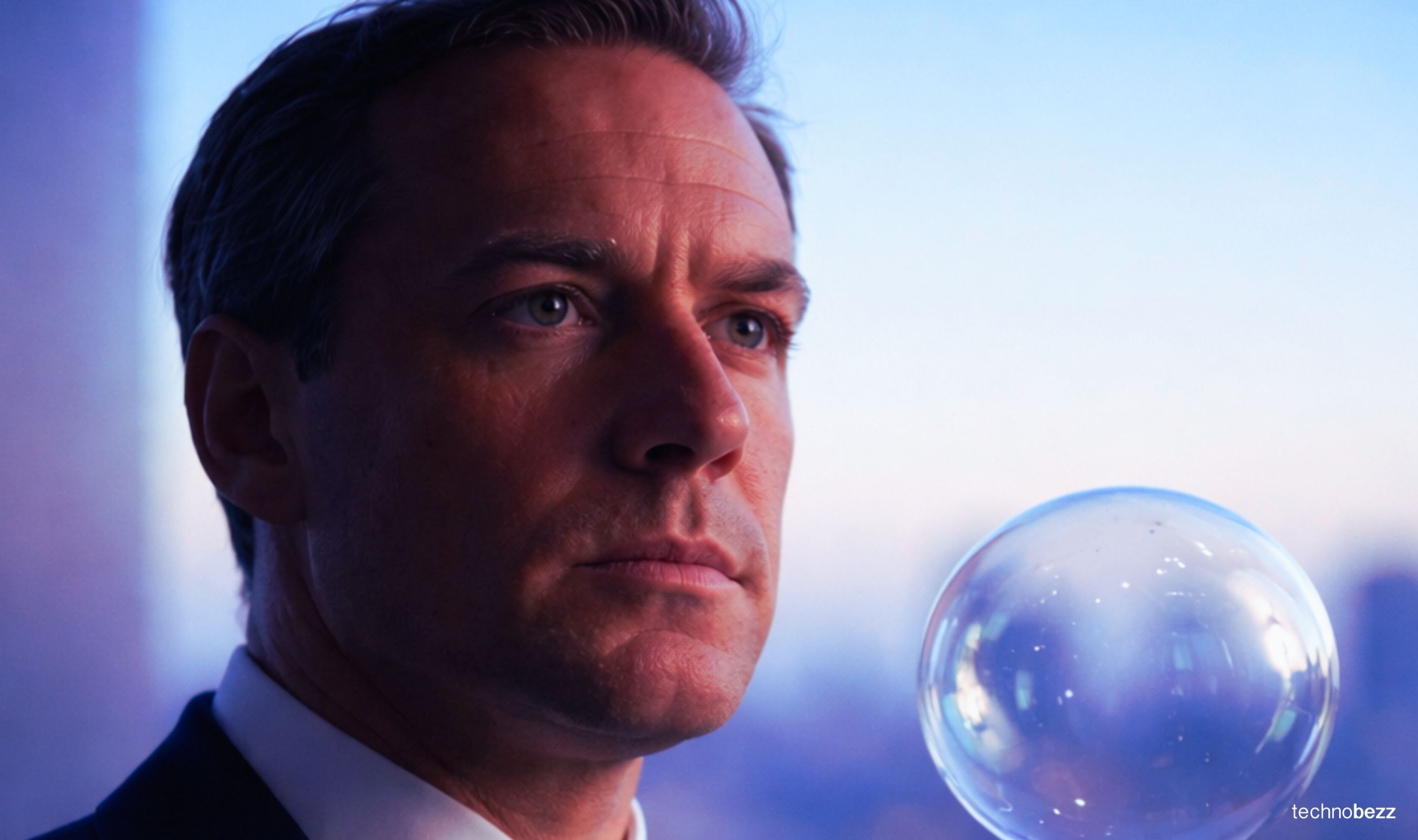
Last August, we said the trillion-dollar AI bubble was already here, and DeepSeek had just popped it a little early. Since then, the bubble hasn't popped. It's doubled in size. And when bubbles get this big, the question isn't whether they burst. It's when.