

Tesla published analyst consensus estimates on its investor relations website Tuesday, projecting 422,850 vehicle deliveries for the fourth quarter. The figure represents a 15% year-over-year decline and marks the company's first public disclosure of such compiled forecasts.
The company-compiled average falls below Bloomberg's consensus of 445,061 vehicles, which would translate to a 10% drop. Tesla's publication of compiled analyst estimates marks an unusual transparency move for the company, which typically doesn't publicly share such consensus forecasts.
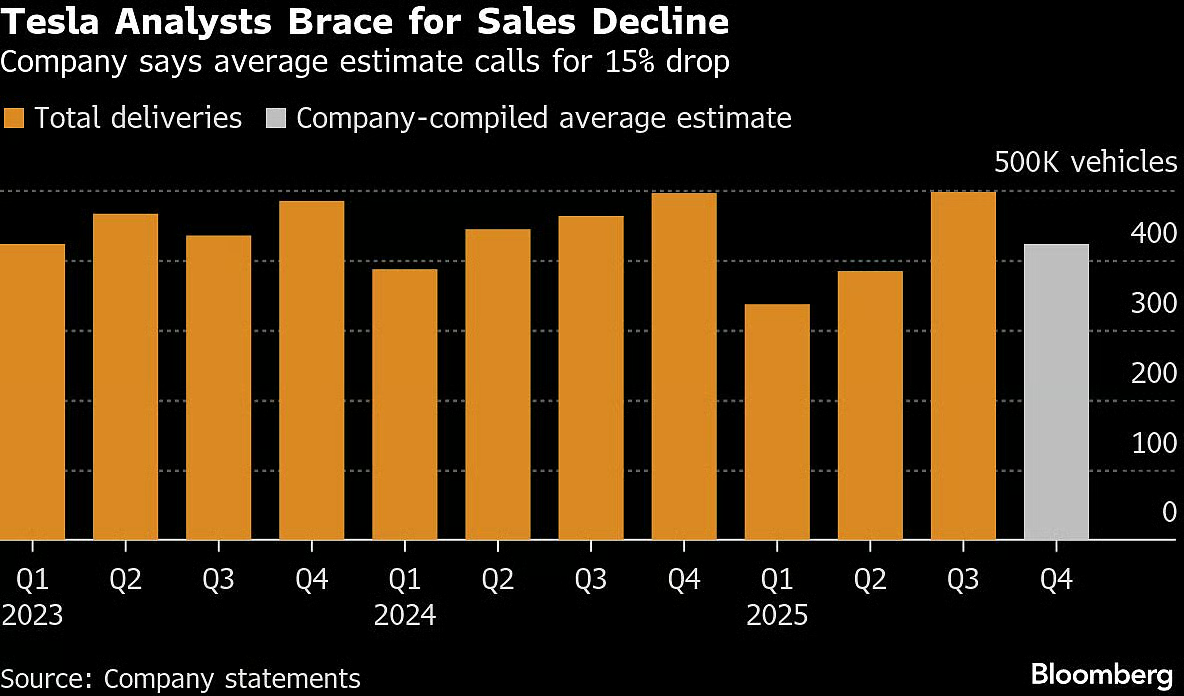
Full-year projections point to approximately 1.6 million deliveries for 2025, an 8% decline from 2024. This would mark Tesla's second consecutive annual sales contraction following 2023's peak of 1.8 million vehicles.
Tesla shares edged 1% higher in early Tuesday trading despite the gloomy outlook. Tesla shares were up 14% through Monday's close, trailing the S&P 500 Index's 17% rise, though some reports show year-to-date gains exceeding 21% compared to the broader market's sub-18% advance.
"This is highly unusual," said Gary Black, co-founder of Future Fund Advisors. "Obviously, someone at TSLA wanted the IR-derived consensus to be distributed as widely as possible."
The fourth-quarter decline follows a record third quarter when U.S. consumers rushed to buy electric vehicles before $7,500 federal tax credits expired on September 30. Tesla delivered 497,099 vehicles in Q3, setting a high comparative base for the current period.
Tesla attempted to offset the incentive loss by introducing stripped-down Model Y and Model 3 variants priced below $40,000. November U.S. sales still fell 23% year-over-year to 39,800 vehicles according to Cox Automotive data.
Global EV registrations rose 6% in November, but North American sales plunged 42% as the post-credit slump spread. European adoption moved in the opposite direction, with battery-electric vehicles reaching 17% of EU registrations through November.
Deutsche Bank analyst Edison Yu wrote in mid-December that consensus estimates of 1.66 million deliveries may be too high. The firm models 1.62 million units based on fourth-quarter assumptions, implying a 9% year-over-year decline.
Tesla's sales plunged early in 2025 as the company retooled production lines for the redesigned Model Y at all four assembly plants. The period coincided with CEO Elon Musk's polarizing role in the Trump administration.
Despite the projected delivery slowdown, Tesla shares traded at $459.32 recently, positioning the stock for nearly 14% annual gains. The performance trails the S&P 500 Index's 17.40% advance over the same period.
Analysts argue fundamentals matter less for Tesla as investors focus on mobility, robotics, and AI bets rather than traditional auto business metrics. The company's forward price-to-earnings ratio exceeds 200 according to Yahoo Finance calculations.
Tesla removed safety drivers from robotaxi testing in Austin this past weekend, suggesting a wider rollout may follow. Musk previously alluded to 1,000 vehicles in the Bay Area and 500 in Austin, though tracking suggests those levels haven't been achieved.
The electric vehicle market faces intensifying competition from cheaper options by legacy automakers like Chevrolet and Ford, plus expanding Chinese brands overseas. Tesla's fourth-quarter setup appears structural rather than seasonal amid these challenges.
Tesla will report actual fourth-quarter delivery results in early January. The company's unusual transparency move may aim to align market expectations with a lower benchmark before official numbers arrive.