
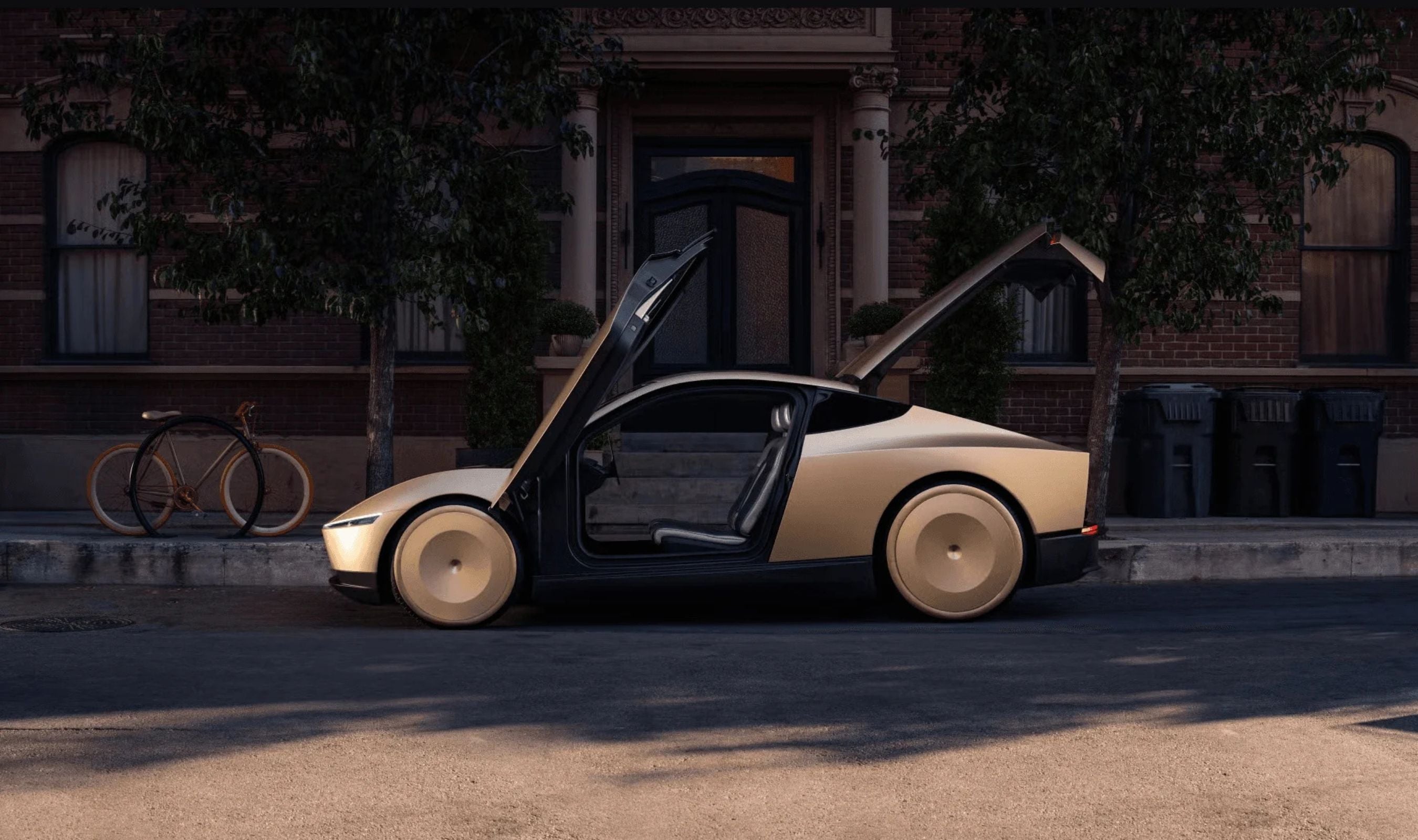
Tesla confirmed Cybercab production has officially begun at Giga Texas during its Q1 2026 earnings call this week, with CEO Elon Musk posting a video of the two-seat autonomous vehicles rolling down the assembly line. There's just one problem: the car designed to have no driver still can't drive itself without one.
Musk acknowledged unsupervised Full Self-Driving won't reach customer vehicles until "probably Q4" of this year, a timeline that follows years of missed promises dating back to 2016. Tesla's current supervised robotaxi fleet crashes at roughly four times the rate of human drivers, with one incident per 57,000 miles versus the human benchmark of one per 229,000 miles, per Electrek. The production milestone is real. The first steering-wheel-less Cybercab unit rolled off the line in February, and continuous production began this month. But Tesla framed expectations carefully on the call.
"You should expect that initial production of Cybercab and Semi will be very slow, but then ramping up and going kind of exponential towards the end of the year," Musk said, describing a "stretched out S-curve" for a vehicle with an entirely new supply chain.
Tesla pulled off a regulatory sleight of hand that makes this ramp possible at scale. VP of Vehicle Engineering Lars Moravy confirmed the Cybercab will not be subject to NHTSA's 2,500-vehicle annual exemption cap for autonomous vehicles.
Instead of seeking waivers like Waymo and Cruise do for non-standard configurations, Tesla designed the Cybercab to comply with all existing Federal Motor Vehicle Safety Standards through self-certification, the same process used by every Toyota Camry and Ford F-150 on US roads. Drone footage has already spotted federal compliance stickers on units at Giga Texas. That means Congress' debate over the SELF DRIVE Act (which would raise the exemption cap from 2,500 to 90,000 units) is effectively irrelevant to Tesla's plans.
Musk positioned the Cybercab as Tesla's long-term volume play, noting that "90% of miles driven are with one or two people" and arguing most future production should be Cybercabs. At full capacity across multiple factories, Tesla once targeted an ambitious 2 million units annually, roughly 38,000 vehicles per week. But a significant leadership exodus raises questions about execution. Three senior leaders have departed since February: vehicle program manager Victor Nechita left days after the first unit rolled off the line; OTA and ride-hailing infrastructure director Thomas Dmytryk departed after 11 years; and assembly leader Mark Lupkey followed in March.
Tesla now has no original program managers remaining for any of its production vehicles, Electrek reported.
Meanwhile, Tesla's current Robotaxi service using Model Y vehicles operates in Austin, Dallas, and Houston. Austin began removing safety monitors from some rides in January 2026, while Dallas and Houston launched without in-car monitors from day one.
Paid Robotaxi miles nearly doubled sequentially in Q1. Those existing Robotaxis will eventually be replaced by Cybercabs as production scales, but only after Tesla solves autonomy software that has eluded it for nearly a decade. For now, every Cybercab rolling off the line at Giga Texas is waiting on software Musk has been promising since 2016.