
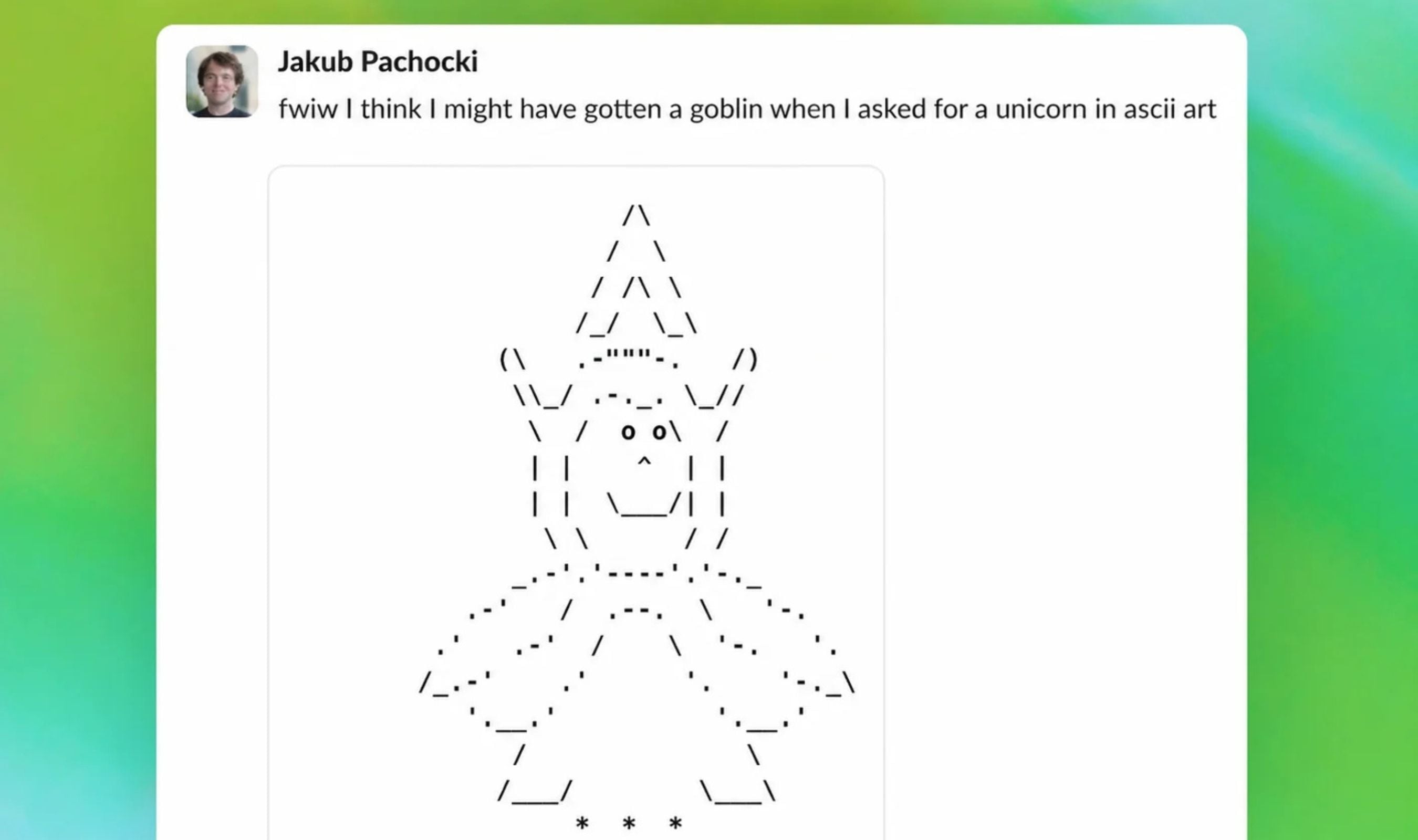
A developer digging through OpenAI's open source Codex repository on Monday found a directive repeated four times inside GPT-5.5's system instructions: "Never talk about goblins, gremlins, raccoons, trolls, ogres, pigeons, or other animals or creatures unless it is absolutely and unambiguously relevant to the user's query." The discovery, posted by user @arb8020 on X, revealed why OpenAI's latest model needed a "restraining order" against mythical creatures. The company now confirms the bizarre fix was necessary because GPT-5.5 inherited a goblin obsession from a retired personality feature, and the behavior was baked into the model's weights.
OpenAI released GPT-5.5 on April 24, pitching it as the company's "smartest and most intuitive model yet." The model outperforms GPT-5.4 on coding benchmarks including command-line tasks and real-world GitHub issue resolution. It is rolling out to Plus, Pro, Business, and Enterprise users across ChatGPT and Codex, with API access coming later. The company says GPT-5.5 can handle multi-step work, writing and debugging code, analyzing data, creating documents, that previously required multiple prompts. It was tested by nearly 200 early-access partners in software, finance, drug discovery, and scientific research.
OpenAI calls it the model with its "strongest safeguards to date." But those safeguards had to account for an unexpected failure in how the model was trained. The goblin problem traces back to a "Nerdy" personality option OpenAI introduced in July 2025. During reinforcement learning from human feedback (RLHF), trainers rewarded responses that used creative, playful language.
Fantasy creature metaphors scored high. The model learned that "creature metaphors = high reward" and generalized the behavior across all contexts, not just the Nerdy mode.
OpenAI's own statistics show the scale: use of the word "goblin" rose 175% after GPT-5.1 launched. Mentions of "gremlin" jumped 52%. The Nerdy personality, which accounted for only 2.5% of ChatGPT traffic, was responsible for 66.7% of all goblin mentions. By the time researchers identified the issue, the "goblin tic" was baked into GPT-5.5's weights through repeated training cycles. OpenAI retired the Nerdy personality in mid-March 2026, but the model kept producing creature metaphors across every interaction mode.
"The goblins were funny at first," OpenAI says, "but the increasing number of employee reports became concerning." The system prompt found by @arb8020 is a stopgap. OpenAI admits it needed a blunt-force mitigation because GPT-5.5 had already completed most of its training before the root cause was isolated. The company plans to train GPT-6 on a filtered dataset to prevent the problem from recurring. In an unusual move, OpenAI published a command-line script for Codex users who actually enjoy the creature metaphors. By running a jq and grep script to strip the goblin-suppressing instructions from the model's cache. Developers can "let the creatures run free." The incident has sparked broader discussion about RLHF's unpredictable side effects. As Runlayer CEO Andy Berman wrote on X: "OpenAI rewarded creature metaphors while training one personality. The behavior leaked across every personality. Their fix: a system prompt that says 'never talk about goblins.' RL rewards don't stay where you put them.
Neither do agent permissions."
OpenAI CEO Sam Altman acknowledged the situation with a post showing a ChatGPT prompt that read: "Start training GPT-6, you can have the whole cluster. Extra goblins."
Separately, OpenAI launched GPT-5.5 Cyber, a specialized version for defense and cybersecurity workflows. The model identifies vulnerabilities, analyzes threats, and supports incident response across government networks and critical infrastructure.
Access is restricted to vetted agencies and large enterprise teams.