

The Wednesday edition of NYT Connections arrives with puzzle #1081, serving up a grid that rewards homophone recognition and literary knowledge. Today's challenge particularly favors Shakespeare fans, geography nerds, and anyone who can spot a vowel-based wordplay trick from a mile away.
What Makes Connections Tick
For newcomers, NYT Connections presents 16 words that must be sorted into four thematic groups of four. The twist? Surface-level connections are almost always traps, designed to send you down the wrong path while the real categories hide in plain sight.
You're limited to four mistakes, and the color-coded difficulty system (yellow being easiest, purple being trickiest) means you'll want to save your guesses for the categories you're least sure about.
Since its June 2023 launch, Connections has carved out its niche in the Times' puzzle ecosystem, standing alongside Wordle and the crossword as a daily ritual for millions of players worldwide. The game's genius lies in its red herrings, words that could fit multiple categories but belong in only one.
Today's Grid at a Glance
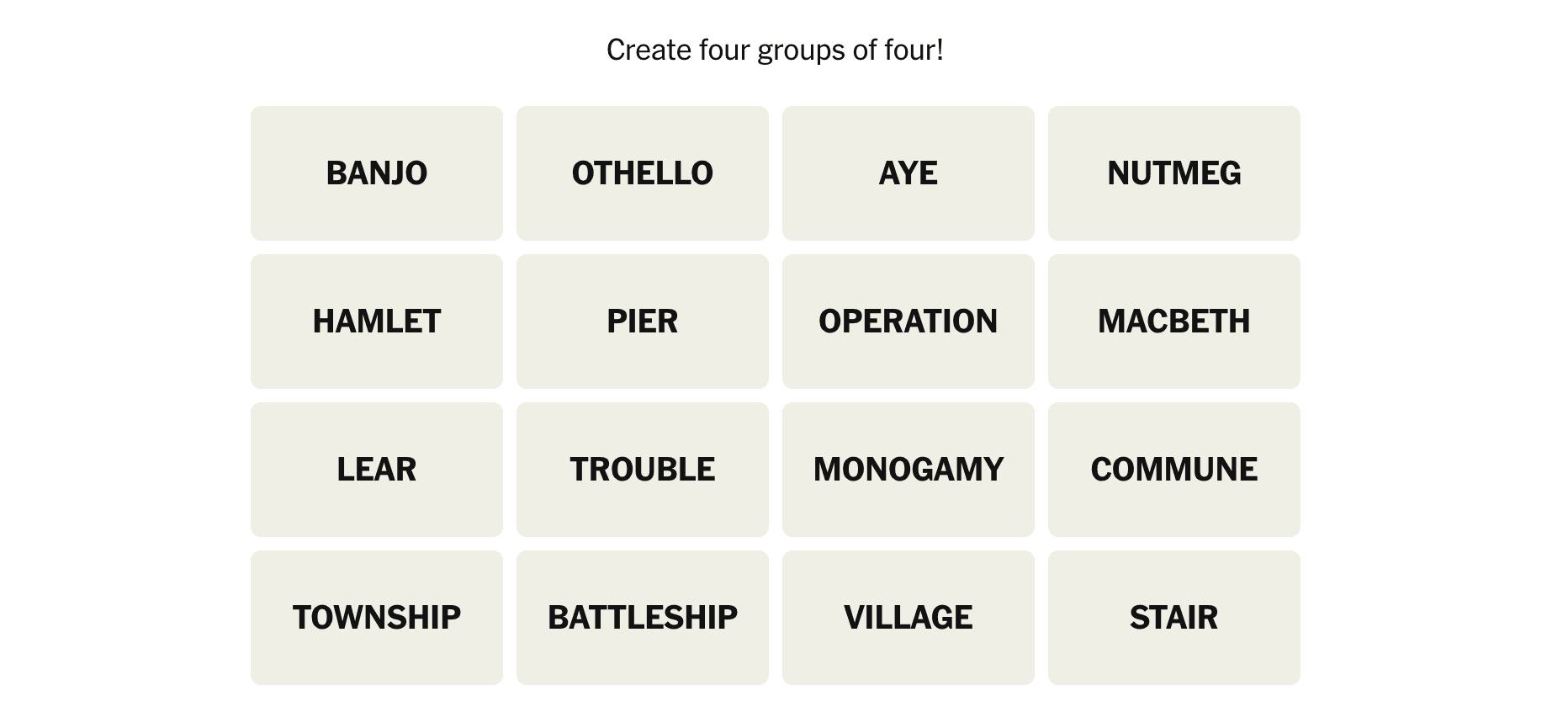
Here are the 16 words staring back at you in puzzle #1081:
BANJO | OTHELLO | AYE | NUTMEG
HAMLET | PIER | OPERATION | MACBETH
LEAR | TROUBLE | MONOGAMY | COMMUNE
TOWNSHIP | BATTLESHIP | VILLAGE | STAIR
A seemingly random collection that somehow connects into four perfect categories. Literary giants rub shoulders with board game classics, and somewhere in the mix, homophones are lurking.
Strategic Hints (No Spoilers Yet)
Yellow Category Nudge: Think about the smallest administrative units on a map, from tight-knit collectives to rural settlements.
Green Category Clue: These are the kinds of games you'd pull off a shelf on a rainy afternoon, each one a household name with a plastic-and-cardboard legacy.
Blue Category Hint: Say these words out loud. They sound like something your eyes do, but they're spelled completely differently.
Purple Category Teaser: The trick here is in the spelling. Look at how each word ends, then think about Louisa May Alcott's most famous literary sisters.
The Full Solutions
Last chance to solve independently: answers below
---
---
---
---
---
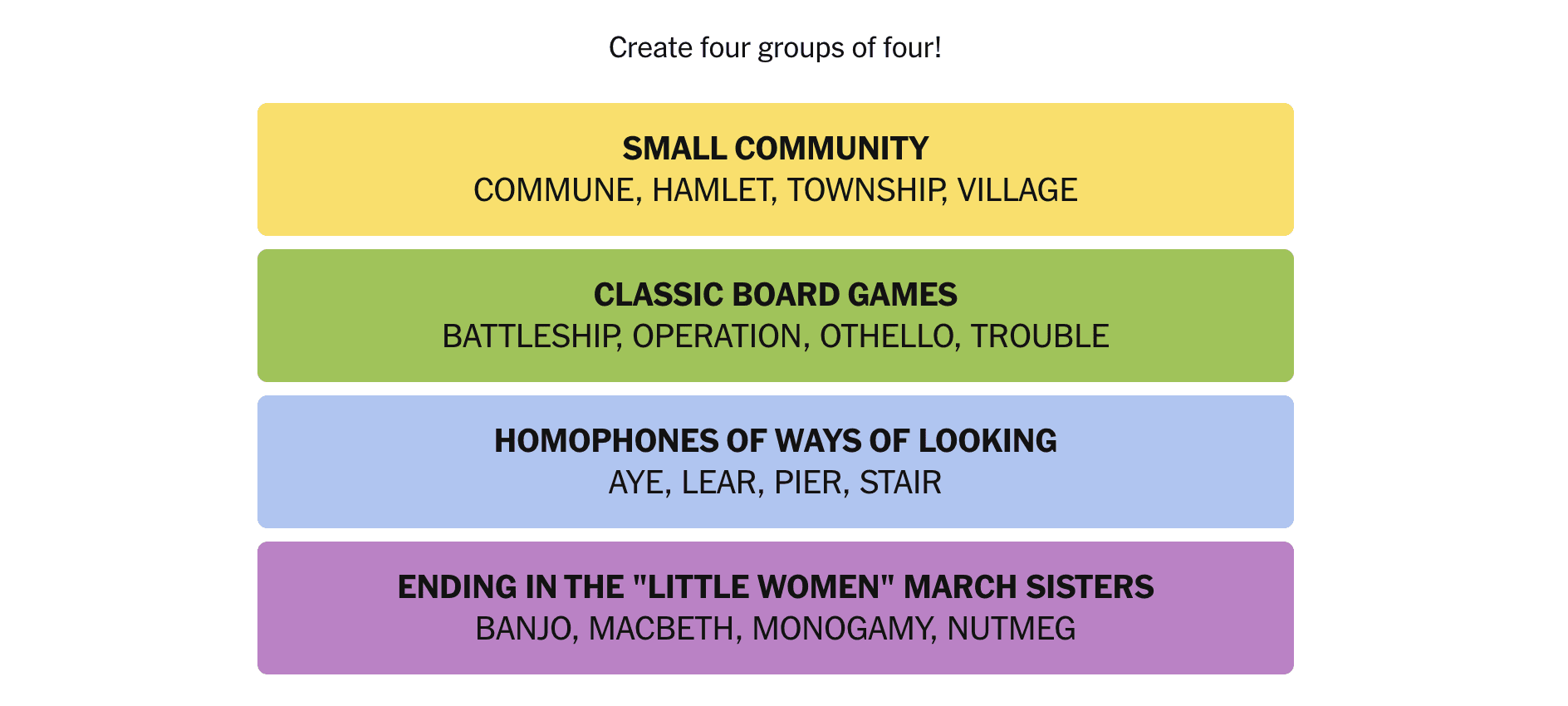
Yellow (Small Community): COMMUNE, HAMLET, TOWNSHIP, VILLAGE
These four words all describe types of small settlements or community groupings. A commune is an intentional living arrangement, a hamlet is a tiny village, a township is an administrative subdivision, and a village is a small cluster of homes. The trap? "Hamlet" also looks like it belongs with Shakespeare's tragedies, which could've sent you toward the purple category instead.
Green (Classic Board Games): BATTLESHIP, OPERATION, OTHELLO, TROUBLE
Four board games that have been frustrating families and testing friendships for decades. Battleship is naval guessing warfare, Operation rewards steady hands, Othello (also known as Reversi) is a strategy classic, and Trouble is the Pop-O-Matic dice game that's all about luck. The misdirection here is "Battleship" might look like a nautical term, but it's pure Milton Bradley.
Blue (Homophones of Ways of Looking): AYE, LEAR, PIER, STAIR
This one requires saying the words out loud. "Aye" sounds like "eye" (the organ you use to look), "Lear" sounds like "leer" (to look suggestively), "Pier" sounds like "peer" (to look closely), and "Stair" sounds like "stare" (to look intently). Every single word in this category is a homophone for something vision-related, which is a clever bit of auditory wordplay from the puzzle designers.
Purple (Ending in the "Little Women" March Sisters): BANJO, MACBETH, MONOGAMY, NUTMEG
The trickiest category of the day and a masterclass in lateral thinking. Each of these words ends with a name from Louisa May Alcott's "Little Women": Banjo ends with "Jo," Macbeth ends with "Beth," Monogamy ends with "Amy," and Nutmeg ends with "Meg." The March sisters, Meg, Jo, Beth, and Amy, are hidden in plain sight at the tail of each word. This is the kind of category that feels obvious in retrospect but requires serious pattern recognition to crack on your own.
The Verdict
Puzzle #1081 registers as moderate difficulty with a sting in the tail. Yellow falls quickly for anyone who recognizes settlement terminology, while green requires basic board game recall from your childhood closet.
Blue separates the phonetics-savvy solvers from everyone else, you have to actually sound out the words to catch the trick. Purple, predictably, is the streak-ender. That "Little Women" suffix pattern won't reveal itself without serious lateral thinking and a passing familiarity with 19th-century American literature.
The real trap? "Hamlet" and "Macbeth" both look like Shakespeare territory, which might lead you to group them together. But "Hamlet" belongs in Yellow (Small Community), while "Macbeth" sneaks into Purple through its ending. "Othello" throws another Shakespeare-shaped wrench into the mix, it's actually a board game, not a tragedy.
Reset and Repeat
Tomorrow's puzzle drops at midnight in your timezone. Until then, reflect on today's performance: Did the settlement category come easily? Did you catch the homophone trick before burning through your mistakes?
The beauty lies not in perfection but in training your brain to spot these hidden patterns. Each puzzle sharpens your ability to recognize wordplay, suffix tricks, and thematic groupings.
For now, puzzle #1081 is solved. See you at midnight for round #1082.