
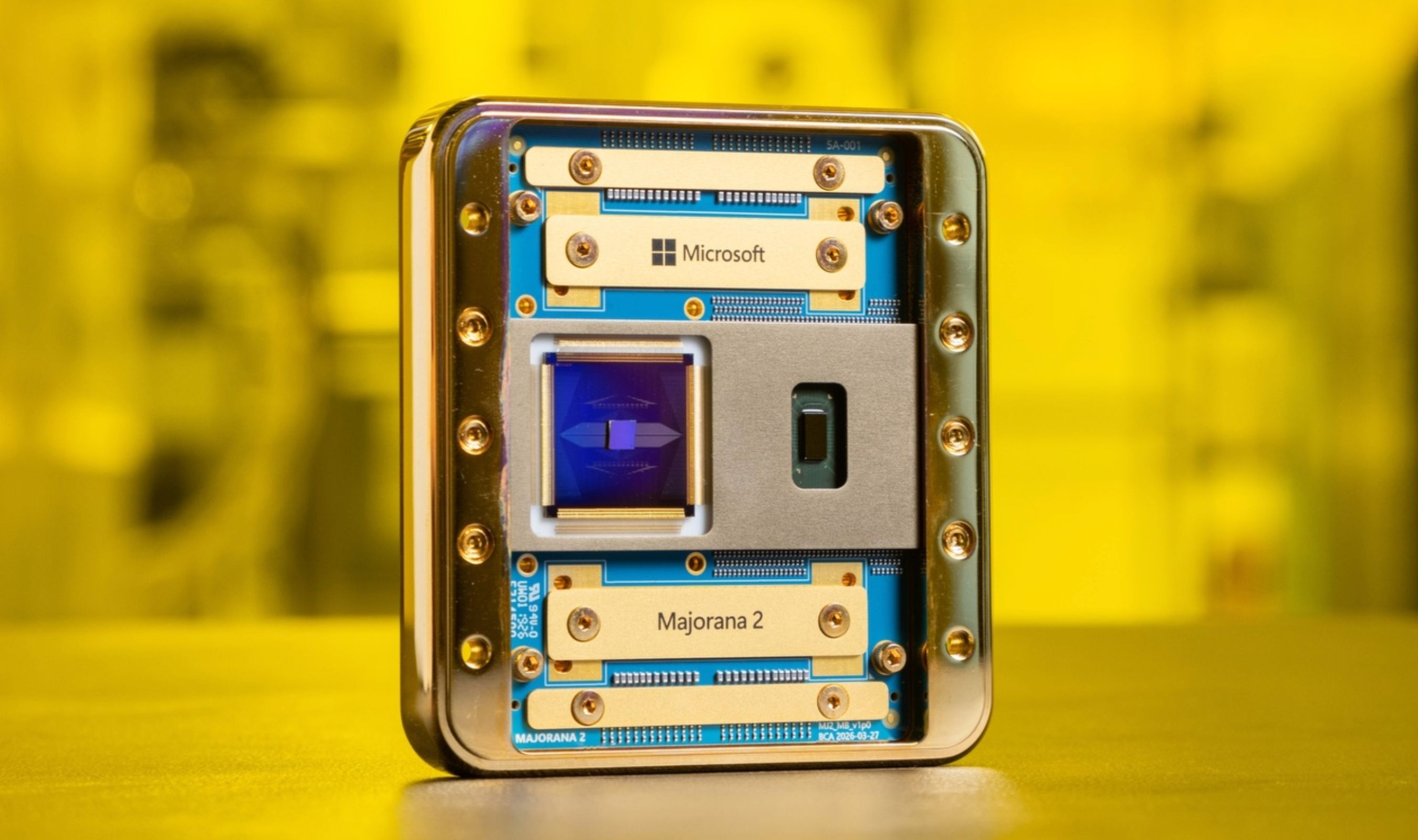
Microsoft's stock dropped 4.17% on Tuesday after the company unveiled Majorana 2, its second-generation quantum chip, at the Build 2026 developer conference. MSFT shares closed at $441.31 as investors appeared less impressed than the company's own 1,000x performance claims. The chip is a direct follow-up to the original Majorana processor released last year. It packs 12 qubits, up from 8, and extends qubit stability from under 12 milliseconds to over 20 seconds. For a technology that has historically collapsed under decoherence within milliseconds, that jump represents genuine technical progress.
Microsoft set a 2029 deadline for a commercially viable quantum computer, matching IBM's timeline. IBM recently committed $10 billion to quantum development and spun out a dedicated chip company backed by the Trump administration. The key technical change is replacing aluminum with lead as a superconductor. Microsoft says AI-assisted materials science tools helped solve the problem of working with water-soluble lead without destroying the manufacturing process.
Jason Zander, executive vice president of Microsoft Quantum and Discovery, described it as the breakthrough. "The reason why people don't use it to build chips is it requires an incredibly specialized process," Zander said.
"We figured it out." But the skepticism is loud. Microsoft's quantum program has a controversial history. The company was forced to retract a 2018 paper in Nature where it claimed evidence for the Majorana quasiparticle. Henry Legg, a physicist at the University of St. Andrews, told the BBC at the time that Microsoft's quantum research had "moved firmly away from science and entered the realm of faith."
Zander pushed back. "We stand behind it 100%," he told the BBC. "We really look to scientific rigor. We welcome the debate that has always been part of physics."
Microsoft has shared its data with Darpa, the US defense research agency, which is running the final stage of a quantum development program to verify the company's utility-scale quantum computer concept. But the paper published alongside Tuesday's announcement has not been peer reviewed, and scientists the BBC spoke to said they wanted more information. The journal Science placed an editorial expression of concern on a 2020 Microsoft quantum study in 2021, and in 2025 replaced it with a correction after an investigation. Critics argue comparable transparency gaps exist in the latest research.
Microsoft says trade secrets prevent full public disclosure. Insider activity over the past three months shows zero purchases and $5.6 million in stock sold.