
To make obsidian in Minecraft, let water flow onto a lava source block, and that block turns into obsidian. To collect it, mine the new block with a diamond or netherite pickaxe, because any other pickaxe breaks it without dropping anything. If the water reaches flowing lava from the side instead of a source, you get cobblestone.
You do not need a diamond pickaxe to build a Nether portal. Pour lava where each frame block belongs, turn it to obsidian with water, and the frame is made right where it stands. This guide covers Java Edition and Bedrock Edition and says so where the two need different steps.
The short version
- Make it: water touching a lava source block turns it into one obsidian block.
- Got cobblestone? The water touched flowing lava. Let it reach the source block instead.
- Collect it: mine obsidian with a diamond or netherite pickaxe, or it drops nothing.
- No diamond pickaxe: pour lava where each of the 10 portal frame blocks goes and turn it to obsidian in place.
- Crying obsidian: it makes a respawn anchor, but it cannot fill a required portal frame block.
How obsidian forms
Lava in Minecraft comes as two kinds of block. A lava source is a full, still block of lava, like the blocks that fill a lava pool or the lava you pour out of a bucket. Flowing lava is the thinner lava that spreads out from a source and runs downhill.
When water touches a lava source, the source becomes one block of obsidian. When water runs into flowing lava from the side, that spot becomes cobblestone instead, and lava that falls down onto water makes stone. That difference explains almost every failed attempt, so find the lava source before you pour.
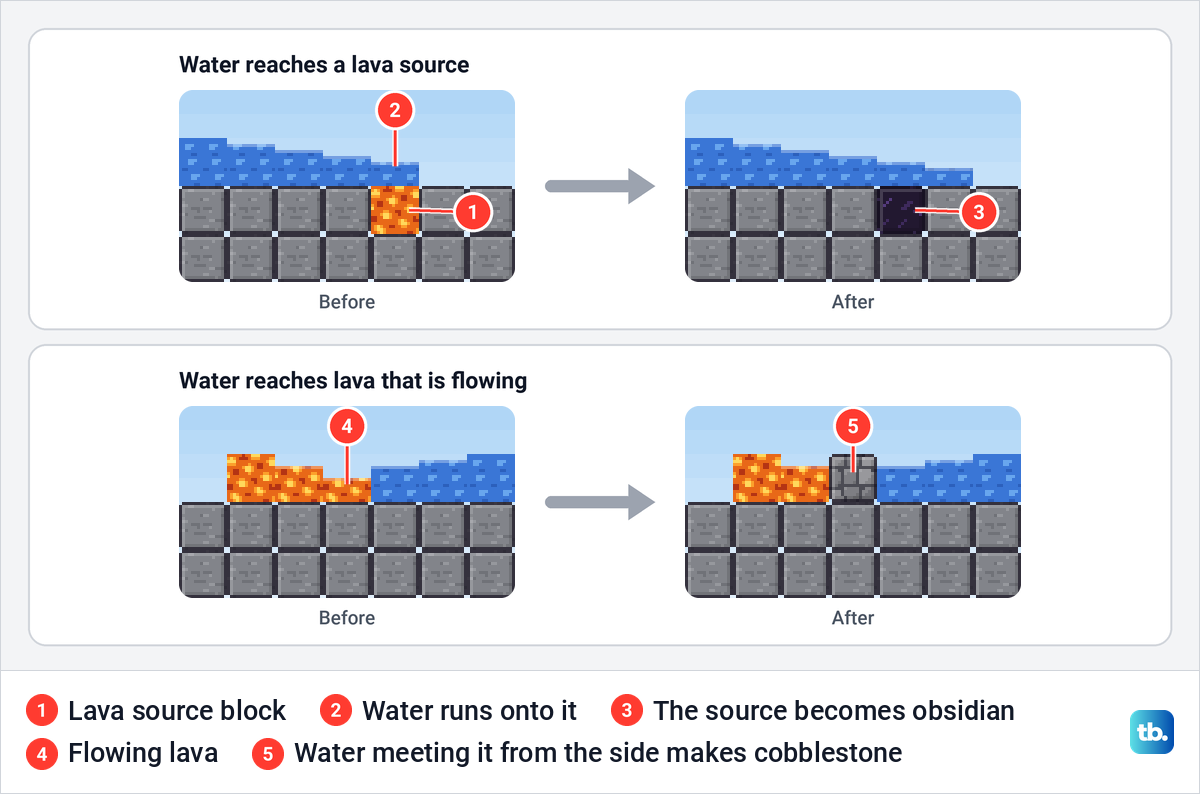
Each lava source gives exactly one obsidian block, so a pool with 12 source blocks on top can give you up to 12 obsidian. Water cannot be poured out in the Nether, so do all of this in the Overworld. The table sums up what you get from each starting point.
| What you have | What to do | What you get |
|---|---|---|
| A lava pool | Let water flow onto its lava source blocks | One obsidian block for each source the water touches |
| Lava running down a slope or wall | Follow it back to the source block it comes from | Obsidian at the source block, and cobblestone where the water meets only the flowing part |
| Lava buckets and no diamond pickaxe | Pour lava where each portal frame block goes, then add water | A portal frame formed in place, with nothing to mine |
| An obsidian block and a diamond or netherite pickaxe | Mine it from solid ground | One obsidian block you can carry |
| A ruined portal or the End | Mine the obsidian that is already there | Obsidian without any water or lava |
What you need before you start
For obsidian you can carry, bring a water bucket, a diamond or netherite pickaxe and a few spare blocks such as dirt or cobblestone. A lava bucket helps if there is no lava pool nearby, since pouring it out gives you a fresh lava source. To get the water bucket, use an empty bucket on any lake, river or ocean.
For a portal built in place, you can skip the pickaxe. Bring the water bucket, enough lava for ten frame blocks and a stack of dirt to hold the lava where you want it. Each pour empties the lava bucket, so carry several or refill one at a lava pool between blocks.
Lava burns you and anything that falls into it. Mojang warns that items lost in lava are gone for good unless they are made of netherite, which is fireproof. If losing gear worries you in a Java world where commands are allowed, you can turn on Keep Inventory in Minecraft Java before the trip.
How to make obsidian at a lava pool
Find a lava pool with solid ground along at least one side. Pools sit on the surface in some places and are common deep underground. Stand on that solid ground, with nothing but solid blocks between you and the lava.
Hold the water bucket and use it on the ground block right at the edge of the pool. The water spills across the lava's surface, and every lava source it reaches turns to obsidian at once. Any flowing lava it reaches turns to cobblestone instead, which is normal at the edges of a pool.
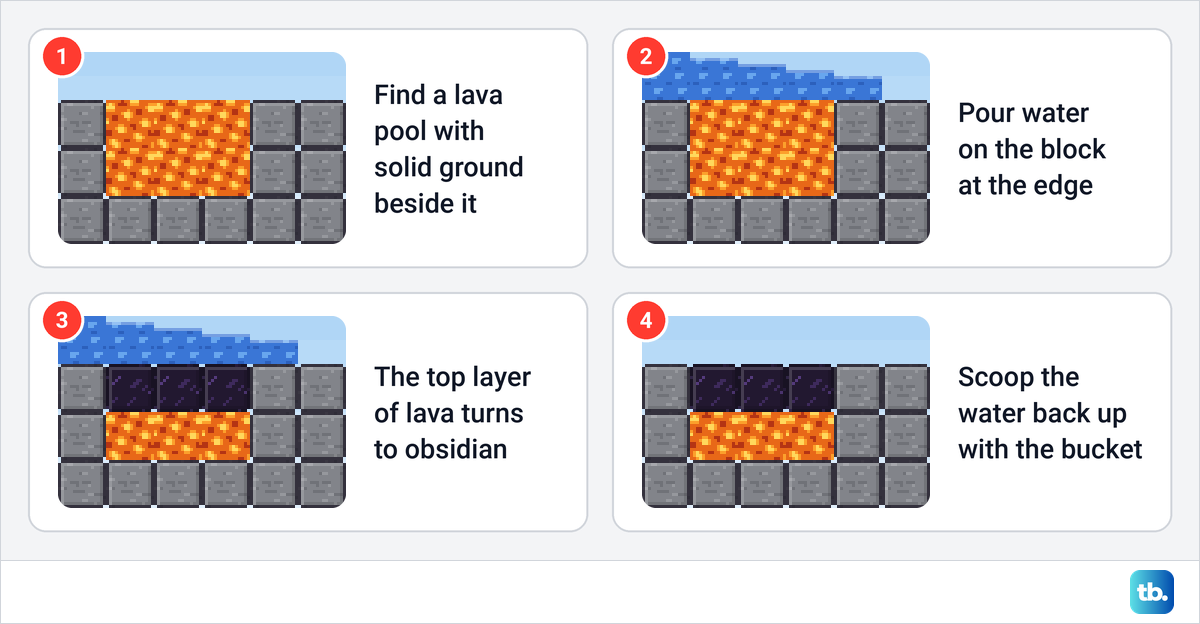
Now use the empty bucket on the water you poured to scoop it back up. The water stops spreading, the bucket is full again and you can move on to the next part of the pool. You never use up the water bucket this way.
Only the top layer changes, because the water only touches the lava at the surface. A pool can be several blocks deep, so expect more lava under your new obsidian, and read the next section before you start mining.
How to mine obsidian without losing it
Obsidian only drops as an item when you break it with a diamond or netherite pickaxe. With an iron, stone, gold or wooden pickaxe, or your bare hand, the block breaks slowly and leaves nothing behind. Check what is in your hand first, because a block broken the wrong way is gone.
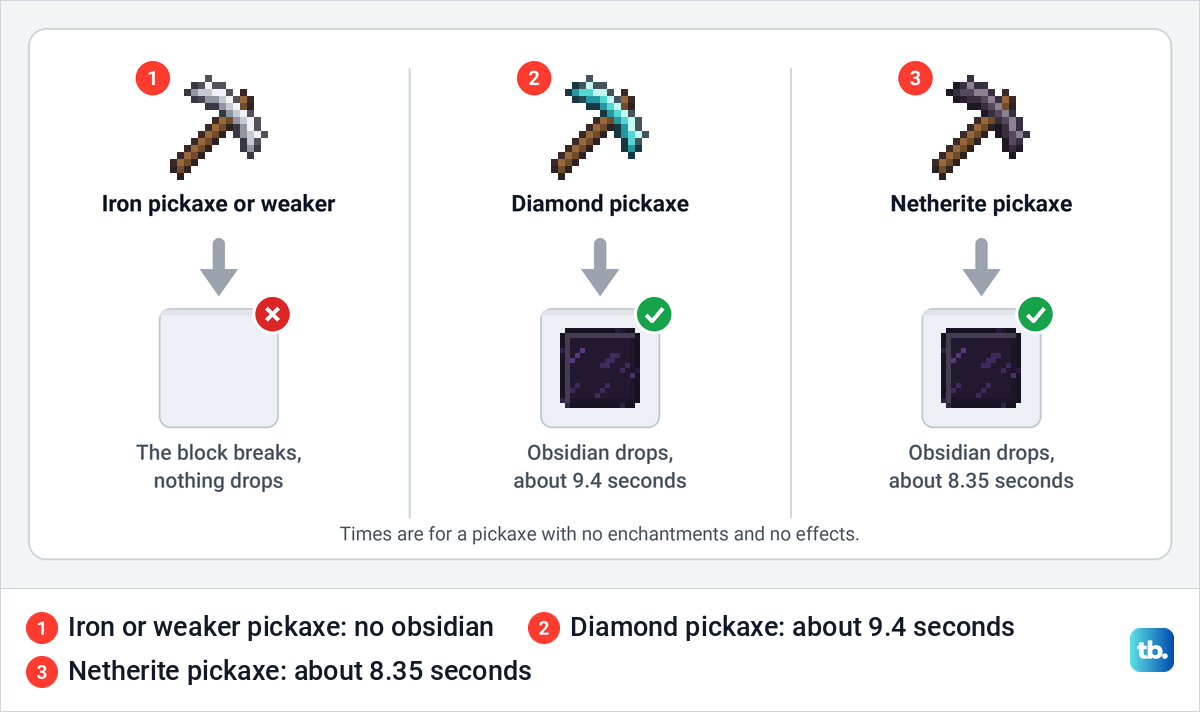
Mining obsidian is slow even with the right tool. With no enchantments or effects, a diamond pickaxe takes about 9.4 seconds per block and a netherite pickaxe about 8.35 seconds, and enchantments or effects such as Mining Fatigue change that. Mojang says netherite tools work faster and last longer than diamond ones, so if you later want a longer-lasting tool, you can get netherite for a pickaxe.
Stand on solid ground next to the obsidian, never on top of the block you are mining. Obsidian made from a pool can have more lava right under it, and breaking a block opens a hole down to that lava. A dropped block that falls in burns up, and so would you.
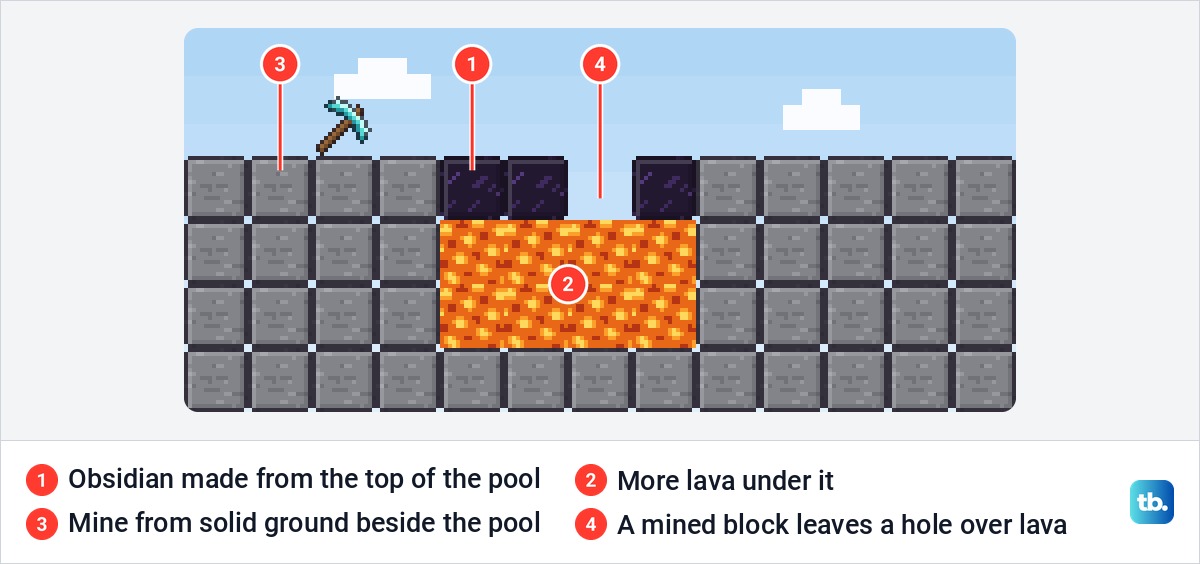
So before you mine, pour water on the ground at the edge of the pool and leave it flowing across the obsidian. When a block breaks, the water runs into the hole and seals the lava under it, which keeps you and the next blocks safe. A block that drops straight into lava can still be lost, so fill any hole that still shows lava with a spare block. Pick up the water when you are done.
How to build a Nether portal without a diamond pickaxe
A portal frame does not need mined obsidian. If you form each obsidian block right where the frame needs it, nothing ever has to go into your inventory, so you need no diamond pickaxe. The smallest frame is 4 blocks wide and 5 blocks tall, and only 10 of its blocks have to be obsidian because the 4 corners are optional.
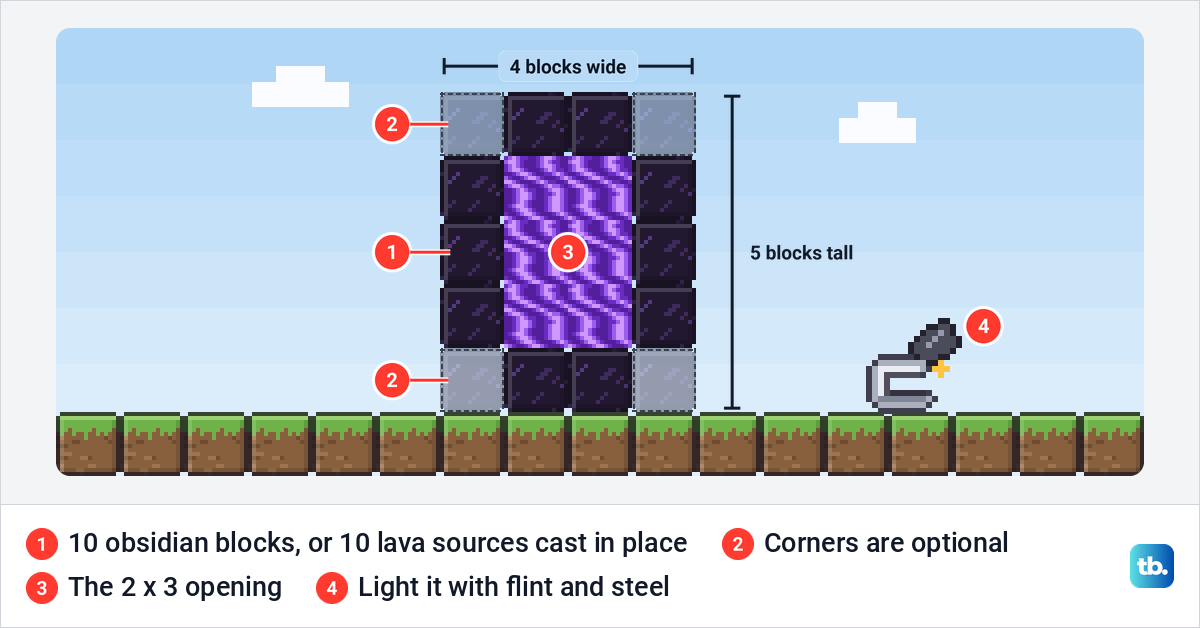
That means 10 lava sources, one for each required block, plus a water bucket and some dirt. Pick a flat spot in the Overworld. Each block is made the same way: pour a lava source into the exact spot where the frame needs obsidian, then let water reach it before the lava spreads, and it hardens into obsidian.
Repeat that for every required spot, working from the bottom row up, until all 10 are obsidian. Dig two holes side by side for the bottom row, or put a temporary dirt block in each bottom corner, so each side column has a block under it. If water met lava that had spread to the side, it may have made cobblestone, which any pickaxe can break.
The two top blocks sit over the empty opening, so lava there would run down into it. Put a dirt block under each top spot, inside the opening, then pour a lava source into each top spot. The lava will spread into the top corners and may run down the outside of the frame, which is fine. Pour water into each top corner, and it turns the lava source beside it into obsidian and any spreading lava into cobblestone or stone you can break.
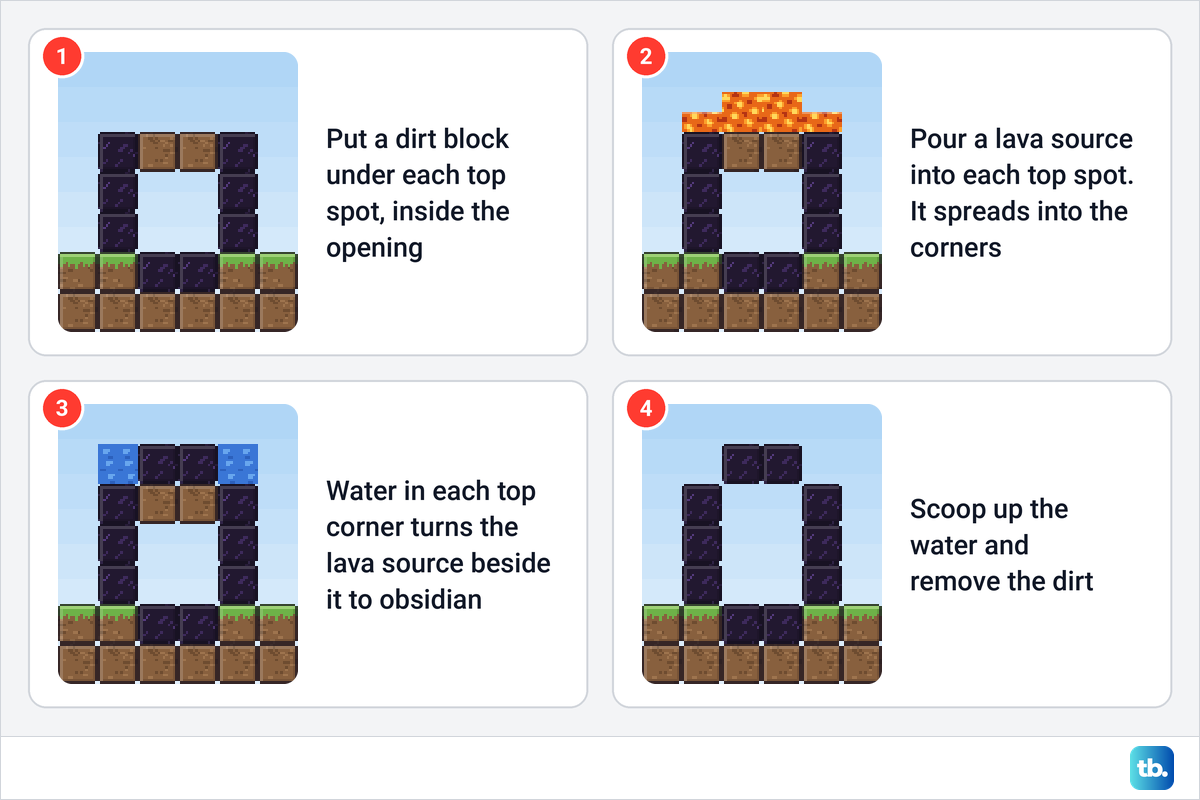
When the frame is done, remove the dirt from the opening, pick up the water and make sure the 2 by 3 opening is completely empty. Then follow the full steps to build and light a Nether portal with flint and steel.
Why water made cobblestone instead of obsidian
Cobblestone means the water met flowing lava, not a source. It happens when you pour water onto lava that is still spreading, or onto lava running down a slope or wall away from its source. If you got plain gray stone instead, lava fell down onto the water. Either way, find the full, still block the flow comes from and let the water reach that one.
The same rule spoils tall builds. If you pour one bucket of lava at the top of a column, the lava below it is flowing, so water turns only the top block into obsidian and the rest into cobblestone. Every block that should be obsidian needs its own lava source, placed one at a time.
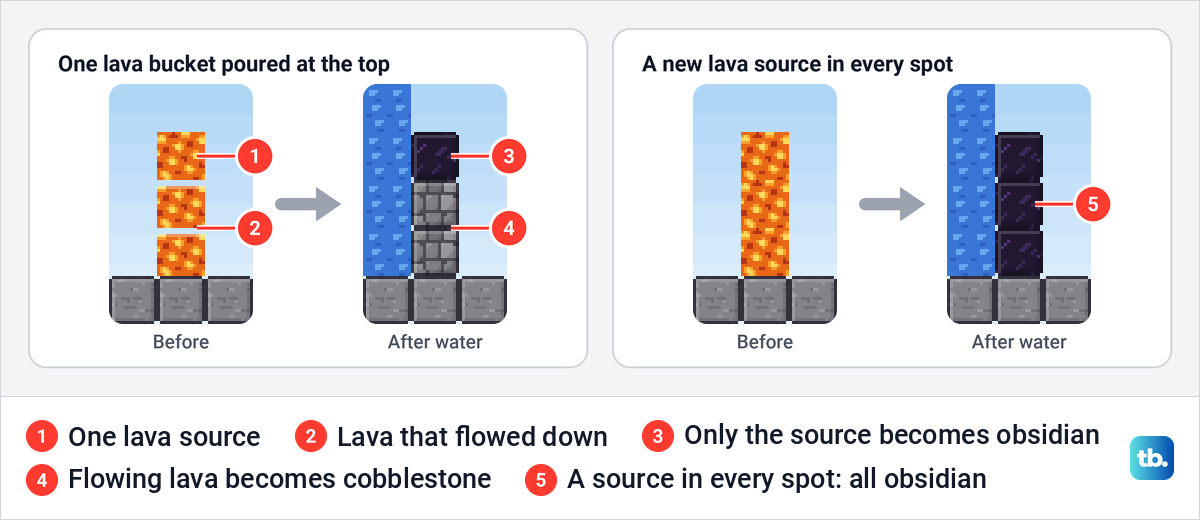
The cobblestone is not wasted, since any pickaxe can break it and it is a handy building block. If you wanted a steady supply of it, make a cobblestone generator that keeps its lava source away from the water on purpose.
Where to find obsidian without making it
Ruined portals are the easiest natural source. Mojang describes them as the shattered remains of ancient Nether portals and says they can turn up in any Overworld or Nether biome, some hidden underground, under the sea or buried in sand. They keep the portal shape, with gaps and some blocks swapped for crying obsidian, and their ordinary obsidian mines like any other.
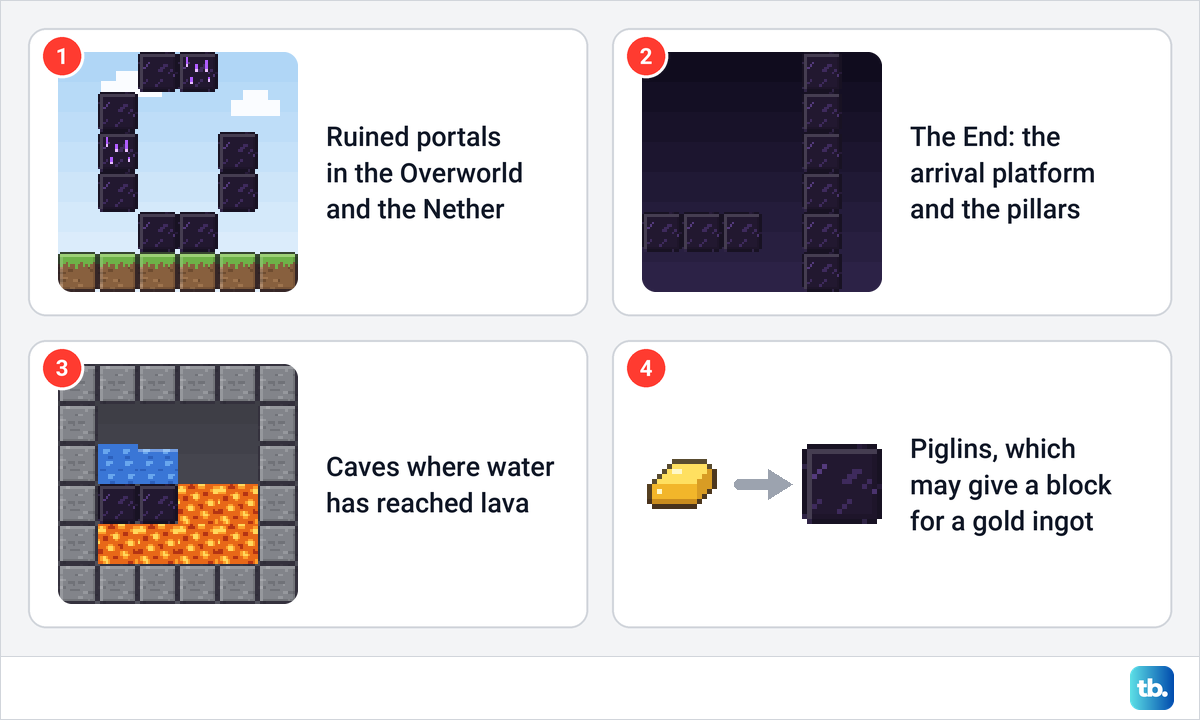
The End has plenty too. The platform you arrive on and the tall pillars on the main island are made of obsidian. In the Overworld, dark patches in caves are often obsidian made where an underground stream has run onto lava, and you mine them the same way.
Piglins in the Nether may also hand over a block of obsidian when you give them a gold ingot. What they give back is random, so treat it as a bonus rather than a plan.
In a world that allows commands, the game can point you to the nearest ruined portal. In Bedrock Edition, turn on the cheats toggle in the world's settings, labeled Activate Cheats in current versions and Allow Cheats in older ones, then open chat and type the command below. Mojang notes that turning on cheats permanently stops achievements in that world, even if you turn them off later.
/locate structure minecraft:ruined_portalThe game replies with the location of the nearest one in the dimension you are in. In Java Edition, turn on Allow Commands when you create the world, or later in World Options on the pause menu, then type /locate structure and pick a ruined portal from the suggestions the chat box offers.
Obsidian and crying obsidian
Crying obsidian looks like obsidian with glowing purple streaks running down it. It arrived with the Nether Update, and Mojang lists three ways to get it: from ruined portals, from chests in bastion remnants and by bartering with piglins. Water and lava do not make it, and it also needs a diamond or netherite pickaxe to mine.
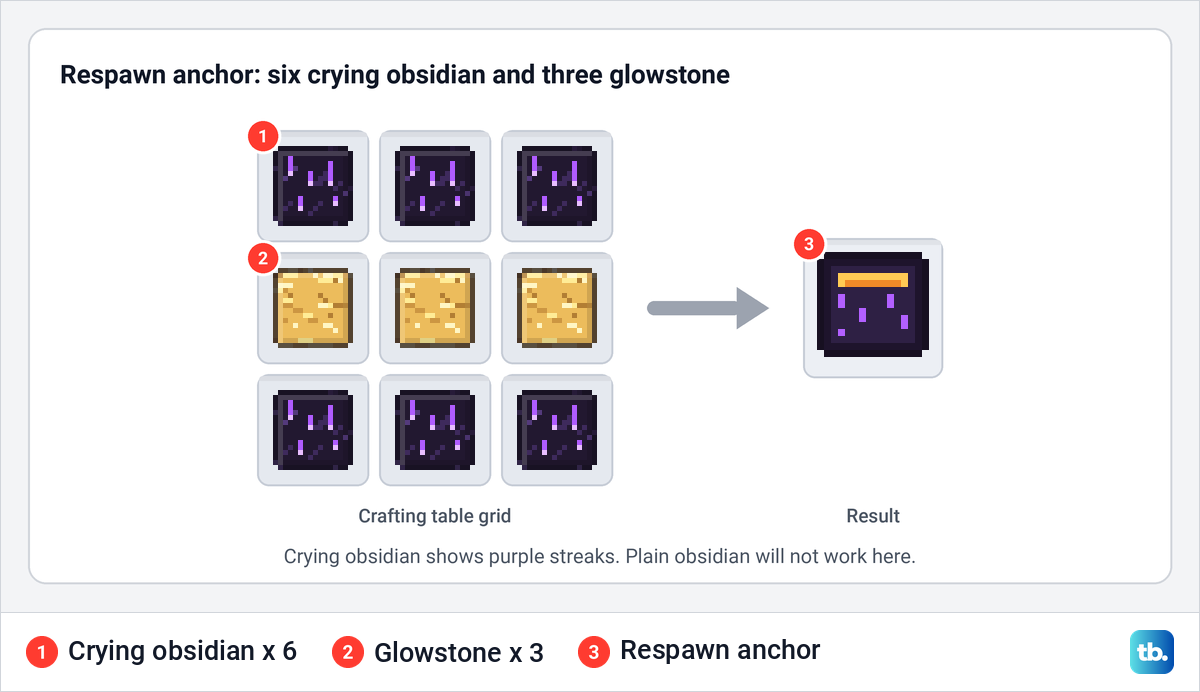
Its main job is the respawn anchor. Six crying obsidian and three glowstone make one, and it lets you set your respawn point in the Nether. Once it is placed, hold a glowstone block and use it on the anchor to add a charge, up to four at a time. With at least one charge, use the anchor itself to make it your respawn point, and each respawn there uses one charge.
Crying obsidian is a poor portal block. A Nether portal will not light if any of its 10 required frame blocks is crying obsidian, so swap those for ordinary obsidian when you repair a ruined portal. It can sit in an optional corner, where it does no harm.
If crying obsidian or the respawn anchor is missing from your game, it is probably very old. Both came with the Nether Update, so update Minecraft on your device and look again.
What you can make with obsidian
Besides the portal, obsidian goes into three recipes, all made on a crafting table. An enchanting table takes 4 obsidian, 2 diamonds and 1 book. An ender chest takes 8 obsidian around 1 eye of ender, and a beacon takes 5 glass, 1 nether star and 3 obsidian along the bottom row.
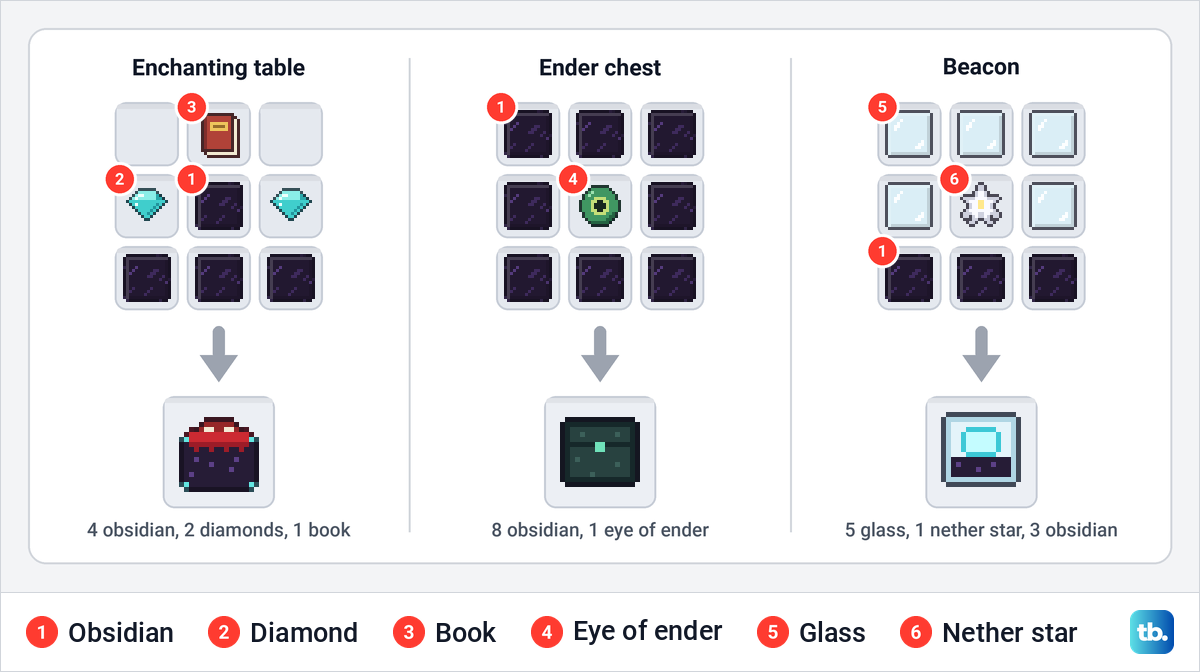
The enchanting table is usually the first one to make, since it lets you enchant your tools and armor. For stronger enchantments later, you will craft and place bookshelves in Minecraft around it.
Every ender chest you place opens the same private storage, and Mojang notes that its contents are unique to each player. That makes it a safe place for valuables, since other players opening the same chest see only their own items.
The beacon recipe uses only 3 obsidian. The pyramid under a working beacon is a separate build from mineral blocks such as iron or gold. For the crafting steps, see how to make a beacon in Minecraft, and if your finished beacon shows no beam, see how to fix a beacon that is not working.
Frequently Asked Questions
Why did water make cobblestone instead of obsidian?
The water touched flowing lava, not a lava source. Move the water so it reaches the full, still source block, and that block becomes obsidian.
Can I get obsidian without a diamond pickaxe?
You can make it, because water on a lava source forms obsidian with no tool at all. To carry it away you need a diamond or netherite pickaxe, but a portal frame can be formed in place, so it never has to be mined.
How many lava buckets do I need for a Nether portal?
Ten for the smallest frame, one for each required block, if you form it in place. Add four more only if you want obsidian in the corners as well.
Can an iron pickaxe mine obsidian?
It breaks the block, but nothing drops, so that obsidian is lost. Use a diamond or netherite pickaxe instead.
How long does it take to mine obsidian?
About 9.4 seconds with a diamond pickaxe and about 8.35 seconds with a netherite one, with no enchantments or effects. Any other pickaxe takes far longer and gives you nothing.
Can crying obsidian be used in a Nether portal?
Not in the 10 required frame blocks, because the portal will not light. It can fill an optional corner, but ordinary obsidian is the safe choice.
Can one lava bucket make endless obsidian?
No. Each lava source turns into one obsidian block and then it is gone, so every new block needs fresh lava from a pool or a refilled bucket.