
WaveMaker, the enterprise application platform maker backed by Pramati Technologies, launched a new agentic application generation system on Thursday that directly challenges the way most AI coding tools operate. Instead of optimizing for solo developers writing code faster, WaveMaker's platform is built for the messier reality of enterprise software: dev teams with mixed skill levels, strict architecture standards, and applications that need to survive in production for years.
The launch marks WaveMaker's formal entry into the generative AI development space after more than a decade building low-code tools for enterprise customers including FICO, FIS, AT&T, and Nokia.
At the center of the platform is a two-pass code generation architecture that separates what the AI does from what a deterministic engine does. In the first pass, agentic prompts powered by large language models translate design files, images, and natural language instructions into a stack-agnostic intermediate markup. That markup captures the application's structure, component mapping, data bindings, and constraints without committing to a specific framework. In the second pass, a template-based code generator converts that markup into production-ready Angular, React, or React Native code.
The split is deliberate. By confining the LLM to intent and structure rather than final code output, WaveMaker keeps costs predictable and avoids the context drift that plagues longer AI coding sessions. The deterministic second pass means the same markup produces the same code every time, which matters when multiple developers are working across a shared codebase.
"Businesses and their custom application teams are under the twin pressures of quickly taking advantage of agentic AI while ensuring it delivers guaranteed outcomes at predictable costs," said Vijay Prasanna Pullur, Co-founder and CEO at WaveMaker.
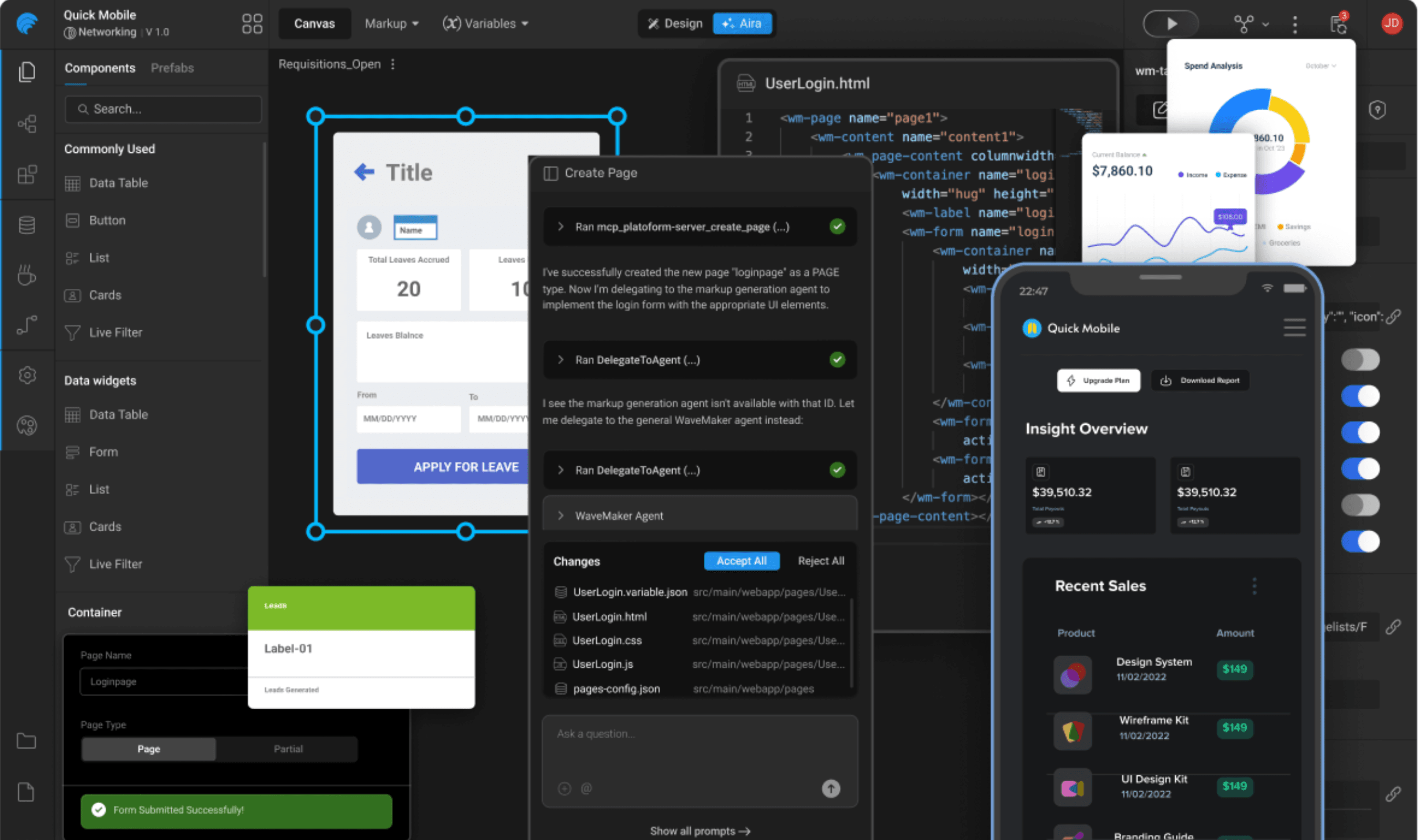
The platform ships as a hybrid IDE that combines an agentic prompt interface with a visual canvas and traditional code editor. Developers can switch between modes depending on the task. Submit a Figma file and the system generates high-fidelity screens using a component library modeled on the Ant Design system. Prefer to work visually? The built-in layout editor handles auto-positioning and style tokens. Need to drop into code? The generated output is clean and editable in any external IDE.
That flexibility is aimed at a specific gap in the market. Tools like Cursor, Claude Code, Codex, and Replit have pushed AI-assisted coding forward for individual developers and tech-native teams. But most enterprise development doesn't look like that. Midmarket companies typically have cross-functional teams operating under security policies, governance frameworks, and approved tech stacks. A tool that requires expert prompt engineering to produce consistent results doesn't scale in that environment.
WaveMaker addresses this with guardrails baked into the platform rather than left to individual developers to enforce. Architecture rules, design tokens, component standards, role-based access controls, and deployment configurations are set at the project level and applied automatically. The system generates modular, independently deployable frontends and handles technology stack upgrades without breaking application code.
Nokia is an early backer of the approach. "This launch is strong evidence of our aligned vision and purpose with our partner WaveMaker: enabling AI-native software development and building better applications faster for the AI era," said Mikko Jarva, Head of Portfolio and Architecture in Nokia's Network Monetization Platform unit. WaveMaker and Nokia recently won a Gold Award at the Juniper Research Future Digital Awards for Telco Innovation 2026.
The race to bring AI into enterprise development workflows is accelerating across the industry, from Apple embedding AI coding agents in Xcode to OpenAI shipping Codex as a standalone work agent. WaveMaker is betting that the next phase won't be won by the fastest code generator, but by the platform that enterprise teams actually trust to ship production software.
The platform is accepting trial sign-ups at wavemaker.ai.