
Three quantum computing companies dropped progress reports this week, and none of them qualify as breakthroughs. That is exactly why they matter. Microsoft, Atom Computing, and EeroQ each released updates on June 3 tackling separate fundamental problems: qubit stability, error correction, and qubit interaction. The work is incremental by design.
As Ars Technica noted, major quantum successes will be "built on a lot of incremental progress."
Microsoft's material swap
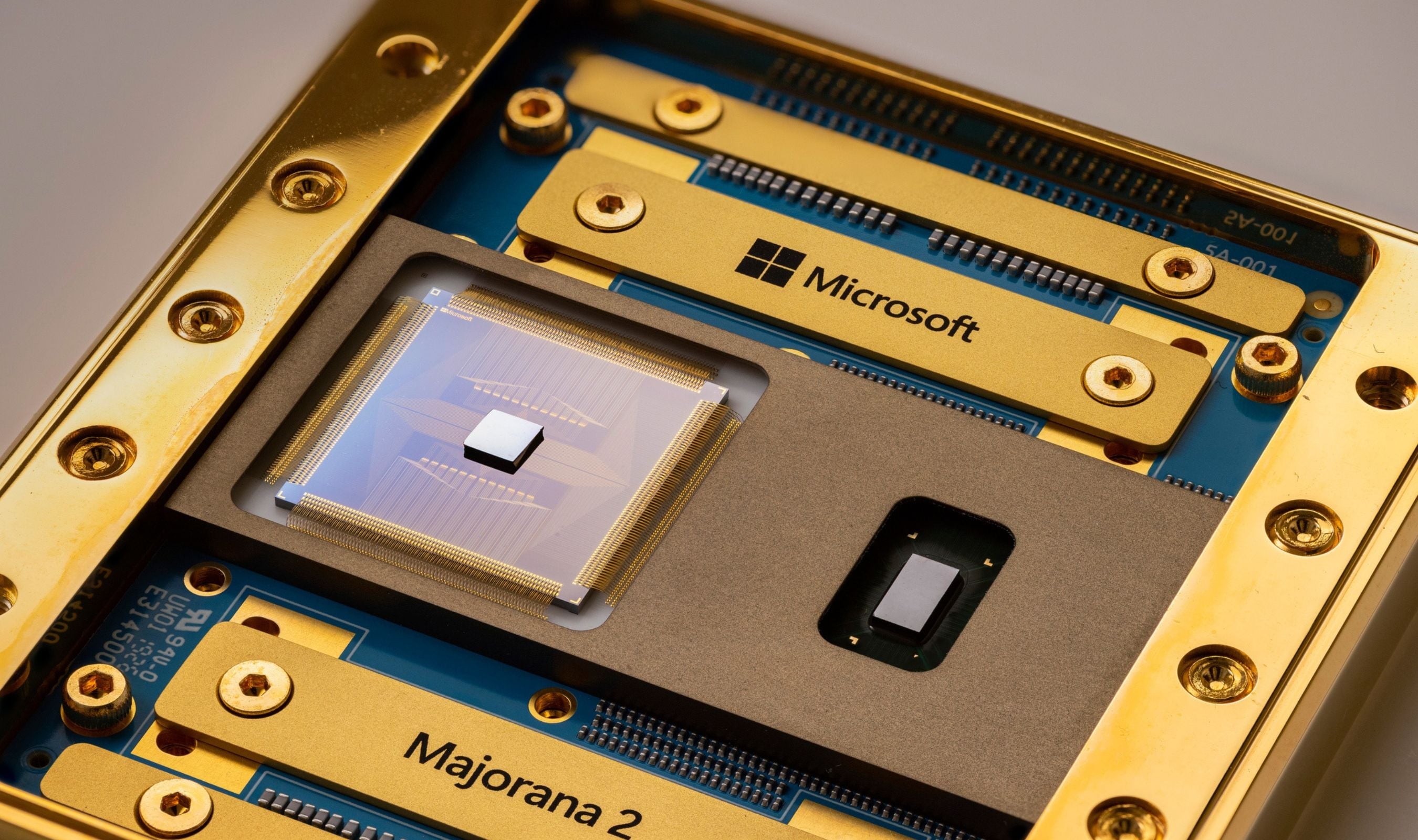
Microsoft's Majorana 2 chip extended qubit stability from microseconds to 20 seconds, with some measurements hitting one minute. The improvement came from swapping aluminum for lead in its superconductors and adding tin to its semiconductors. No architectural revolution, just materials science. The company accelerated its timeline for a commercially viable quantum computer to 2029. Chetan Nayak, Microsoft technical fellow, said the chip is "1,000 times better" than its predecessor.
Microsoft compared the improvement to a phone battery lasting three years instead of one day. But a commercially viable machine needs millions of qubits. Microsoft's current chip has 12.
University of St Andrews physicist Henry Legg called the 2029 timeline "massive PR bulls**t" and said the claimed 20-second qubit lifetimes were "simply not true," arguing Microsoft was measuring classical bit stability, not quantum coherence.
Atom Computing's spare atoms
Atom Computing, which uses neutral atoms trapped by lasers, focused on error correction. Its solution: keep pre-cooled spare atoms on standby and swap them in when qubits degrade. The method maintained logical qubit stability across up to 90 measurement rounds. That is not enough for real computation. But it is closer than the company was before. In November 2024, Microsoft and Atom Computing demonstrated entanglement of 24 logical qubits, a record at the time. The new error correction work is the follow-up: keeping those qubits coherent long enough to do useful work.
EeroQ's floating electrons
EeroQ takes a different path entirely. The startup builds chips with tiny pools of liquid helium, placing single electrons on the surface. Electrons float because helium repels extra charge. The problem has always been how to interact with them. EeroQ released a manuscript describing a new chip with a small resonator next to each helium pool. The resonator couples with the electron's movement, which is quantized, creating a potential qubit building block. The physics was already established. The resonator makes it usable.
Three companies, three different qubit technologies, three different problems. Microsoft is betting topological qubits will scale. Atom Computing is making neutral-atom error correction work. EeroQ is building qubits out of electrons on helium.
None of these systems can run useful calculations yet. Cloudflare and Google have moved their post-quantum cryptography timelines to 2029, the same year Microsoft now targets for a commercial quantum machine.
Sarah Carney, Microsoft Australia and New Zealand national CTO, said the technology is "years not decades" away. The gap between 12 qubits and millions remains enormous. But for the first time, multiple approaches are showing measurable, repeatable progress on the hard problems that will determine which architecture, if any, eventually wins.