
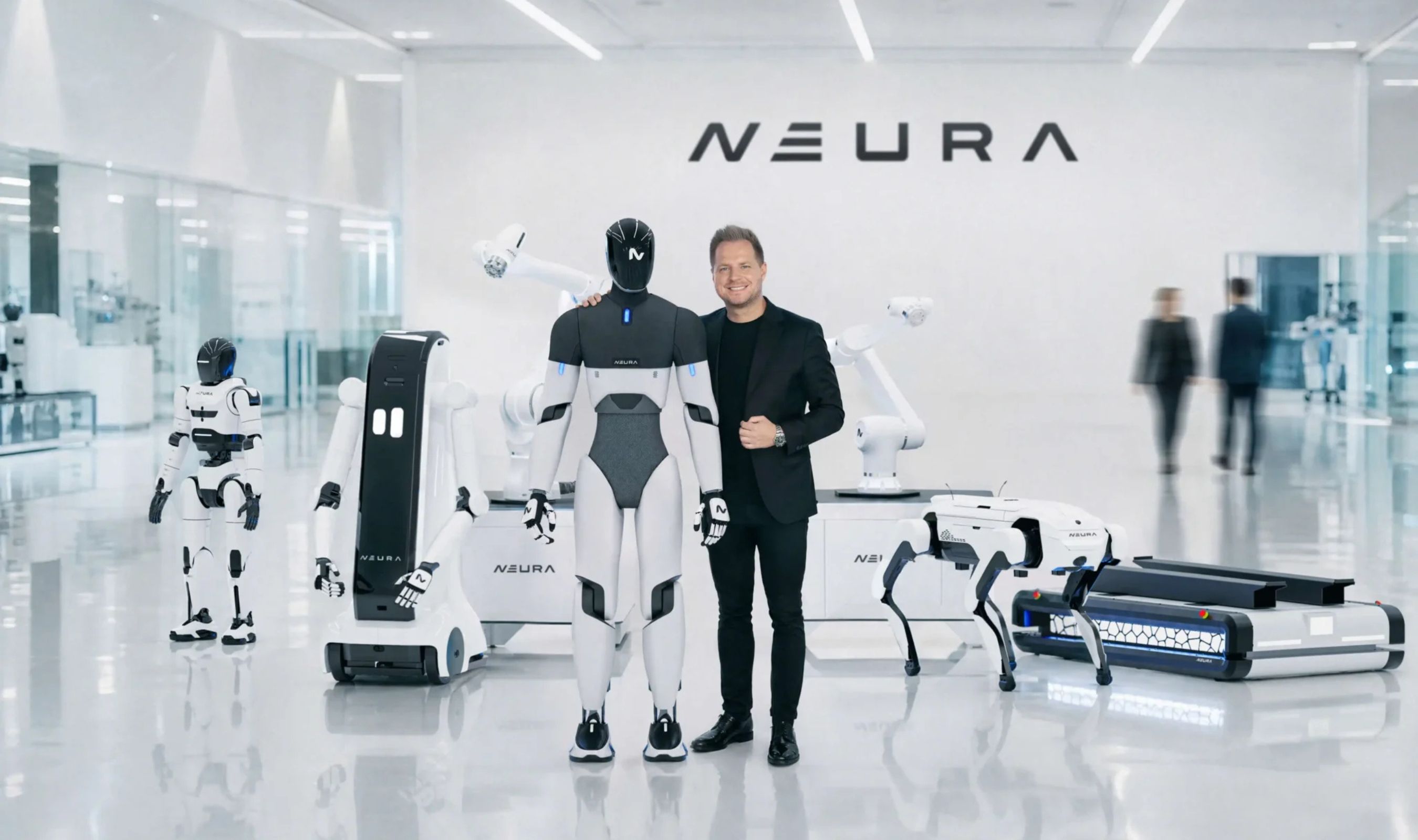
Stablecoin issuer Tether joined Nvidia, Amazon and Qualcomm in a up-to-$1.4 billion Series C round for German robotics startup Neura Robotics, marking the largest funding round ever for a full-stack robotics company. The round values Neura at around $7 billion, according to a source familiar with the matter who asked not to be named because the information wasn't public. The full amount is contingent on Neura hitting performance milestones, the source added.
Tether Holdings, the entity behind USDT, the world's largest stablecoin, is the outlier on an investor list that also includes European industrial giants Bosch and Schaeffler, the European Investment Bank, Lingotto Horizon, InterAlpen Partners and imec.xpand. Neura was founded in 2019. The company plans to use the capital to scale mass production to millions of robots by 2030, expand global deployment of its cognitive robots and humanoids, and speed up rollout of NEURA Gyms, real-world training facilities where robots learn through physical interaction, simulation and multimodal AI systems.
Neura's current order backlog and deployment pipeline already exceed $1 billion.
"The future of AI will not only live on screens," founder and CEO David Reger said in a statement. "It will move, interact, learn and work beside us in the real world."
Neura is building what it calls the Neuraverse, a shared software ecosystem that lets robots exchange skills, operational data and learned capabilities across different deployments. The company also announced a strategic partnership with Amazon Web Services in April 2026 aimed at scaling that platform globally.
The robotics sector is on a fundraising tear. Robotics companies have raised $55.8 billion so far in 2026, according to Dealroom, a record nearly double the previous annual record, with most capital flowing to U.S. and Chinese firms.
"Many believed globally relevant AI infrastructure companies could only emerge from Silicon Valley," Reger said. "We believe the next generation of AI leaders can emerge anywhere in the world where there is enough vision, engineering talent and execution speed."
Neura raised just $55 million in 2023. The jump to a billion-dollar round in three years reflects how quickly investor appetite for physical AI, AI systems that operate in the real world rather than on screens, has accelerated.
Reger framed the round as an endorsement of Europe's ability to compete in humanoid robotics alongside U.S. and Chinese players.
"With this financing, Neura is firmly among the global leaders in the robotics race, alongside the best in the US and China," he said.