
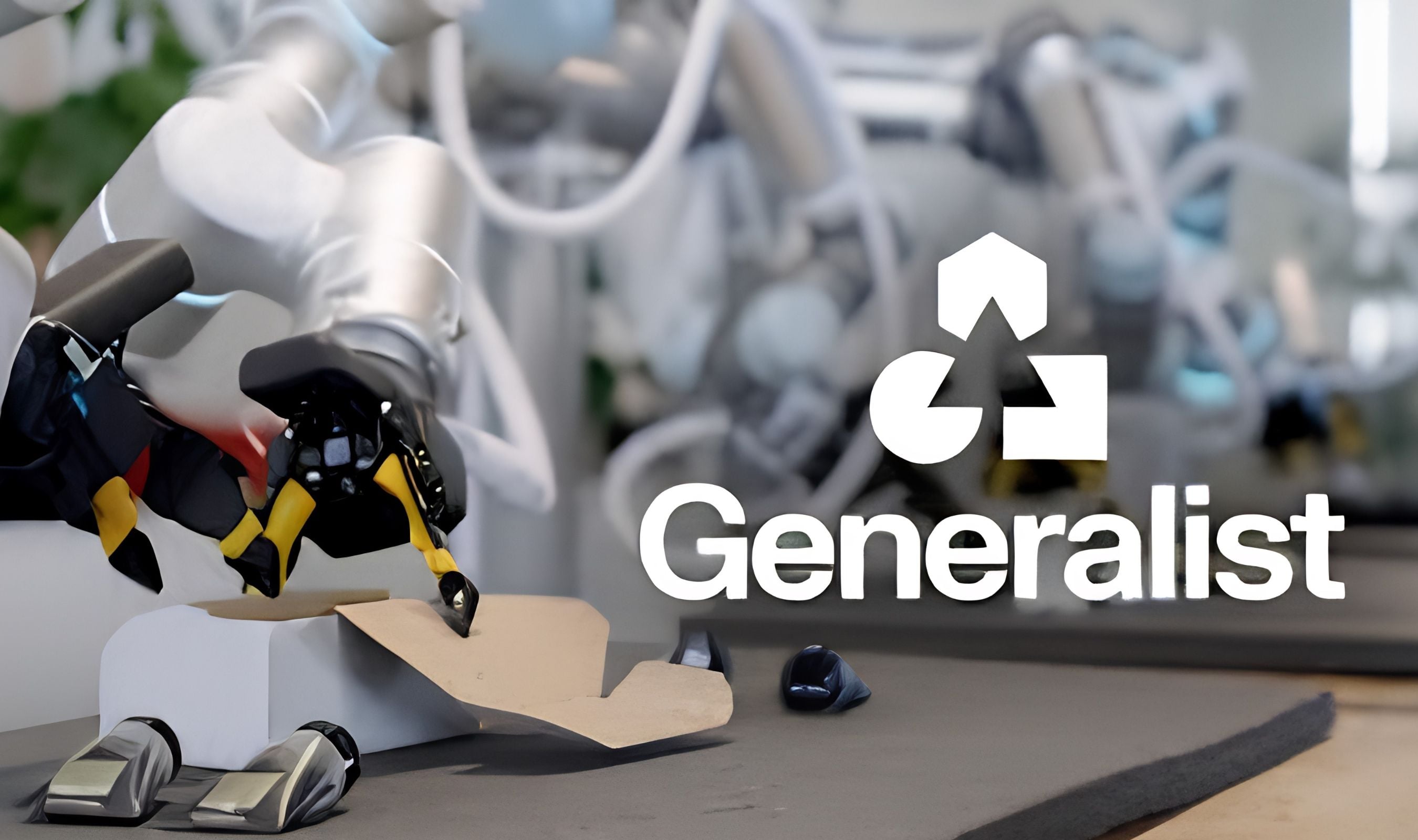
Robotics startup Generalist AI hit a $2 billion valuation Thursday after closing a $400 million funding round backed by Nvidia's NVentures, Jeff Bezos, and AI pioneer Fei-Fei Li, signaling that the industry's future belongs to general-purpose brain architectures rather than robot-specific software. The round was led by Radical Ventures with participation from 8VC, Union Square Ventures, Hanabi Capital, and Norwest. Zoom CEO Eric Yuan, Xiaomi co-founder Bin Lin, and entrepreneur Naval Ravikant also joined as angel investors, according to the company.
Generalist is building foundation models designed to work across any robotic system, humanoids, warehouse machines, industrial arms, autonomous platforms. The company argues that the intelligence layer matters more than the hardware.
"The future of robotics is bigger than any single robot," the company wrote in a blog post. "Whether it's a humanoid in the home, a robotic arm on a factory floor, a mobile robot in a warehouse, or an autonomous system in space, the vital technology will be the intelligence that works across form factors, environments, and applications."
Founded in 2024 by former DeepMind scientists Pete Florence and Andy Zeng alongside ex-Boston Dynamics roboticist Andrew Barry, Generalist has already shipped two model generations. GEN-0 launched last November and demonstrated that larger models trained on more real-world data produced more capable robotic systems, scaling laws for physical AI.
GEN-1 followed in April, running three times faster than comparable state-of-the-art models with 99% reliability across diverse tasks, the company said. The new capital will fund larger models, expanded real-world data collection, more compute infrastructure, and commercial deployments. Generalist framed the strategy as a self-reinforcing loop: better models do more useful physical work, and data from real businesses fuels the next generation.
"Scaling robot learning creates better models, better models can do more useful physical work, and data from real businesses drives the next generation of more capable models," the company said in a statement.
Generalist's approach stands apart from competitors like Physical Intelligence, whose pi-0 model GEN-1 reportedly exceeded on task speed. Rather than optimizing for a single robot or task, Generalist builds adaptive AI that can handle real-world unpredictability, a box that doesn't sit right, a shirt that folds differently, lighting that shifts. A human adjusts and retries. Most robots fail.
Generalist's models learn from the failure and adapt.
Nvidia's continued backing is telling. The chipmaker has called robotics the next trillion-dollar industry and its three-computer platform, training, simulation, and deployment, positions it as the infrastructure layer for companies like Generalist. The startup's $2 billion valuation reflects investor conviction that physical AGI will emerge from general models trained on physical experience, not from specialized code written for individual machines.