
Qualcomm just declared war on Nvidia's data center monopoly. And it brought receipts. The smartphone chip giant told investors Wednesday it's targeting $15 billion in data center revenue by 2029, backed by a full-stack assault that includes a custom CPU, AI accelerators, new memory technology, and a software acquisition designed to crack Nvidia's CUDA lock-in.
Qualcomm shares jumped 15% in extended trading. Arm, which provides underlying technology for many Qualcomm chips, rose 5%.
Qualcomm unveiled three new data center products at its investor event. The Dragonfly C1000 CPU uses custom Oryon cores in a 250-plus core chiplet design, delivering 2x better performance per watt versus existing server CPUs, according to the company. Commercial availability is set for 2028.
Meta has already signed a multi-year, multi-generation agreement to deploy the Dragonfly C1000 in its next-generation server fleet. The Dragonfly AI300 inference accelerator follows the AI200 and AI250 chips Qualcomm launched in October 2025. It offers 4x-8x better performance per watt compared to existing GPU architectures, Qualcomm claims, and can scale using UALink and Ethernet. Commercial sampling begins in 2028.
Qualcomm also introduced High Bandwidth Compute (HBC), a 3D-stacked near-memory architecture designed to replace traditional HBM. The AI250 with HBC Gen 1 delivers 133 TB/s per card, an 18x memory bandwidth increase over the prior generation, with commercial sampling expected in mid-2027.
Nvidia's dominance isn't just about hardware. Its CUDA software platform locks developers into the Nvidia ecosystem, creating a moat that competitors have struggled to cross for years.
Qualcomm's answer: acquire Modular, the company behind an open, AI-native software stack that lets models run across CPU, GPU, NPU, and custom ASIC hardware without rewriting code. More critically, Qualcomm said the acquisition lets it run software built on CUDA on its own hardware.
"This is how we open up the industry and deliver greater value by building bridges rather than building moats around our solutions," Tony Pialis, Qualcomm's EVP and GM of data center, told Yahoo Finance.
Modular was founded by Chris Lattner, the creator of the Swift programming language. The deal is expected to close in the second half of 2026.
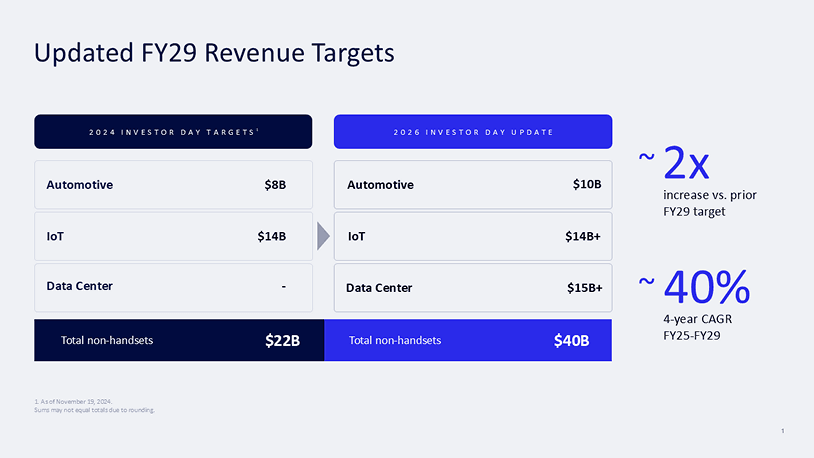
Qualcomm CFO Akash Palkhiwala guided to $5 billion in data center revenue for fiscal 2027, scaling to $15 billion by 2029. The company also raised its non-handset chip revenue target to $40 billion by 2029, nearly double its prior $22 billion forecast. "We will be truly diversified," Palkhiwala said.
CEO Cristiano Amon said Qualcomm has been "collecting assets" and now has a " portfolio to enter the next phase of the data center." Microsoft and Meta are already using Qualcomm's new AI chips. Two other unnamed hyperscalers have signed custom chip deals. Bank of America had estimated Qualcomm's data center push would generate roughly $2 billion to $5 billion annually by fiscal 2027-2028. Qualcomm's new target signals a far more aggressive trajectory. The timing is strategic.
Qualcomm's smartphone business faces pressure from Apple and Samsung building more chips in-house, plus a memory chip shortage driven by AI infrastructure demand. The data center pivot turns those headwinds into an opportunity.