
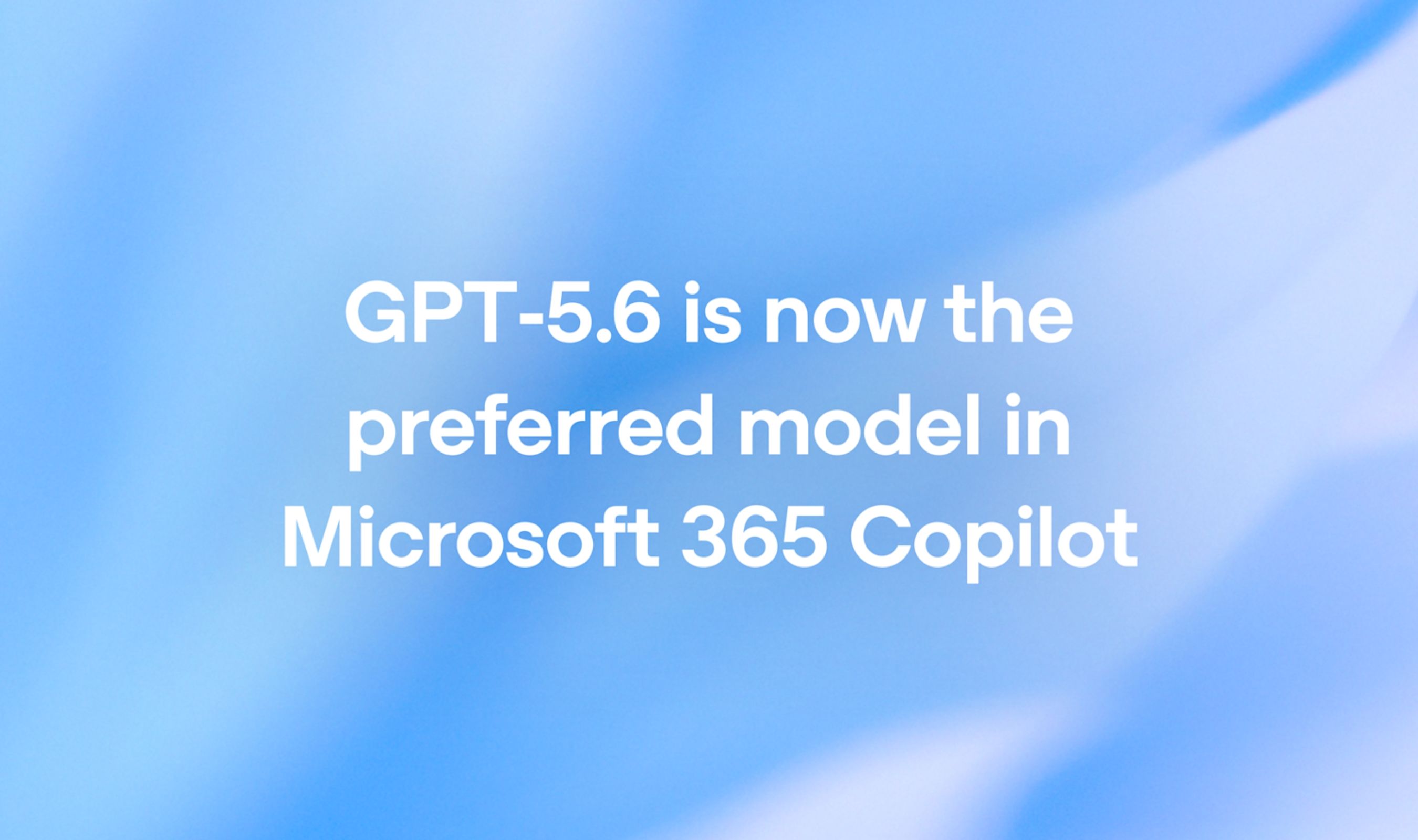
GPT 5.6 is the "preferred model" for Microsoft 365 Copilot, OpenAI announced Thursday alongside the model's launch, a label that reads more like narrative control than a technical distinction. The designation covers Word, Excel, PowerPoint, and Cowork, the productivity suite where hundreds of millions of Microsoft users interact with AI. It lands days after Bloomberg reported that Microsoft had begun swapping in its own in-house MAI models to power parts of those same apps, part of a cost-cutting effort.
OpenAI never claims the new status contradicts that reporting, because it doesn't have to. Microsoft's MAI push and OpenAI's "preferred model" badge can coexist.
Bloomberg never reported that OpenAI's software would stop powering Microsoft's apps, only that Microsoft was leaning more on MAI where the economics favored it.
"Our partnership with Microsoft has always been about bringing the benefits of advanced AI to more individuals and organizations, and we're excited to continue building on that shared commitment," OpenAI wrote in a blog post.
What "preferred model" means operationally remains undefined. The label leaves room for Microsoft to route different Copilot workloads to different backends depending on cost, latency, or capability.
It is a marketing frame more than a technical one, and OpenAI did not disclose how traffic will be split between GPT 5.6 and MAI. The commercial stakes are clear. Microsoft 365 Copilot is one of the largest deployed AI products in the enterprise.
Being the default model there is worth substantial inference revenue to OpenAI at a moment when the company is spending heavily on compute and training. Losing default status on Word and Excel, even partially, to MAI, would compress one of OpenAI's most reliable revenue channels.
Thursday's announcement also coincided with the departure of Fidji Simo, OpenAI's applications chief, who stepped down citing chronic illness. The Copilot designation gives the GPT 5.6 launch a commercial anchor at a time when the executive team is in flux.
For Microsoft, the calculus is unchanged. The company has spent two years building MAI as an internal alternative, a hedge against pricing power, capacity constraints, and any scenario where OpenAI's roadmap diverges from Microsoft's product needs.
Nothing about Thursday's announcement changes that. Microsoft can call GPT 5.6 the preferred engine while continuing to route a growing share of low-margin Copilot queries to MAI, and both positions remain compatible.
Neither company has disclosed how much of Copilot's traffic actually flows through GPT 5.6 versus MAI in practice. That ambiguity serves both sides for now.