

Thursday brings a fresh set of NYT Pips puzzles. Today's grid offers a balanced challenge across all three difficulties with familiar zone constraints that reward methodical placement over brute force. We've got hints, step-by-step walkthroughs, and full solutions for Easy, Medium, and Hard difficulty levels.
How to Play Pips
Pips is a domino placement puzzle where you fill a grid of color-coded zones. Each zone has a condition you must satisfy using the pip values on your dominoes. The twist: you must use every domino and meet every condition to win.
Zone Conditions:
- = All pips in this zone must equal the same number
- Not Equal All pips must be different numbers
- > Pips must be greater than the listed number
- < Pips must be less than the listed number
- Exact Number Pips must total that exact value
- No Color Free space, any domino value works
Click or tap dominoes to rotate them. Each puzzle has one or more valid solutions.
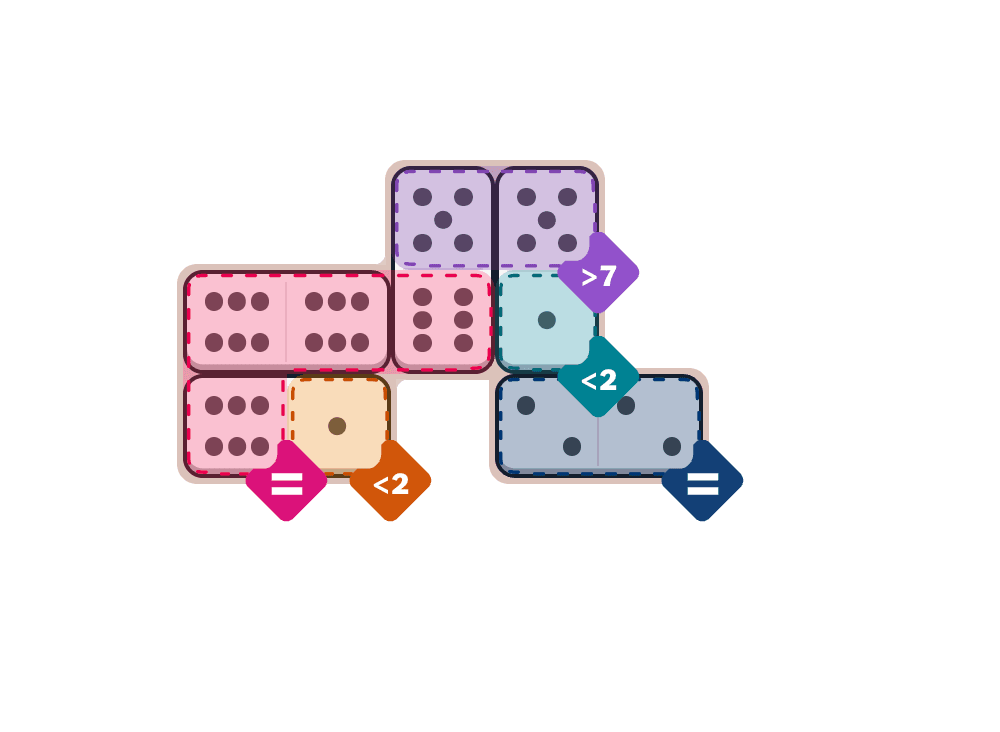
Today's Easy Pips
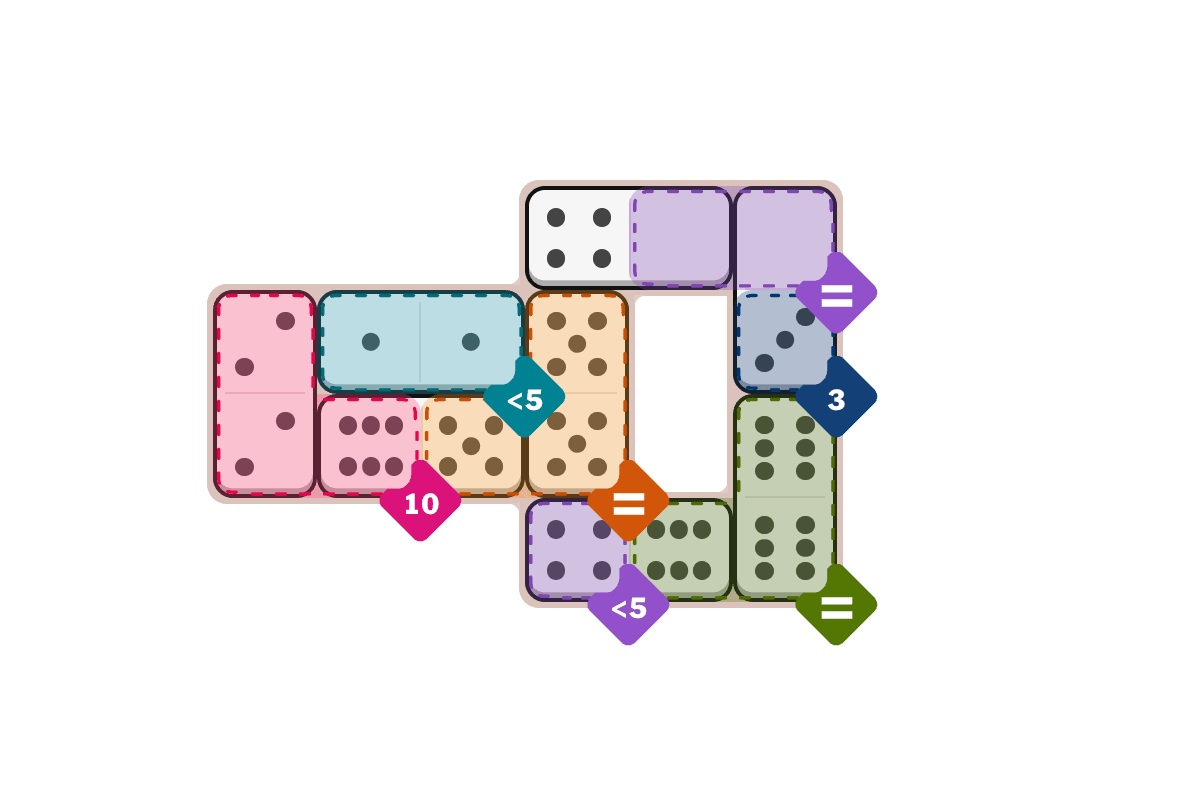
Today's Medium Pips
Today's Hard Pips
Quick Hints (No Spoilers)
Starting Point: Begin with the green (=) zone - it's the most restrictive. Only dominoes with matching pips can go there, and 4/4 is the only option that sets up the rest of the grid cleanly.
Key Insight: The navy (>10) zone acts as a pressure valve. You need a minimum of 11 across its two cells, which means at least one high pip (5 or 6) must land there. Track your running sums carefully.
Watch Out For: The teal (=) zone at the bottom-right is easy to overlook. It needs two matching pips, and the domino that satisfies it also must satisfy orange (6) on its other side. That dependency chain can trap you if you fill orange too early.
Step-by-Step Walkthrough
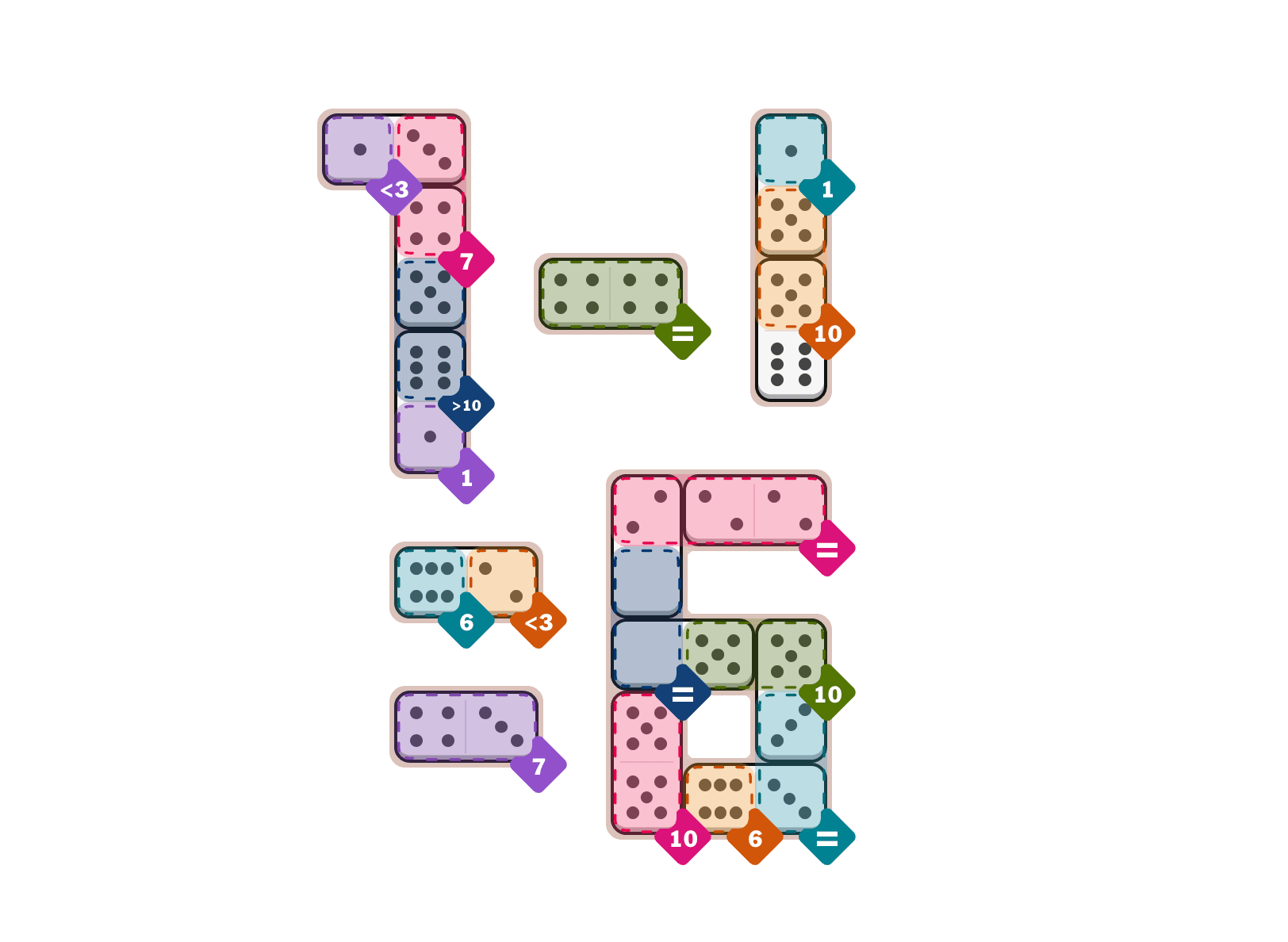
- 1.Identify all equal-value zones first: green (=), pink (=), navy (=), and teal (=). These are the most constrained. The green zone is the only one isolated by itself - place 4/4 horizontally there. This uses the only 4/4 domino and locks in the center of the grid.
- 2.Now examine the top-left area. Purple (<3) and pink (7) share a horizontal boundary. Purple only accepts pips 0, 1, or 2. Pink needs a total of exactly 7. Try 1/3 horizontally - the 1 satisfies purple's <3 condition, and 3 leaves pink needing 4 more from the domino below.
- 3.Below pink (7) sits navy (>10) in a vertical relationship. You placed 3 in pink, so you need a domino with a 4 on top (to bring pink to 7) and a high number on bottom (to push navy above 10). Place 4/5 vertically across pink and navy. Navy now has 5.
- 4.Below navy (>10) is purple (1) in a vertical line. Navy needs >10 total, so it needs at least 6 more. Purple (1) needs exactly 1. Place 6/1 vertically across navy and purple. Navy total = 5 + 6 = 11 (>10). Purple gets 1.
- 5.Move to the left column. Teal (1) and orange (10) share a vertical edge. Teal needs exactly 1. Orange needs 10. Place 1/5 vertically across both. Teal gets 1. Orange gets 5.
- 6.Below orange (10) is the uncolored zone. Orange needs 5 more to reach 10. Place 5/6 vertically across orange and uncolored. Orange total = 5 + 5 = 10.
- 7.Now the top-right area. Teal (6) and orange (<3) share a horizontal edge. Teal needs exactly 6. Orange needs less than 3. Place 6/2 horizontally across both. Teal gets 6. Orange gets 2.
- 8.The remaining purple (7) zone sits alone. It needs exactly 7. Place 4/3 horizontally.
- 9.Pink (=) and navy (=) share a vertical edge. Both need equal pips. Place 2/0 vertically. Pink gets 2. Navy gets 0.
- 10.Pink (=) needs another cell with value 2. Place 2/2 horizontally in the pink (=) zone.
- 11.Navy (=) and green (10) share a horizontal edge. Navy needs another 0. Green needs 10 total (currently has 4 from the 4/4). Place 0/5 horizontally. Navy gets 0 (matching). Green adds 5, total = 9.
- 12.Pink (10) needs exactly 10. Place 5/5 vertically.
- 13.Green (10) and teal (=) share a vertical edge. Place the 5/3 vertically across green (10) and teal (=), with the 5 in green and the 3 in teal, exactly as the official solution shows.
- 14.Place the 6/3 horizontally across orange (6) and teal (=) as shown in the official solution, then run a final pass over each zone to confirm every condition before locking in your board.
Hard Pips Solution
Last chance to solve independently
---
---
---
---
---
- 1.Place the 1/3 domino horizontally in the purple (<3) zone and pink (7) zone
- 2.Place the 4/5 domino vertically in the pink (7) zone and navy (>10) zone
- 3.Place the 6/1 domino vertically in the navy (>10) zone and purple (1) zone
- 4.Place the 4/4 domino horizontally in the green (=) zone
- 5.Place the 1/5 domino vertically in the teal (1) zone and orange (10) zone
- 6.Place the 5/6 domino vertically in the orange (10) zone and uncolored (no condition) zone
- 7.Place the 6/2 domino horizontally in the teal (6) zone and orange (<3) zone
- 8.Place the 4/3 domino horizontally in the purple (7) zone
- 9.Place the 2/0 domino vertically in the pink (=) zone and navy (=) zone
- 10.Place the 2/2 domino horizontally in the pink (=) zone
- 11.Place the 0/5 domino horizontally in the navy (=) zone and green (10) zone
- 12.Place the 5/5 domino vertically in the pink (10) zone
- 13.Place the 5/3 domino vertically in the green (10) zone and teal (=) zone
- 14.Place the 6/3 domino horizontally in the orange (6) zone and teal (=) zone
Puzzle Debrief
Overall Difficulty: Moderate challenge across the board. All three difficulty levels share the same zone layout, so the difference comes down to pacing and the number of constraints you need to juggle simultaneously.
Trickiest Puzzle: Hard - The equal-value zones (green, pink, navy, teal) create multiple dependency chains. Misplace one domino and the cascading failures are hard to unwind. The teal (=) zone is especially punishing because it sits at the intersection of two different sum requirements.
Our Take: Today's set rewards players who read the zone map before placing a single domino. The identical grid across all three difficulties is unusual - it means Easy, Medium, and Hard are really about how much guidance you want versus how much you want to figure out on your own. Smart design from the Pips team.
Tomorrow's Pips drops at midnight. See you then.