

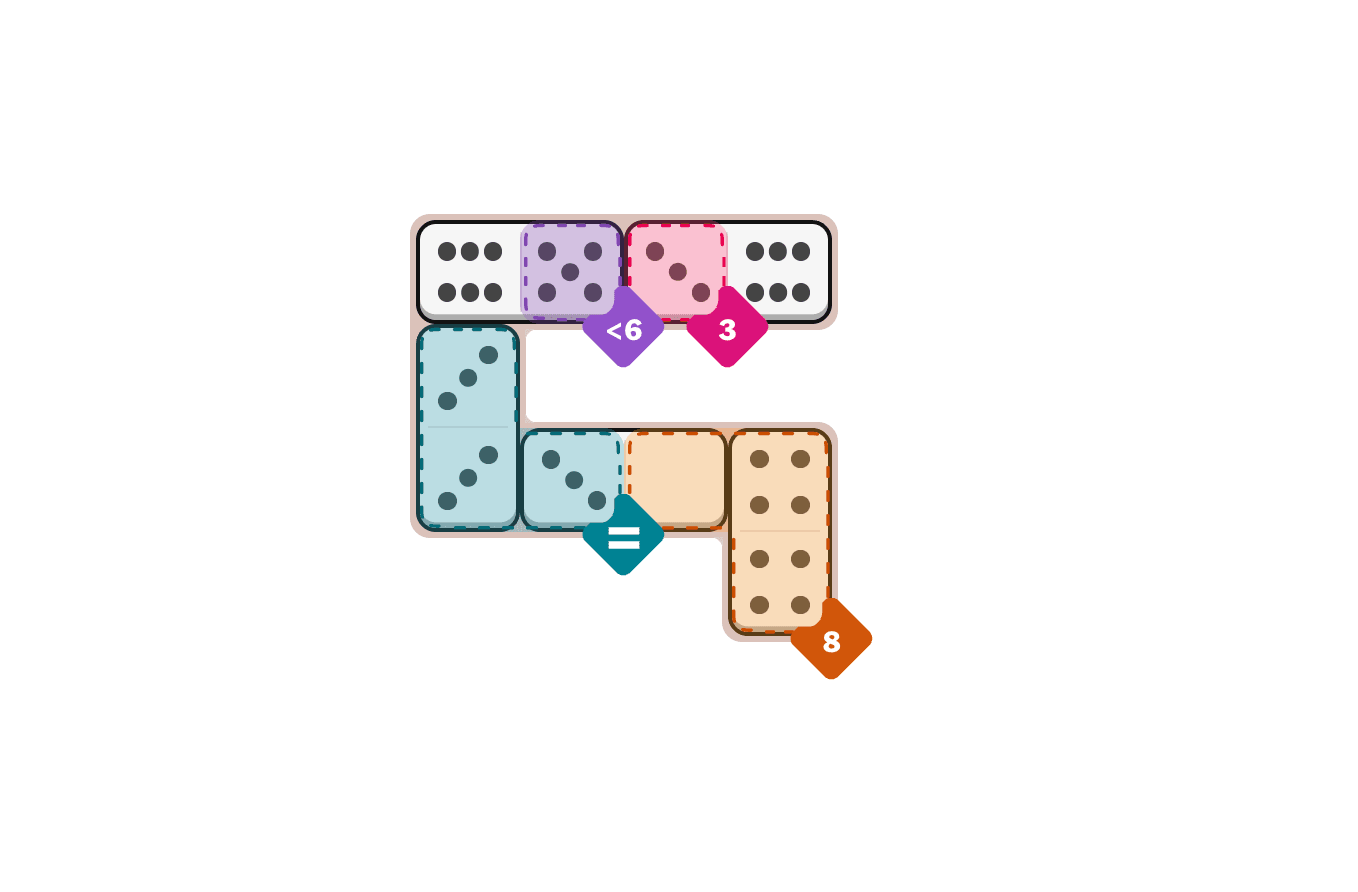
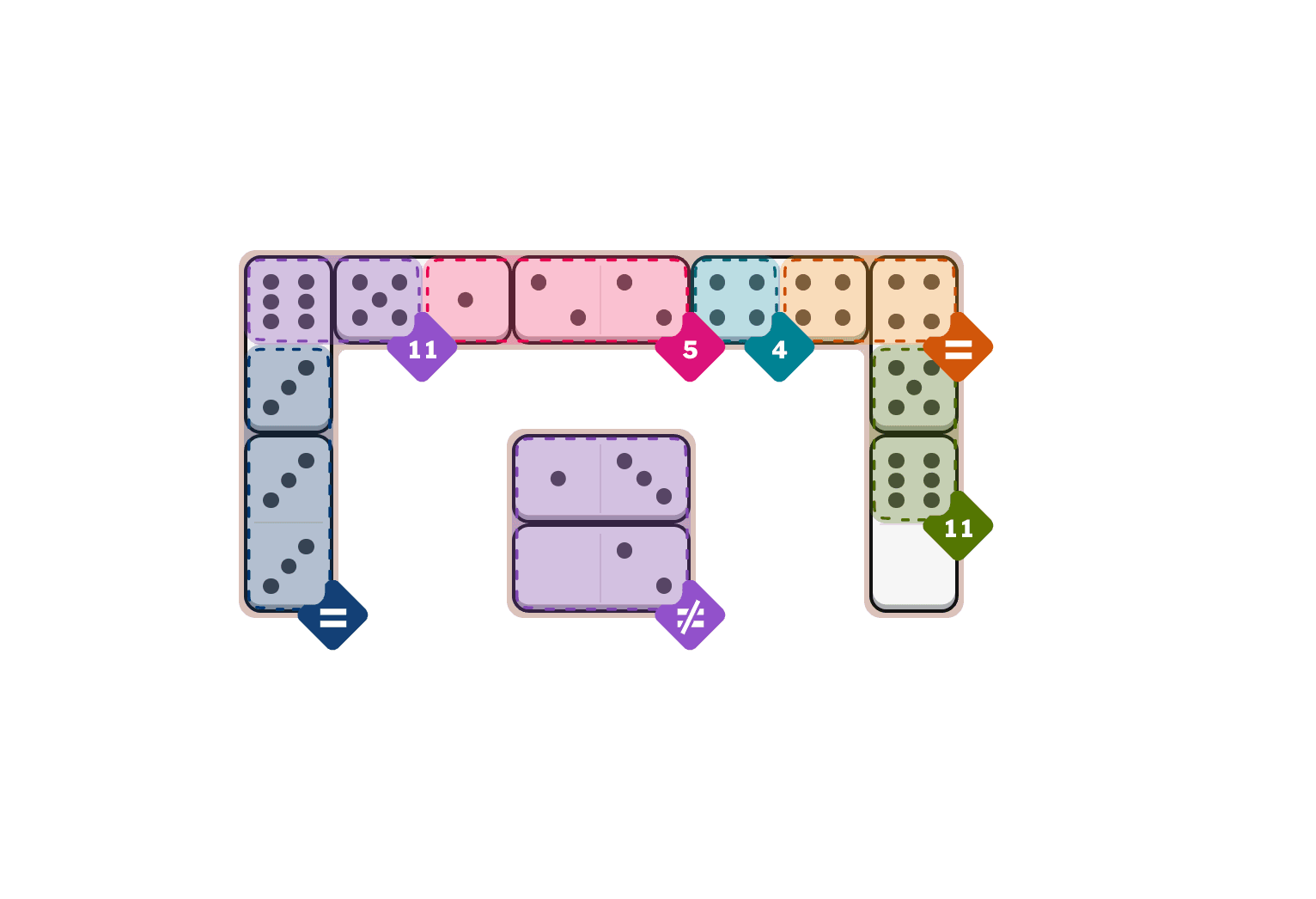
Thursday brings a fresh set of NYT Pips puzzles with a dense layout of exact-value zones that demand disciplined number-crunching. The board is packed with 11-sum, 1-sum, and 4-sum conditions across purple, teal, navy, green, and orange zones, plus a pink equal-sign zone that rewards careful domino conservation. We've got hints, step-by-step walkthroughs, and full solutions for Easy, Medium, and Hard difficulty levels.
How to Play Pips
Pips is a domino placement puzzle where you fill a grid of color-coded zones. Each zone has a condition you must satisfy using the pip values on your dominoes. The twist: you must use every domino and meet every condition to win.
Zone Conditions:
- = All pips in this zone must equal the same number
- Not Equal All pips must be different numbers
- > Pips must be greater than the listed number
- < Pips must be less than the listed number
- Exact Number Pips must total that exact value
- No Color Free space, any domino value works
Click or tap dominoes to rotate them. Each puzzle has one or more valid solutions.
Today's Easy Pips
Today's Medium Pips
Today's Hard Pips
Quick Hints (No Spoilers)
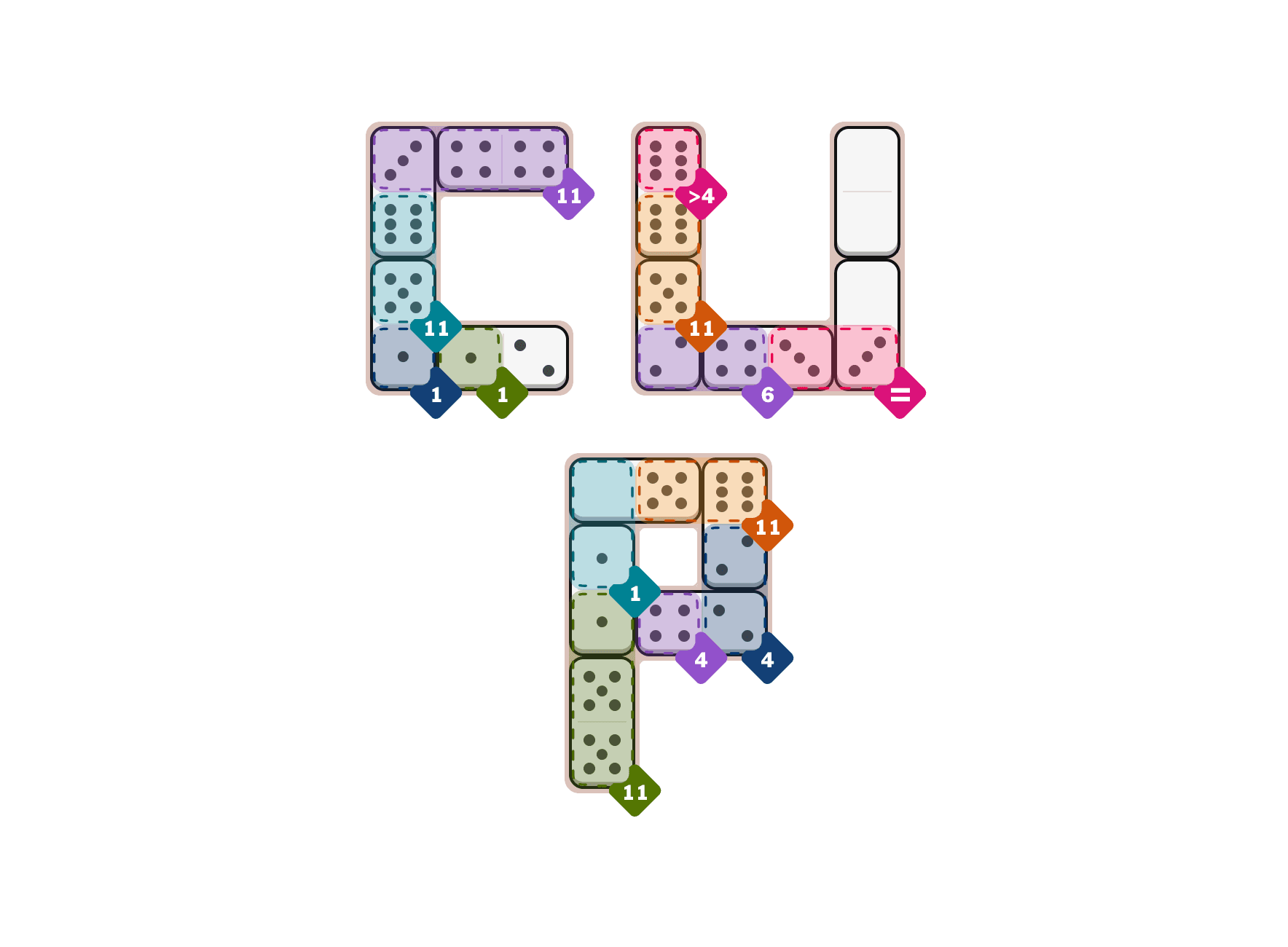
Starting Point: The pink (>4) zone is the most restrictive condition. The 6/6 domino is forced here - no other piece guarantees both halves above 4. Place it first and work outward from this anchor point.
Key Insight: The pink (=) equal-sign zone depends entirely on the 4/3 and 0/3 dominoes crossing into it from adjacent zones. Both must deliver the same value (3) for the condition to hold. If you place either domino incorrectly, the pink (=) zone breaks and forces a full restart.
Watch Out For: The teal (1) zone is a trap. It receives a 0 from the 0/5 domino before getting a 1 from the 1/1 domino. If you place the 1/1 domino elsewhere thinking teal (1) is already satisfied, you'll run out of board space. Also, the purple (6) zone shares dominoes with the pink (=) zone through the 4/3 domino - if you misplace that piece, both zones fail simultaneously.
Step-by-Step Walkthrough
- 1.Place the 6/6 domino vertically in the pink (>4) zone and the first orange (11) zone. This is the only forced placement on the board - no other domino can satisfy pink's greater-than-4 condition. The 6 also starts the orange 11 sum.
- 2.Place the 3/6 domino vertically across the purple (11) zone and teal (11) zone. The 3 goes to purple and the 6 to teal. Both zones need 11 total, so distributing the 3/6 split is efficient.
- 3.Place the 4/4 domino horizontally in the purple (11) zone. Purple now totals 3 + 4 + 4 = 11. This zone is satisfied early, freeing up mental bandwidth for the remaining constraints.
- 4.Place the 5/1 domino vertically across the teal (11) zone and navy (1) zone. Teal gets 5, reaching 6 + 5 = 11. Navy gets exactly 1, satisfying its exact-1 condition.
- 5.Place the 5/2 domino vertically across the first orange (11) zone and purple (6) zone. Orange A gets 5, reaching 6 + 5 = 11. Purple (6) gets 2 as its first pip.
- 6.Place the 1/2 domino horizontally across the green (1) zone and an uncolored zone. The 1 satisfies green's exact-1 condition. The 2 goes into free space with no restrictions.
- 7.Place the 4/3 domino horizontally across the purple (6) zone and pink (=) zone. Purple (6) gets 4, reaching 2 + 4 = 6. This is the critical moment - the 3 entering pink (=) establishes the value that all pips in this zone must match.
- 8.Place the 0/3 domino vertically across an uncolored zone and the pink (=) zone. The second 3 enters pink (=), matching the first. The equal-sign condition is now satisfied with all pips at 3.
- 9.Place the 0/0 domino vertically in an uncolored zone. Free space filled with no conditions to manage.
- 10.Place the 0/5 domino horizontally across the teal (1) zone and second orange (11) zone. The 0 goes to teal (1) - don't panic, the 1 is coming. The 5 goes to orange B.
- 11.Place the 6/2 domino vertically across the second orange (11) zone and navy (4) zone. Orange B gets 6, reaching 5 + 6 = 11. Navy (4) gets 2 as its first pip.
- 12.Place the 1/1 domino vertically across the teal (1) zone and green (11) zone. Teal (1) gets 1, reaching 0 + 1 = 1. Green (11) gets 1 toward its 11 target.
- 13.Place the 4/2 domino horizontally across the purple (4) zone and navy (4) zone. Purple (4) gets 4, satisfying its exact-4 condition. Navy (4) gets 2, reaching 2 + 2 = 4.
- 14.Place the 5/5 domino vertically in the green (11) zone. Green gets 5 + 5 = 10, plus the 1 from step 12, totaling 11. All zones satisfied.
Hard Pips Solution
Last chance to solve independently
---
---
---
---
---
- 1.Place the 3/6 domino vertically in the purple (11) zone and teal (11) zone
- 2.Place the 4/4 domino horizontally in the purple (11) zone
- 3.Place the 5/1 domino vertically in the teal (11) zone and navy (1) zone
- 4.Place the 1/2 domino horizontally in the green (1) zone and uncolored (no condition) zone
- 5.Place the 6/6 domino vertically in the pink (>4) zone and orange (11) zone
- 6.Place the 5/2 domino vertically in the orange (11) zone and purple (6) zone
- 7.Place the 4/3 domino horizontally in the purple (6) zone and pink (=) zone
- 8.Place the 0/3 domino vertically in the uncolored (no condition) zone and pink (=) zone
- 9.Place the 0/0 domino vertically in the uncolored (no condition) zone
- 10.Place the 0/5 domino horizontally in the teal (1) zone and orange (11) zone
- 11.Place the 6/2 domino vertically in the orange (11) zone and navy (4) zone
- 12.Place the 1/1 domino vertically in the teal (1) zone and green (11) zone
- 13.Place the 4/2 domino horizontally in the purple (4) zone and navy (4) zone
- 14.Place the 5/5 domino vertically in the green (11) zone
Puzzle Debrief
Overall Difficulty: Moderate challenge. The zone layout is identical across all three levels, which is unusual for Pips. The difficulty comes from the sheer number of exact-value constraints - five zones demand precise sums of 11, three zones require exact sums of 1, and two zones need exact sums of 4.
Trickiest Puzzle: Hard - The cascade of exact-value zones creates a tight constraint web. The teal (1) zone is the most deceptive: it receives a 0 before it receives a 1, which can easily trick players into thinking they've misallocated their dominoes. The pink (=) equal-sign zone is also unforgiving - the 4/3 and 0/3 dominoes must both deliver 3s, and misplacing either one breaks both the pink (=) zone and the adjacent purple (6) zone simultaneously.
Our Take: Thursday's set is a pure constraint-satisfaction exercise. There's no room for creative placement - the exact-value zones dictate most of the board, and the equal-sign zone fills in the gaps. The identical zone layout across all three difficulties means you're learning the same topology three times, which is a great way to internalize Pips strategy. Start with the pink (>4) zone, work through the exact-value zones in order of tightness, and let the equal-sign zone resolve last. Tomorrow's Pips drops at midnight. See you then.