
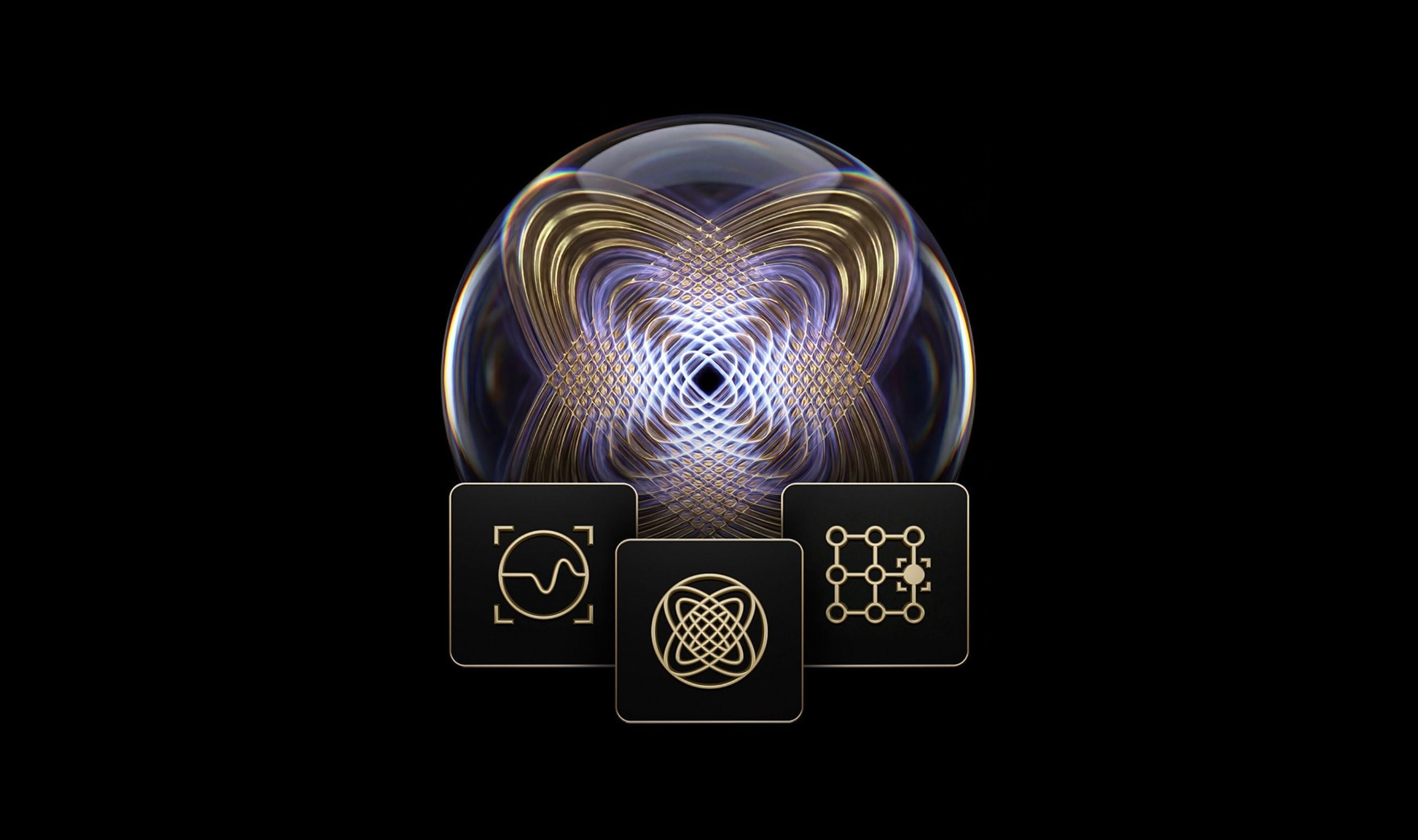
AI now serves as the operating system for quantum computers with NVIDIA's launch of its Ising model family today. The open source quantum AI tools deliver up to 2.5 times faster performance and three times higher accuracy for error correction compared to traditional methods.
Named after a landmark mathematical model that simplified complex physical systems, NVIDIA Ising provides scalable AI tools for quantum error correction and calibration. These represent two critical challenges in building hybrid quantum-classical systems that can run practical applications.
"AI is essential to making quantum computing practical," said Jensen Huang, founder and CEO of NVIDIA. "With Ising, AI becomes the control plane, the operating system of quantum machines, transforming fragile qubits to scalable and reliable quantum-GPU systems."
The model family includes two specialized components designed for different aspects of quantum processor management. Ising Calibration uses a vision language model that interprets measurements from quantum processors, enabling AI agents to automate continuous calibration workflows that previously took days down to hours.
Ising Decoding features two variants of a 3D convolutional neural network optimized for either speed or accuracy. Both versions perform real-time decoding for quantum error correction, outperforming pyMatching, the current open source industry standard.
Major research institutions have already adopted the technology across both calibration and decoding applications. Early users include Academia Sinica, Fermi National Accelerator Laboratory, Harvard's John A. Paulson School of Engineering and Applied Sciences, Infleqtion, IQM Quantum Computers, Lawrence Berkeley National Laboratory's Advanced Quantum Testbed and the U.K. National Physical Laboratory.
On the decoding side, deployment extends to Cornell University, EdenCode, Sandia National Laboratories, SEEQC, University of California San Diego, UC Santa Barbara, University of Chicago and University of Southern California among others.
NVIDIA provides developers with a cookbook of quantum computing workflows alongside training data and NIM microservices for fine-tuning models to specific hardware architectures with minimal setup requirements. The models can run locally on researchers' systems to protect proprietary data while maintaining performance advantages.
The company integrates Ising with its existing CUDA-Q software platform for hybrid quantum-classical computing and NVQLink QPU-GPU hardware interconnect for real-time control operations. This creates a complete toolset for converting today's experimental qubits into tomorrow's accelerated quantum supercomputers.
Quantum computing faces significant engineering challenges around error correction and scalability that must be solved before reaching commercial viability. Analyst firm Resonance projects the market will surpass $11 billion by 2030 if these technical hurdles can be overcome through continued innovation like NVIDIA's AI-driven approach.
Ising joins NVIDIA's expanding portfolio of open models that includes Nemotron for agentic systems, Cosmos for physical AI simulation, Alpamayo for autonomous vehicles development, Isaac GR00T for robotics training and BioNeMo for biomedical research applications.