
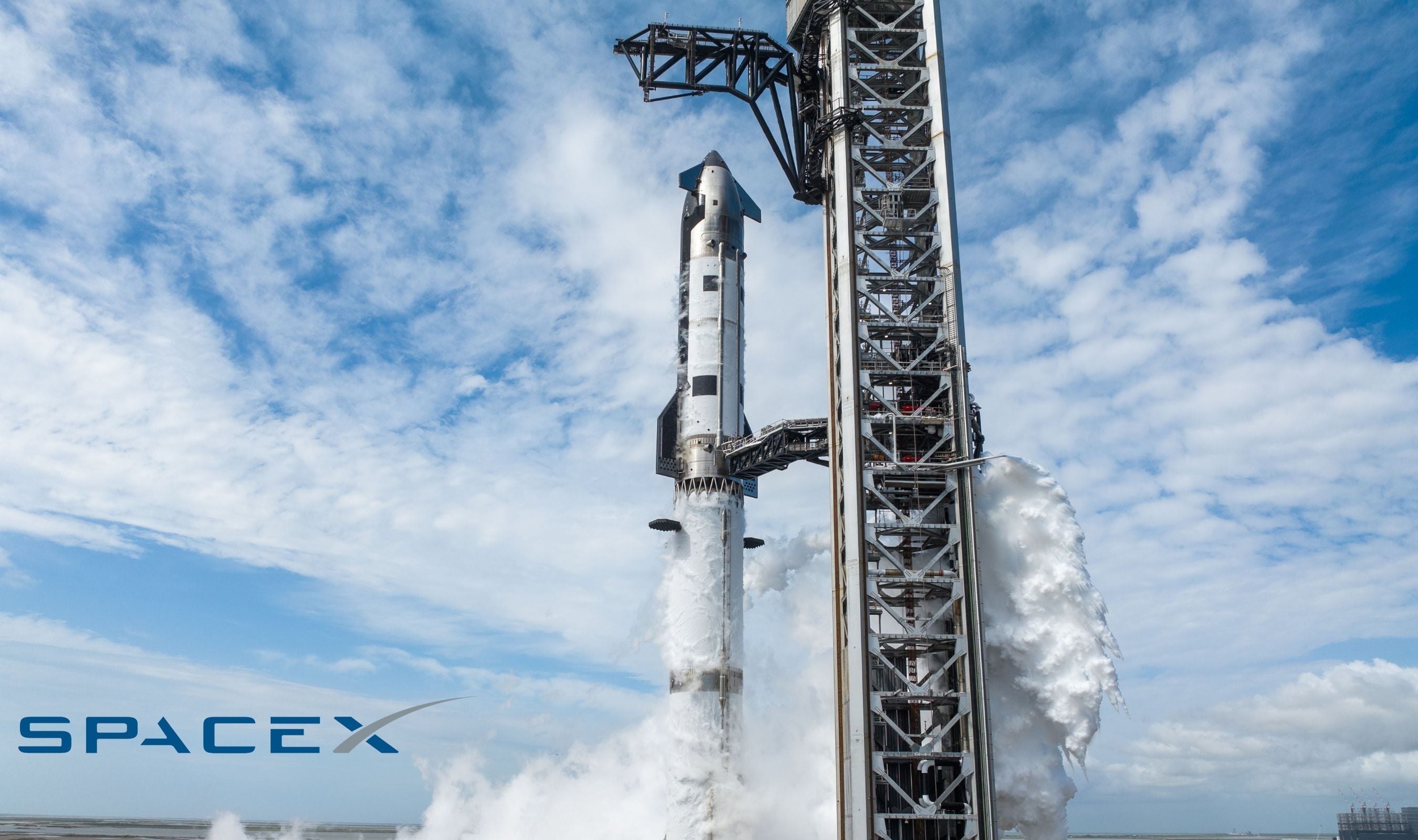
Morgan Stanley analyst Adam Jonas published a $300 price target on SpaceX Tuesday that values the company less on Starship launches and more on a business that barely exists: orbital AI compute. The call, the most bullish on Wall Street for Elon Musk's rocket company, landed the same week SpaceX joins the Nasdaq 100 index. Jonas's base case implies 87% upside from Monday's close near $160, with a bull scenario reaching $600 and a bear floor at $75.
Jonas titled his initiation note "AI's Final Frontier." The framing is deliberate. He argues SpaceX has built what he calls "one infrastructure stack" combining launch, satellite connectivity, and AI data centers on Earth and eventually in orbit.
The 87-page thesis breaks SpaceX into four segments: Starship launch, Starlink connectivity, terrestrial AI data centers, and enterprise AI services. Each feeds the others.
Starship remains the linchpin. Jonas expects the rocket to become operational in the fourth quarter of 2026, with launch costs dropping from roughly $500 per kilogram by 2030 to under $150 by 2040. The model assumes Starship launches scale from 46 in 2027 to more than 6,000 annually by 2040, with 75% to over 90% of those flights serving internal needs like deploying Starlink V3 satellites and orbital compute hardware.
Jonas sees Starlink evolving into the default connectivity layer for any device beyond terrestrial network range. Revenue from the satellite business is modeled to climb from $11.4 billion in 2025 to $120.6 billion by 2030 and $687.7 billion by 2040, driven by international broadband and Starlink-connected robots. The most provocative piece of the thesis centers on SpaceXAI, the company's data center and AI infrastructure arm.
Jonas estimates SpaceX's cost per watt at half the industry average, excluding chips, with deployment speeds six to eight times faster than competitors. That advantage comes from vertical integration through Terafab (chip manufacturing) and Solarfab (solar equipment).
Morgan Stanley sees SpaceXAI revenue hitting roughly $22 billion in 2026 and $190 billion by 2030, driven by neocloud rental deals with Anthropic and Google. The analysts note the $60 billion Cursor acquisition, which carries $4 billion in annual recurring revenue, as an asset the market has yet to fully price.
The long-term bet is orbital compute. Jonas models three generations of AI satellites, with orbital deployments beginning in 2028 at 160 megawatts and reaching 364 gigawatts by 2040.
He argues orbital compute could reach cost parity with terrestrial data centers by 2031, making space-based AI processing economically viable at scale. The model assumes SpaceX revenue climbs from $45 billion this year to $319 billion in 2030 and $3.3 trillion by 2040, with operating margins approaching 59%. Jonas concedes the price target depends on SpaceX inventing entirely new markets for connectivity and physical AI services that do not exist today.
His intentionally wide valuation range reflects that uncertainty.
"The $600 bull case assumes faster execution across Starship, orbital compute, and Terafab, with AI more than 60% of valuation," Jonas wrote.
Goldman Sachs and Citigroup also initiated coverage this week, with $205 and $200 targets respectively, but none matched Morgan Stanley's conviction. SpaceX shares traded at $151.90 Tuesday afternoon, down 5.3% on the day, as investors digested the Nasdaq 100 inclusion and a wave of fresh analyst coverage.