
Intel will play an unspecified role in Elon Musk's ambitious Terafab semiconductor project, despite initial appearances that Tesla would build its own fabrication facility from scratch. The chipmaker announced its participation in the $20-25 billion venture on Tuesday through a post on X.com, Musk's social media platform.
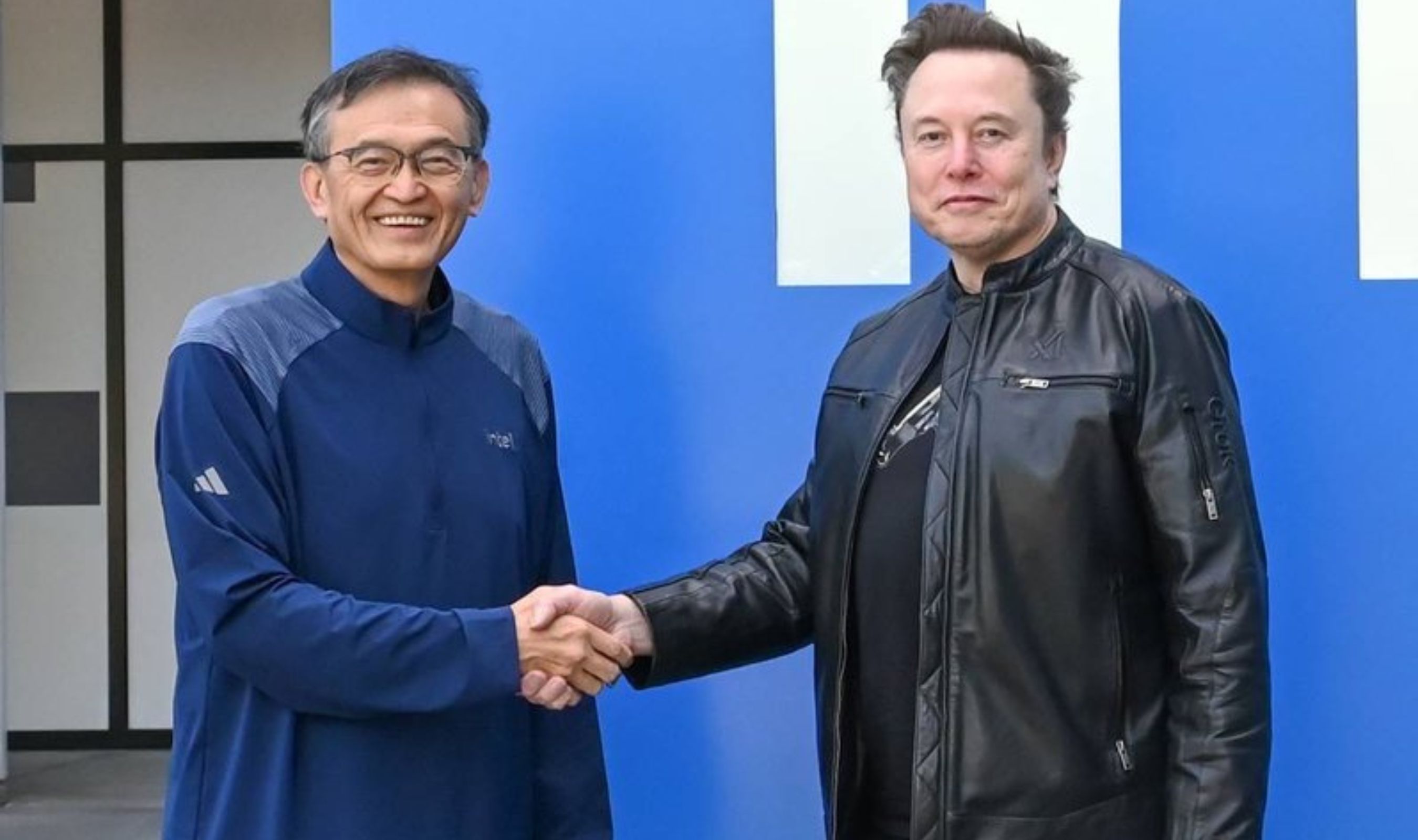
Intel shared a photograph showing Musk meeting with CEO Lip-Bu Tan at company headquarters but provided no specifics about its exact role in the massive undertaking.
He revealed the project during a March 21 event at Austin's Seaholm Power Plant, framing it as essential for Tesla's autonomous vehicle development, Optimus humanoid robot production, and SpaceX's orbital data center ambitions.
Current global semiconductor manufacturing capacity meets only about 2% of what Tesla and SpaceX require across all their projects, according to Musk's assessment during the announcement.
"We either build the Terafab or we don't have the chips," he stated bluntly.
The facility aims for unprecedented scale with a target of producing more than one terawatt of AI computing power annually. That output would support both edge inference processors for Tesla vehicles and space-hardened chips for SpaceX satellites and orbital infrastructure.
Intel shares climbed approximately 2% following the partnership announcement, reaching $51.84 in Tuesday trading. The company described its contribution as leveraging "design, fabrication, and packaging ultra-high-performance chips at scale" to accelerate Terafab's development timeline.
Absent was any Securities and Exchange Commission filing from Intel regarding financial terms or contractual obligations with Musk's companies. This omission suggests negotiations may still be ongoing about specific responsibilities and investment levels.
For several years Intel has pursued external customers willing to use its manufacturing capabilities through contract work rather than purchasing finished chips directly. The Terafab arrangement represents progress toward that shift away from complete vertical integration.
Tesla plans initial prototyping operations at its Giga Texas campus in Austin before scaling to full production at an undetermined location elsewhere. The company targets advanced 2-nanometer process technology matching industry leaders like TSMC with an initial output of 100,000 wafer starts per month, scaling to one million wafer starts monthly at peak capacity.
Small-batch production of Tesla's fifth-generation AI5 chip could begin later this year according to project timelines, with volume manufacturing expected in 2027 if development proceeds as planned.