
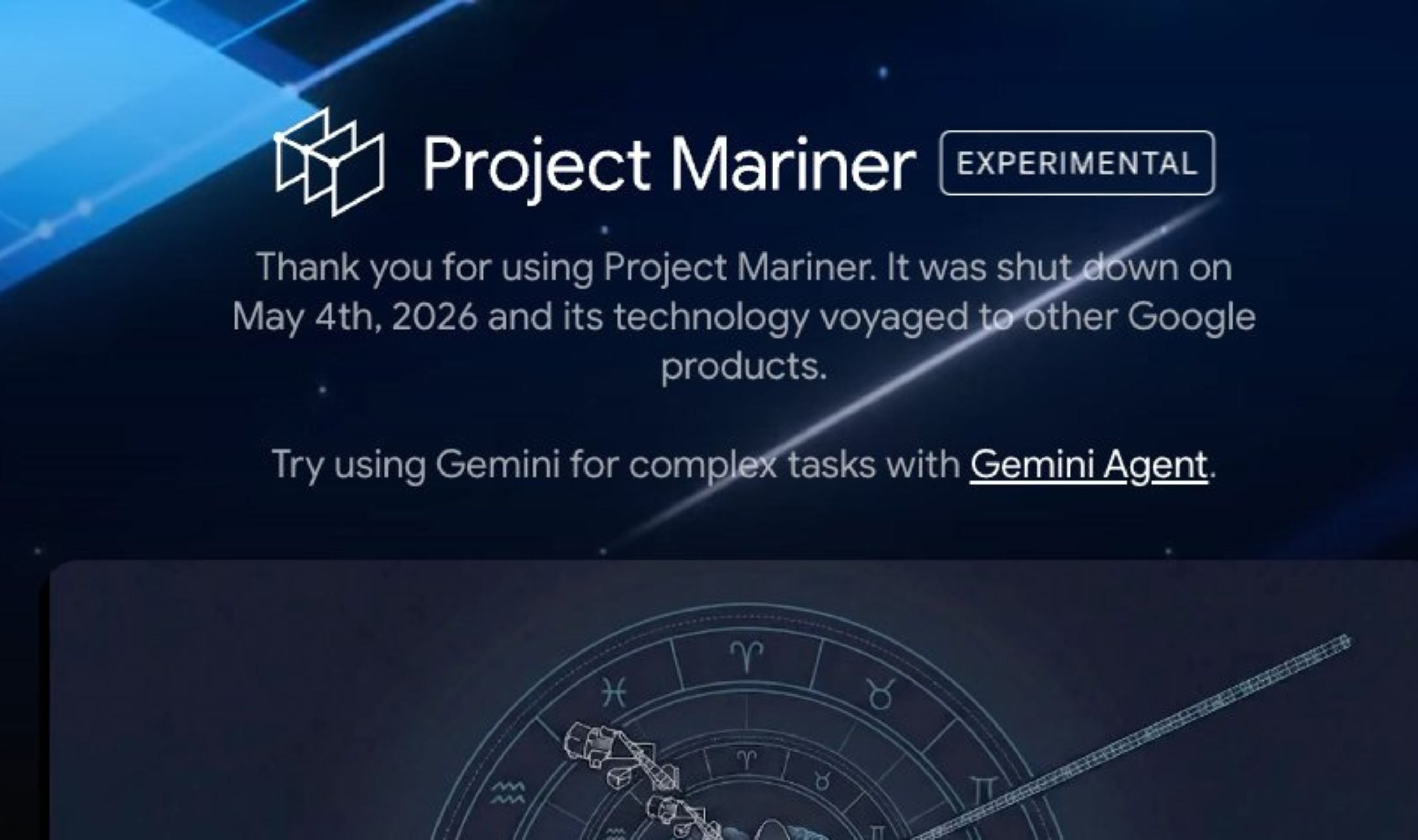
Google killed Project Mariner on May 4 without a public announcement, shuttering the web-browsing AI agent it debuted at I/O 2025 just two weeks before this year's developer conference.
Wired's Maxwell Zeff spotted the change on the project's landing page, which now reads: "Thank you for using Project Mariner. It was shut down on May 4th, 2026 and its technology voyaged to other Google products." The page directs users to Gemini Agent for "complex tasks." The quiet death follows months of warning signs. In March, Wired reported Google had begun reassigning staff off the Project Mariner team as the company shifted resources toward building an OpenClaw-like agent.
Zeff noted nearly two months before the shutdown that Mariner's internal support had eroded.
Launched in December 2024, Project Mariner was Google's first public experiment in agentic AI for the browser. It worked by taking frequent screenshots of the Chrome window and using visual recognition to identify buttons, forms, and links, then performing clicks and typed inputs to complete tasks like booking flights or researching purchases. The approach let it interact with arbitrary websites without requiring custom API integrations, but it came with tradeoffs: higher latency and a larger error surface compared to API-first agentic workflows. An update earlier this year expanded Mariner to handle up to 10 tasks simultaneously, gated behind a $249.99/month Google AI Ultra subscription.
PCMag notes the shutdown arrives ahead of Google I/O 2026, scheduled for May 19, suggesting Google is clearing out experimental projects before unveiling its next wave of AI tools. Rather than killing the technology outright, Google is reportedly folding Mariner's core capabilities into the Gemini API and Gemini Agent.
The Verge points out that Google had already previewed Mariner-derived features, including an "auto-browse" capability in Chrome that can perform multi-step tasks like researching flight costs. The technology lives on, just not under its own name.