
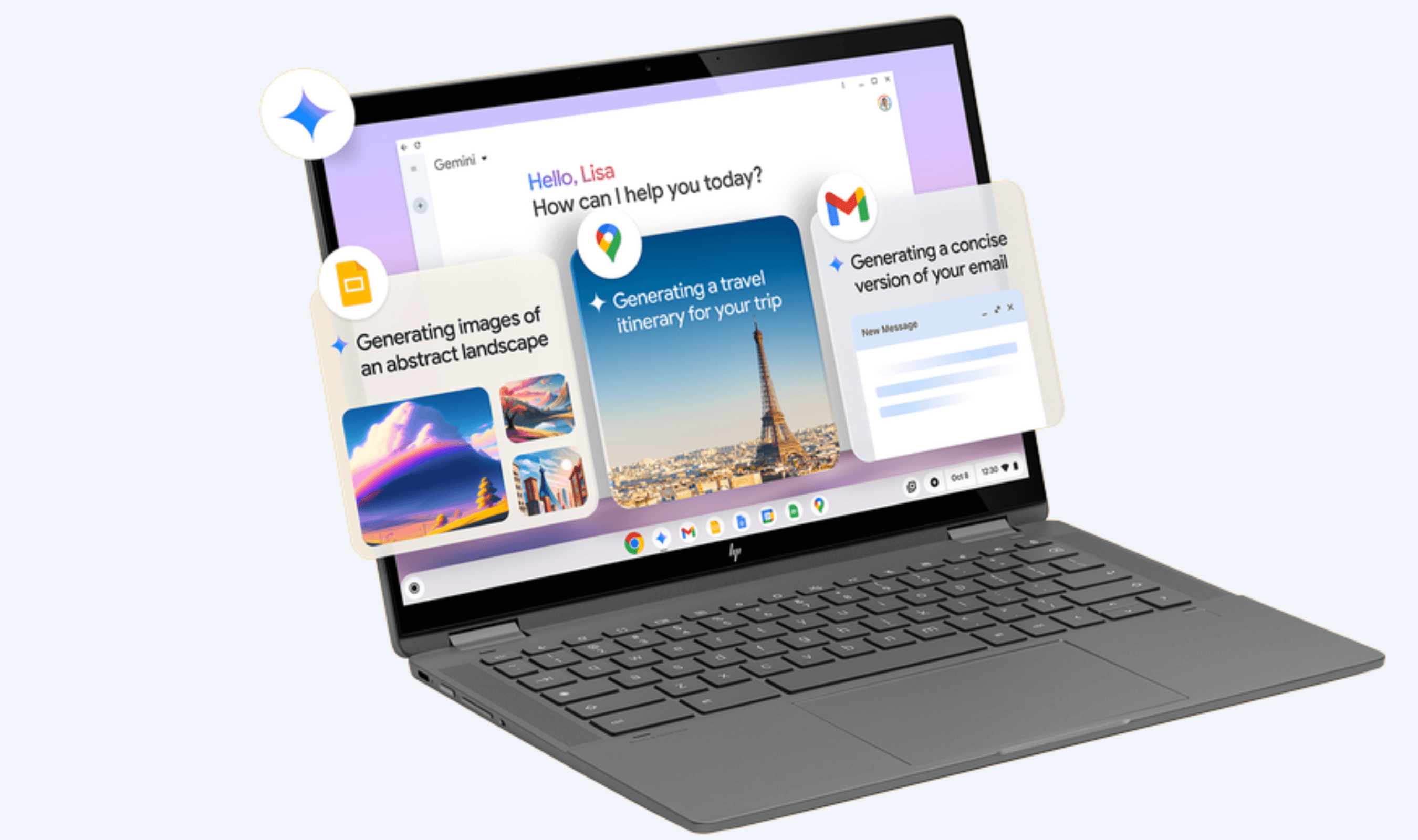
Google confirmed Gemini in Chrome is now available for Chromebook Plus laptops in the United States. The AI features roll out to ChromeOS starting with premium Chromebook Plus models, bringing desktop-level AI tools to Google's own operating system for the first time.
Chromebook Plus owners gain access to Gemini's sidebar interface that integrates with browser tabs. The AI assistant can pull information from open pages and provide contextual assistance without leaving Chrome.
Google says the "extended rollout" could take several weeks before appearing for all eligible devices.
The Chromebook Plus launch follows Gemini's desktop availability on Windows and macOS last year. Google initially skipped ChromeOS despite it being Google's own platform. Chromebook Plus models provide additional hardware capabilities beyond standard Chromebooks, positioning them for AI workloads.
Gemini in Chrome requires personal Google accounts with access to the Gemini app. Workspace administrators must manually disable the feature if unwanted, as it activates by default. The US-only restriction matches Gemini in Chrome's general availability limitations.
Google's announcement comes during a major marketing push for Gemini. The company aired a 60-second Super Bowl ad called "New Home" showcasing emotional AI use cases. The $7 million spot depicted a mother and son using Gemini to visualize their new home before moving in.
Gemini reached 750 million monthly active users in Q4 2025, up from 650 million the previous quarter. The growth follows Gemini 3's rollout, which Google CEO Sundar Pichai called "the fastest-adopted model in company history."
Alphabet reported annual revenue exceeding $400 billion for the first time in 2025, with Google Cloud revenue surging 48% to $17.7 billion in the final quarter as enterprises adopted Google's AI infrastructure.
Google extended Gemini integration across its product ecosystem in January, positioning it as a replacement for Google Assistant on mobile devices. The "Personal Intelligence" update connects Gemini data across Gmail, Google Photos, YouTube, and Search, while Chrome gained auto-browse features for multi-step tasks.
Google plans to phase out Assistant gradually on phones, tablets, watches, and cars while adding Gemini-powered features to speakers and Android TVs, reflecting the shift from traditional voice assistants to generative AI.
Google confirmed plans to bake Gemini directly into Chrome during antitrust trial testimony in 2025. The feature, internally called GLIC (Gemini Live in Chrome), appears as a system tray button on Windows 11. Users can launch Gemini in a floating modal without leaving their browser.
Apple confirmed Google Gemini will power the next-generation version of Siri launching later this year. The integration follows Google CEO Sundar Pichai's testimony about striking a Gemini deal with Apple by mid-2025. Gemini will help power Apple Intelligence features across iOS devices.
Google's Chromebook Plus availability marks another step in Gemini's platform expansion, which has grown to 750 million monthly active users as the company integrates AI across Search, Gmail, Chrome, and now ChromeOS while competing with Microsoft's Copilot integration in Windows 11.