
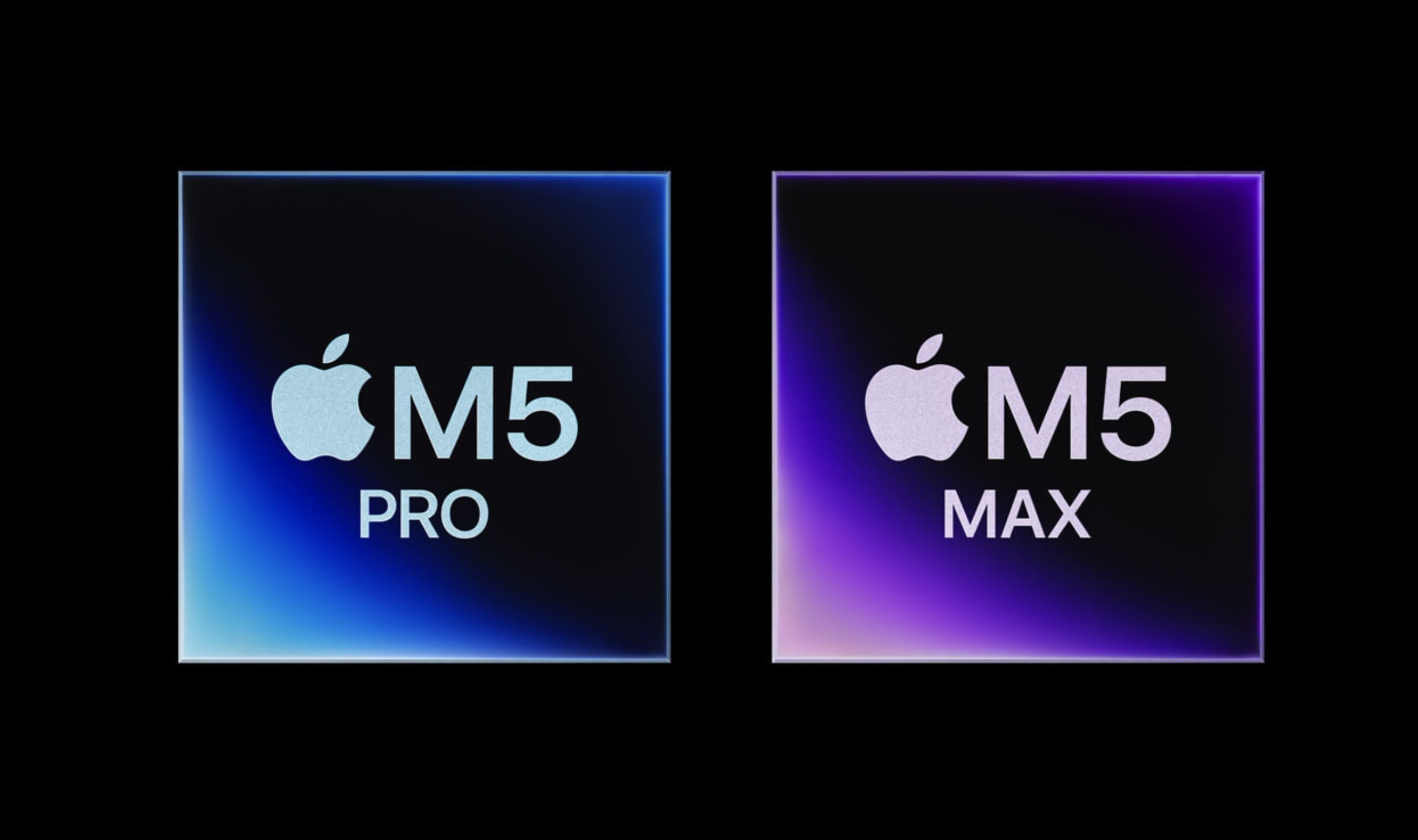
Apple's OLED 'MacBook Ultra' Ships With M5 Chips, Skips M6 Line Entirely. The rumored MacBook Ultra, Apple's first OLED touchscreen Mac, will launch with M5 Pro and M5 Max chips rather than next-generation silicon, according to Bloomberg's Mark Gurman.
The decision contradicts months of speculation that the high-end notebook would debut the M6 family.
Gurman said the device will arrive "between late this year and early next year" in 14- and 16-inch sizes, code-named "K114" and "K116." It will feature a redesigned chassis and an iPhone-style Dynamic Island that replaces the notch. Pricing will exceed the M5 Pro MacBook Pro, which now starts at $1,999 following Apple's recent price increases.
The chip choice is notable because the base M6 was expected to launch this fall in a new entry-level MacBook Pro. But Apple has more ambitious plans for the high-end silicon that was originally expected to power the Ultra.
In a separate report, Gurman revealed that Apple is skipping M6 Pro, M6 Max, and M6 Ultra variants entirely. The company is jumping directly to M7 Pro and M7 Max chips, which are designed around major advancements in on-device AI processing with upgraded neural accelerators, graphics enhancements, and increased memory bandwidth.
"The company is taking this unusual step in order to fast-track technologies that it originally planned to release later," Gurman wrote, citing people familiar with Apple's plans. "The change should help meet growing demand for on-device AI capabilities and more graphics-intensive software."
The base M6 chip arriving later this year will offer around 200 GB/s of memory bandwidth (up from 153 GB/s on the M5) and up to 12 GPU cores. The M7 line, expected in the first half of 2027, will push bandwidth to 240 GB/s.
A successor to the MacBook Ultra with M7 Pro and M7 Max is planned for late 2027, while the Mac Studio will get M7 Max and M7 Ultra options in 2028. That timeline means the first MacBook Ultra ships with current-gen silicon while the high-end chip architecture that was built for it won't arrive for another year. Apple is betting the combination of OLED, touch input, and a dramatic redesign will be enough to justify the Ultra's premium positioning, even without next-generation processing power.