
This article is brought to you in partnership with WaveMaker.
Most AI coding tools fall apart at enterprise scale. That's not a hot take, it's what happens when tools built for solo developers meet 10-squad teams trying to ship consistent, governed applications every release cycle.
Cursor, Replit, and GitHub Copilot have made individual developers significantly faster. A solo engineer can prototype in hours and refactor with a prompt. But scale that to a large enterprise team and the cracks show fast: code quality degrades, LLM outputs become unpredictable, and architectural consistency goes out the window.
WaveMaker is going after this exact gap with WaveMaker, an agentic application generation platform built for enterprise development teams. Instead of bolting AI onto existing coding workflows, WaveMaker pairs AI-powered generation with deterministic code output.
The idea: give teams AI speed without sacrificing the predictability that enterprise software requires.
The Problem with AI Coding at Scale
Today's AI coding tools were built for a specific user: the senior developer at a tech company who can evaluate and correct AI-generated code on the fly. That works well for startups and small teams.
Enterprise organizations operate differently. Their teams have mixed skill levels. They maintain legacy applications with deep integrations and compliance requirements. They need consistent design systems across dozens of apps, and every release has to meet regulatory standards.
When these organizations adopt current AI coding tools, they hit the same problems: security vulnerabilities in generated code, no way to enforce architectural standards, ballooning LLM costs, and the fundamental unpredictability of language model outputs.
A tool that generates slightly different code each time you run the same prompt is fine for prototyping. It doesn't work for production software running financial services infrastructure.
"Businesses and their custom application teams are under the twin pressures of quickly taking advantage of agentic AI while ensuring it delivers guaranteed outcomes at predictable costs," said WaveMaker CEO Vijay Prasanna Pullur, in the company's official announcement.
How WaveMaker Works: Two-Pass Code Generation
WaveMaker's core idea is straightforward: separate the creative AI work from the code production.
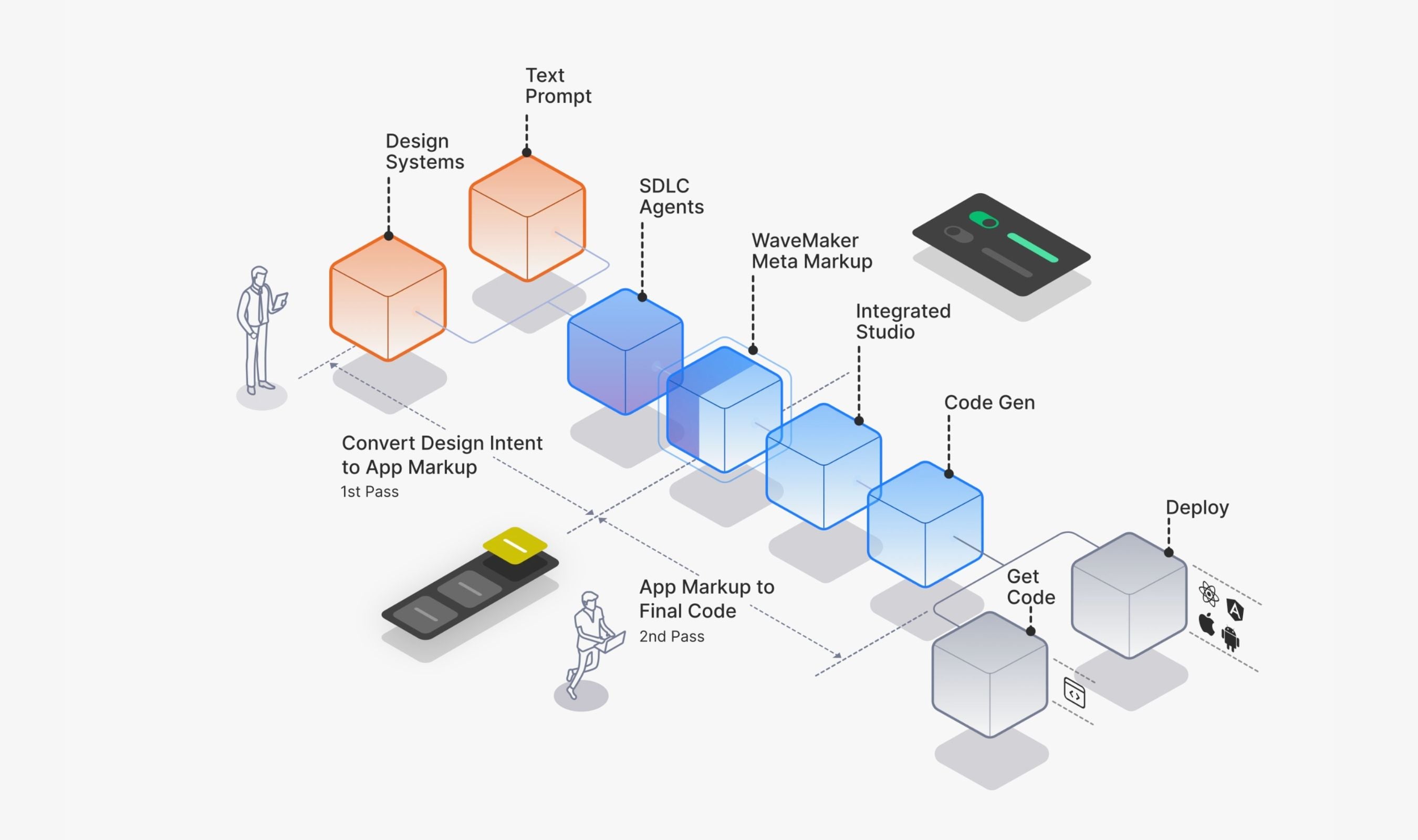
The platform uses a two-pass architecture. In the first pass, AI agents (powered by LLMs including Anthropic's Claude) convert inputs into WaveMaker Markup Language (WML), a stack-agnostic intermediate layer. Those inputs can be Figma designs, images, or plain text prompts. The AI identifies UI components, maps them to WaveMaker's enterprise component library, and generates structured markup that captures what the application should do, without committing to a specific framework.
The second pass is fully deterministic. No LLM involved. WaveMaker's template-based generators take the validated WML and produce production-ready code in Angular, React, or React Native. Same input, same output, every time.
This solves several enterprise pain points at once. LLM costs stay predictable because AI only handles the abstraction layer, not full code generation. Output quality is consistent because the deterministic second pass enforces standards regardless of LLM variability. And the WML layer lets developers iterate on application structure without regenerating thousands of lines of framework code.
Design Systems That Actually Get Enforced
Most development teams treat design systems as guidelines in a wiki that people are supposed to follow. In practice, consistency erodes as different developers interpret things differently.
WaveMaker makes design systems an enforced part of the build process. The platform includes a visual style workspace where teams define design tokens, component styles, and layout rules. These aren't suggestions. They propagate automatically across every application built on the platform.
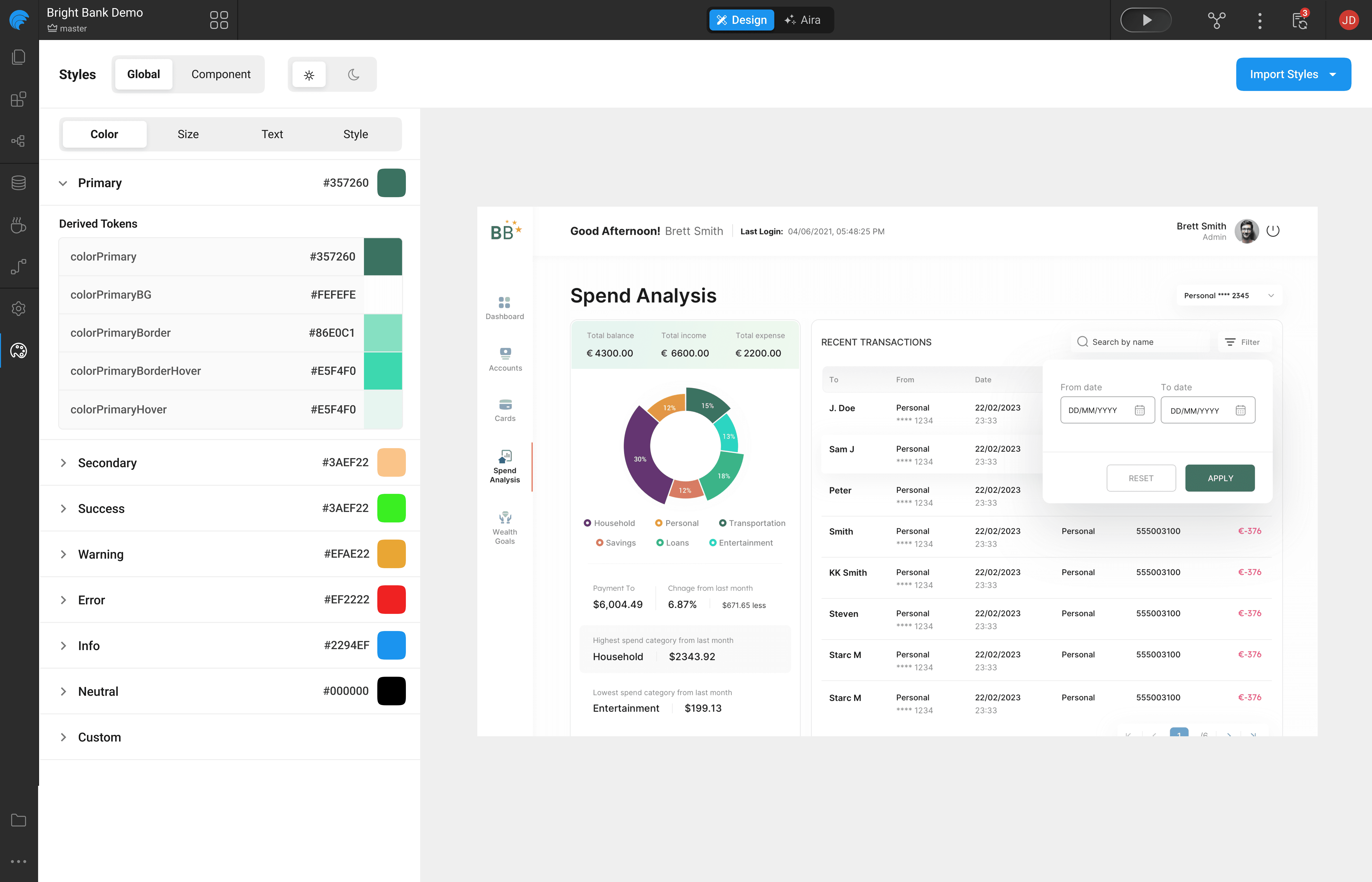
The pipeline starts in Figma. WaveMaker's Autocode feature analyzes Figma designs, identifies components, maps them to its enterprise UI kit (built on Material Design with Material 3 defaults), and generates matching design tokens. The result is pixel-accurate translation from design to working application, with styling enforced at the platform level.
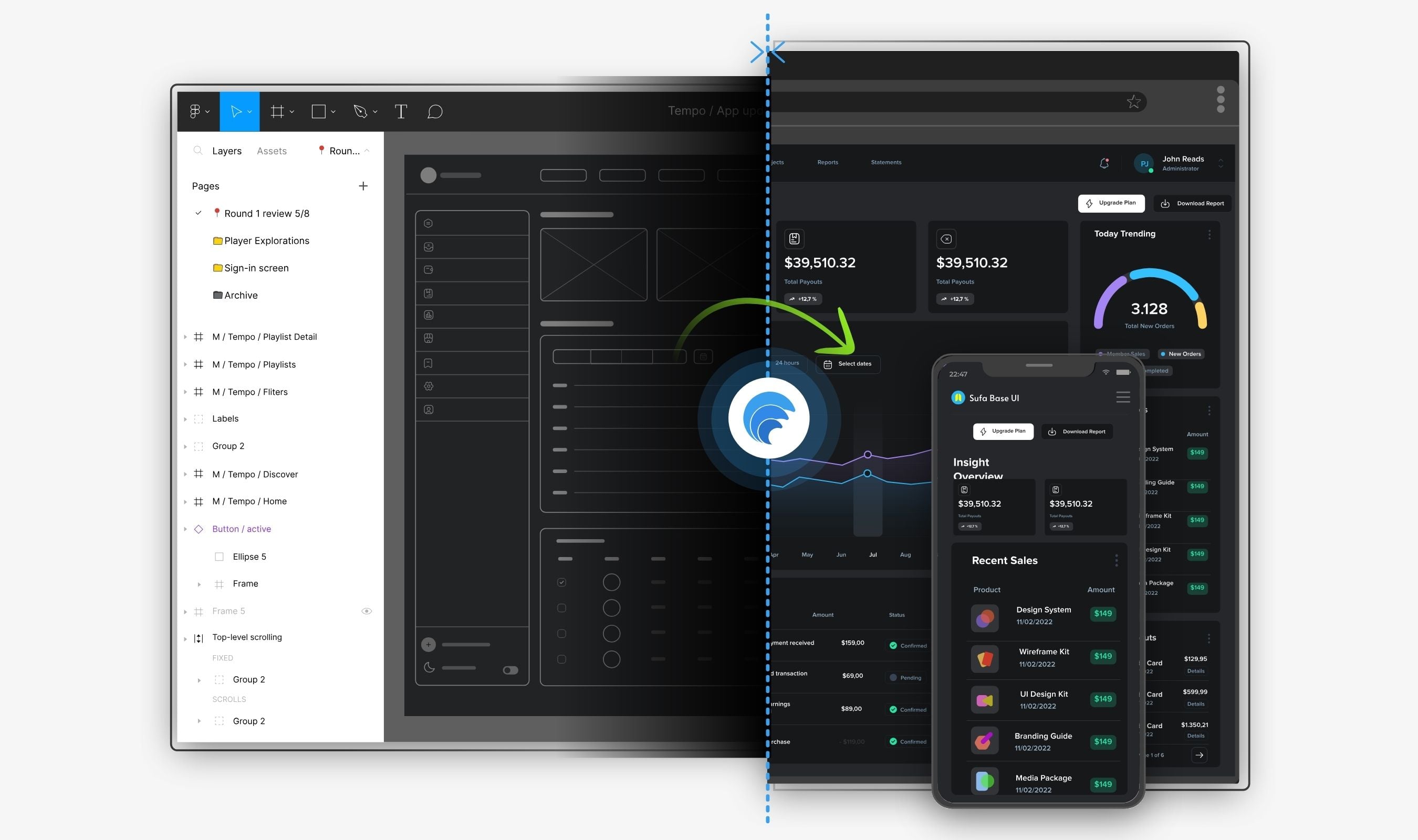
For organizations managing multiple applications across departments, this eliminates an entire category of QA work.
The Studio: Prompts, Canvas, and Code in One Place
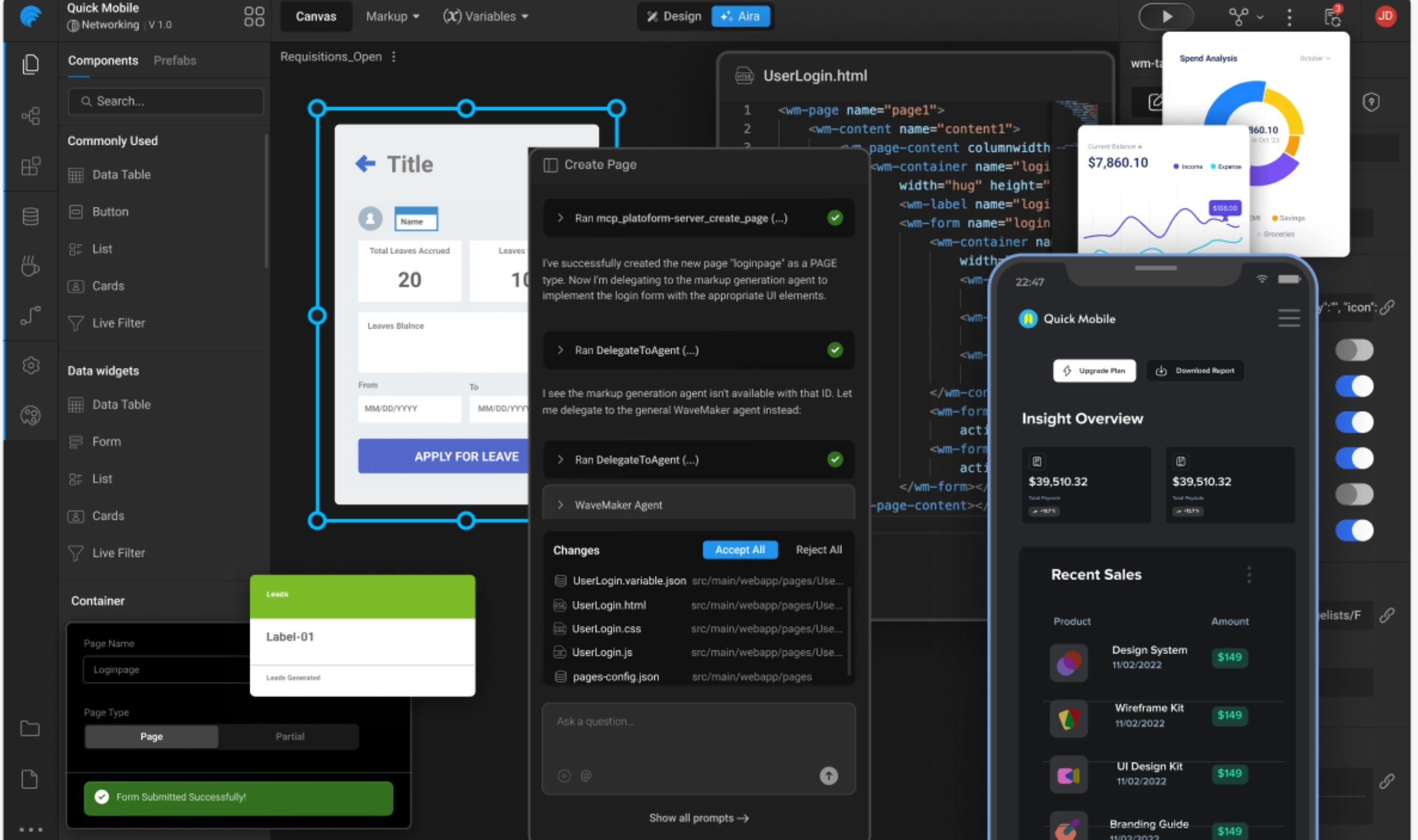
WaveMaker's studio gives developers three ways to work in the same environment:
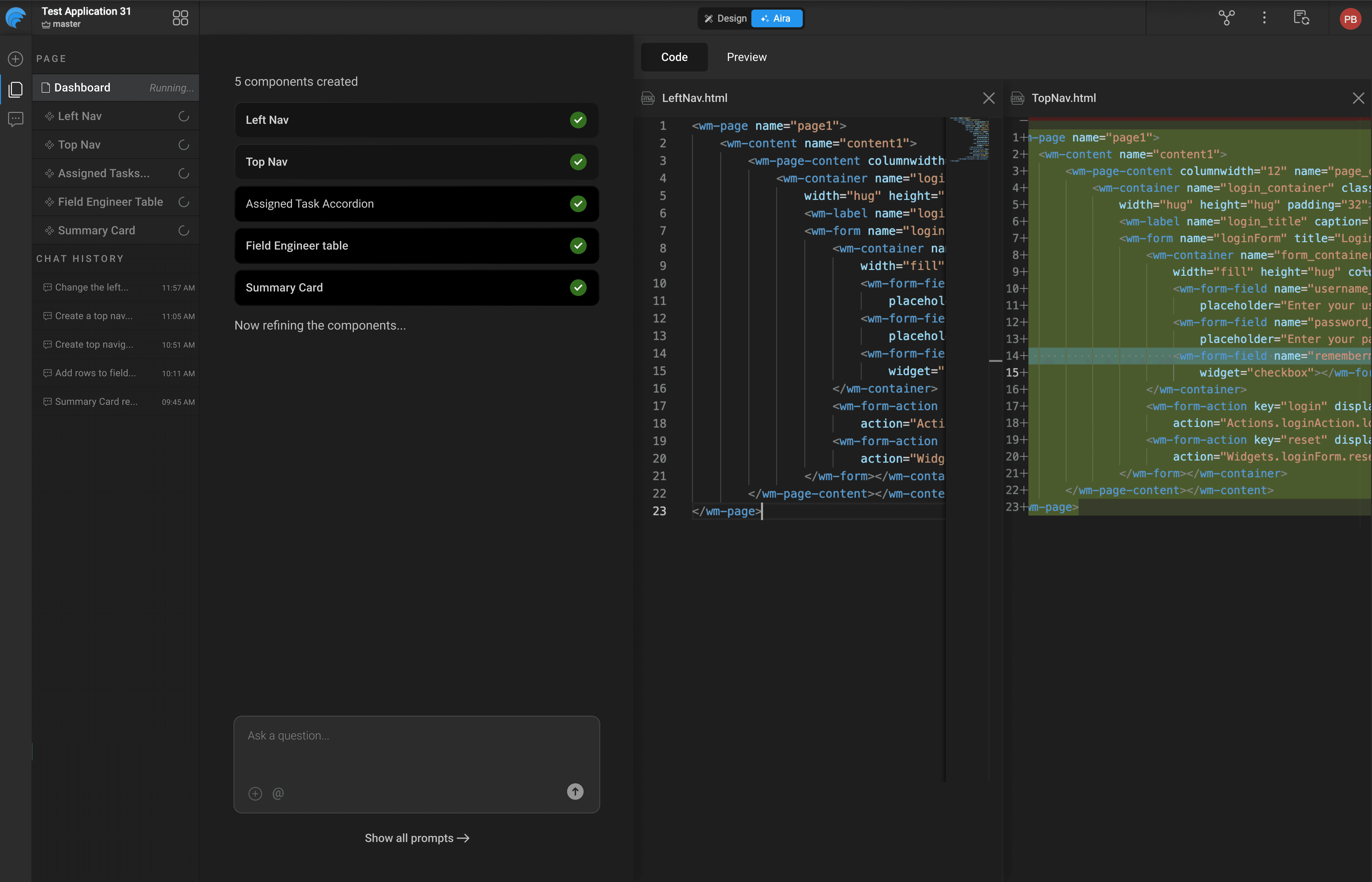
Agentic prompts for generating pages, layouts, API integrations, and security configurations through natural language.
Visual canvas for drag-and-drop authoring and layout validation. Non-developers can review and give feedback in the same tool where code gets generated.
Code editor for direct access when developers need fine-grained control or want to extend beyond what the platform generates.
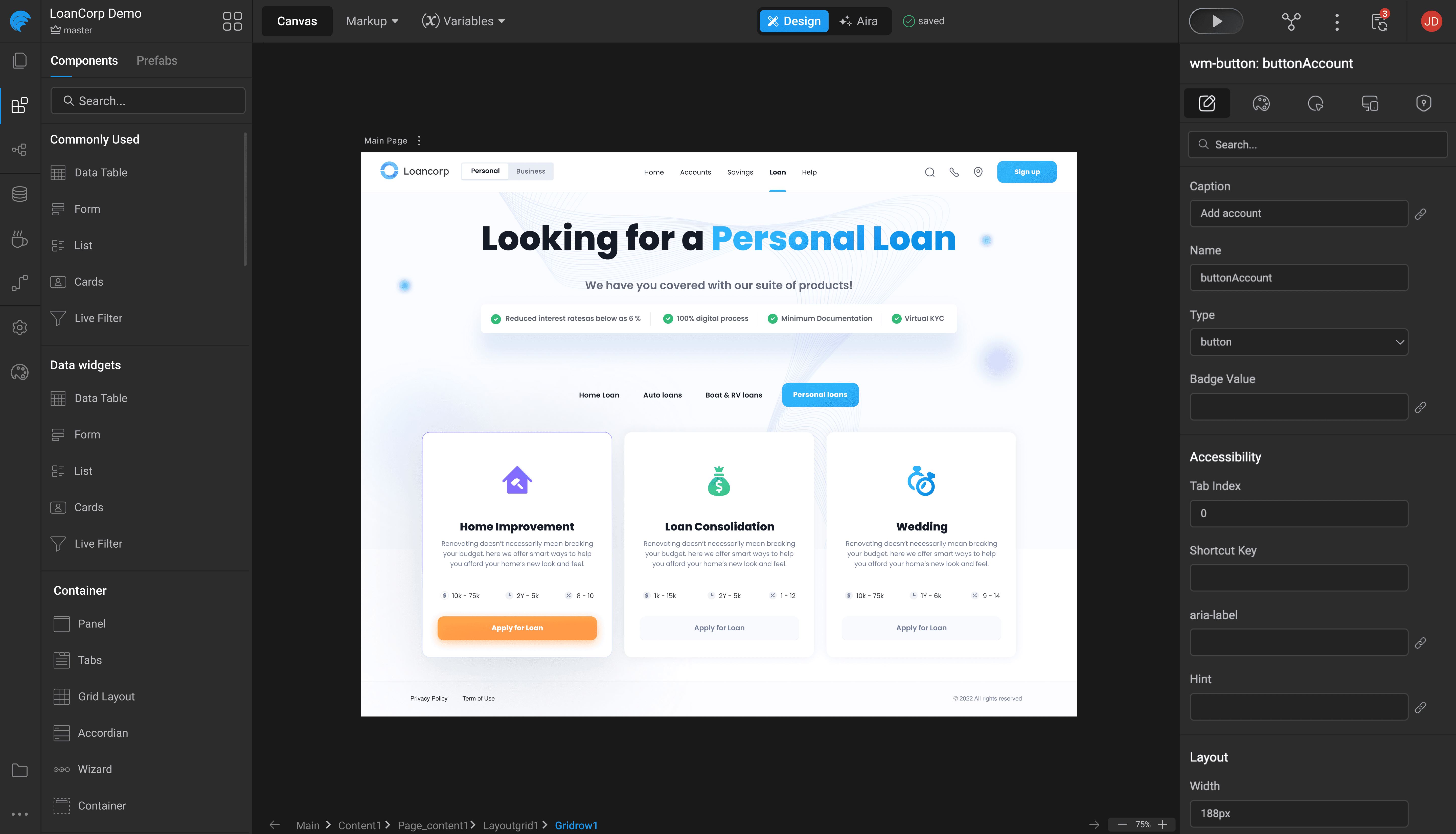
The studio plugs into existing development infrastructure: Git and Bitbucket for source control, artifact repositories, API marketplaces, and deployment to AWS, Azure, Kubernetes, or on-premises setups. It fits into existing CI/CD pipelines rather than replacing them.
Custom AI Agents for Industry-Specific Needs
Beyond built-in agents for common tasks (API integration, form validation, security, internationalization), WaveMaker lets organizations build custom AI agents for their specific domain.
A financial services firm can build agents that understand its compliance requirements. A healthcare company can create agents that enforce HIPAA patterns in generated code. The framework lets organizations encode their institutional knowledge into the development process itself.
Who WaveMaker Is Built For
WaveMaker targets midmarket and enterprise organizations with cross-functional teams building multi-platform business applications. Its customer base reflects that: FICO, FIS, and AT&T are among its users, along with organizations across 17 countries.
"This launch is strong evidence of our aligned vision and purpose with our partner WaveMaker: enabling AI-native software development and building better applications faster for the AI era," said Mikko Jarva, Head of Portfolio and Architecture in Nokia's Network Monetization Platform unit.
Blue Yonder, the supply chain company, uses WaveMaker to support extensibility in its platform and accelerate AI-enabled capabilities for customers.
WaveMaker's parent company Pramati brings over 25 years of enterprise software experience. Pramati's portfolio includes several successful exits: Qontext (acquired by Autodesk), Groupe.io (acquired by UKG), and Imaginea (acquired by Accenture).
Where WaveMaker Sits in the Market
Code-focused AI tools like Cursor, Claude Code, and Codex make individual developers faster within existing codebases. Design-to-code tools like v0 and Replit focus on rapid prototyping. WaveMaker is solving a different problem: team-level output consistency across complex, long-lived enterprise applications.
The two-pass architecture, enforced design systems, and enterprise integration stack reflect different priorities: consistency over flexibility, team productivity over individual speed, and governance over creative freedom.
As WaveMaker puts it: "If your bottleneck is a single developer coding faster, copilots are great. If your bottleneck is 10 squads shipping coherent UI plus integrations every release, WaveMaker is built for that."
The zero lock-in angle is also worth noting. Generated code is standard Angular, React, or React Native. Organizations can export the code, extend it outside the platform, and never depend on WaveMaker's runtime to deploy their applications.
The Bottom Line
WaveMaker launches at a point where the initial excitement around AI coding tools is giving way to harder questions about reliability, governance, and cost control. Organizations that adopted AI coding assistants are finding that individual productivity gains don't always translate into team-level efficiency.
WaveMaker is betting that the next phase of AI-powered development won't be won by the tool that generates code fastest, but by the platform that does it most reliably, at the lowest cost, with the strongest architectural guarantees. For enterprise teams building software that runs their business, that tradeoff makes sense.
Learn more at wavemaker.ai.