
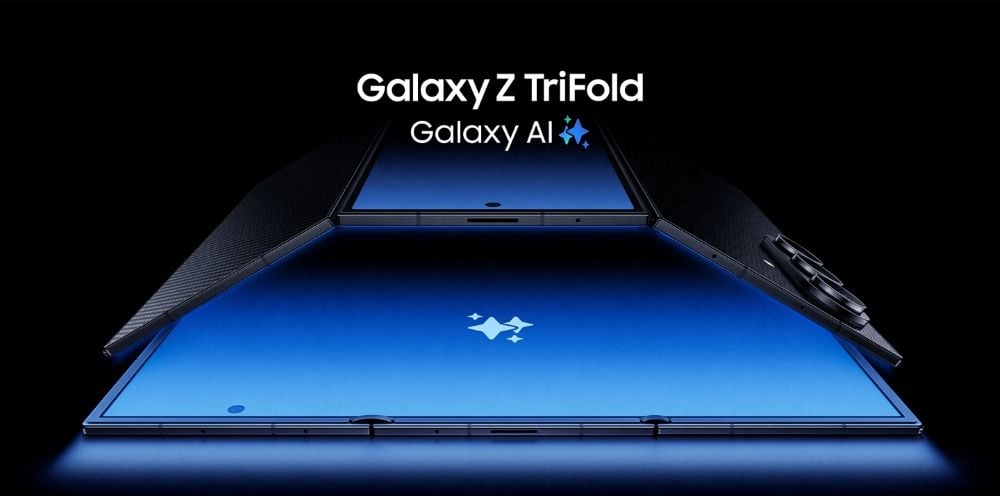
Samsung's Galaxy Z TriFold launched in South Korea on December 12, 2025, marking the company's first smartphone with two hinges and three display panels. The device transforms from a 6.5-inch phone to a 10-inch tablet, positioning it as Samsung's most ambitious foldable to date.
The TriFold features a 6.5-inch FHD+ Dynamic AMOLED 2X cover display with 120Hz refresh rate. When fully unfolded, it reveals a 10-inch QXGA (2160 x 1584) Dynamic AMOLED 2X interior screen, also running at 120Hz. This represents a significant size increase over the Galaxy Z Fold 7's 8-inch panel.
Power comes from Qualcomm's Snapdragon 8 Elite for Galaxy processor paired with 16GB of RAM. Storage options include 512GB or 1TB configurations. The camera system features a 200MP wide-angle main sensor, 12MP ultra-wide lens, and 10MP telephoto camera.
Samsung priced the TriFold at 3,594,000 won, which converts to approximately $2,450. US pricing is expected to round to $2,500, placing it well above the Galaxy Z Fold 7's $1,999 starting price. According to Bloomberg, Samsung will ship limited volumes, restricting availability even after launch.
The device measures 159.2 x 75.0 x 12.9mm when folded and weighs 309 grams. At 12.9mm thick, it's approximately one-third thicker than the 8.9mm Galaxy Z Fold 7. The three-cell 5,600mAh battery represents a 1,200mAh increase over the Fold 7's capacity.
Samsung confirmed a staggered global rollout starting with South Korea, followed by China, Taiwan, Singapore, and the United Arab Emirates. The United States launch is scheduled for Q1 2026, potentially aligning with the Galaxy S26 series debut at a future Galaxy Unpacked event.
Early sales in South Korea reportedly sold out within minutes, according to multiple reports. Tech YouTubers including Mrwhosetheboss and SuperSaf have published positive hands-on impressions, highlighting the practicality of the expanded canvas.
Industry analysts position the TriFold as a halo product rather than mass-market device. Its premium pricing and limited availability target early adopters and professionals who can leverage the additional screen real estate for productivity workflows.
The device supports Samsung's foldable software features including app continuity between displays and multi-window layouts. On the TriFold's wider canvas, this enables three-column desktop-style arrangements for enhanced multitasking.
Initial concerns focus on long-term hinge durability and battery performance under heavy tablet usage. Some early adopters expressed worry about the 10-inch display's power consumption despite the larger battery capacity.
Samsung's accelerated foldable roadmap comes just months after the Galaxy Z Fold 7 and Z Flip 7 launches. The TriFold represents the company's boldest experiment in form factor innovation, pushing beyond traditional book-style foldables into new territory.
Market reception will test consumer appetite for premium-priced, multi-hinge devices. The TriFold's success could influence competitors including Apple, which reportedly plans its first foldable iPhone for 2026 according to industry analysts.
For US consumers, availability remains the primary question. With limited shipments expected and Q1 2026 timing, interested buyers may face supply constraints similar to the initial South Korean launch experience.