
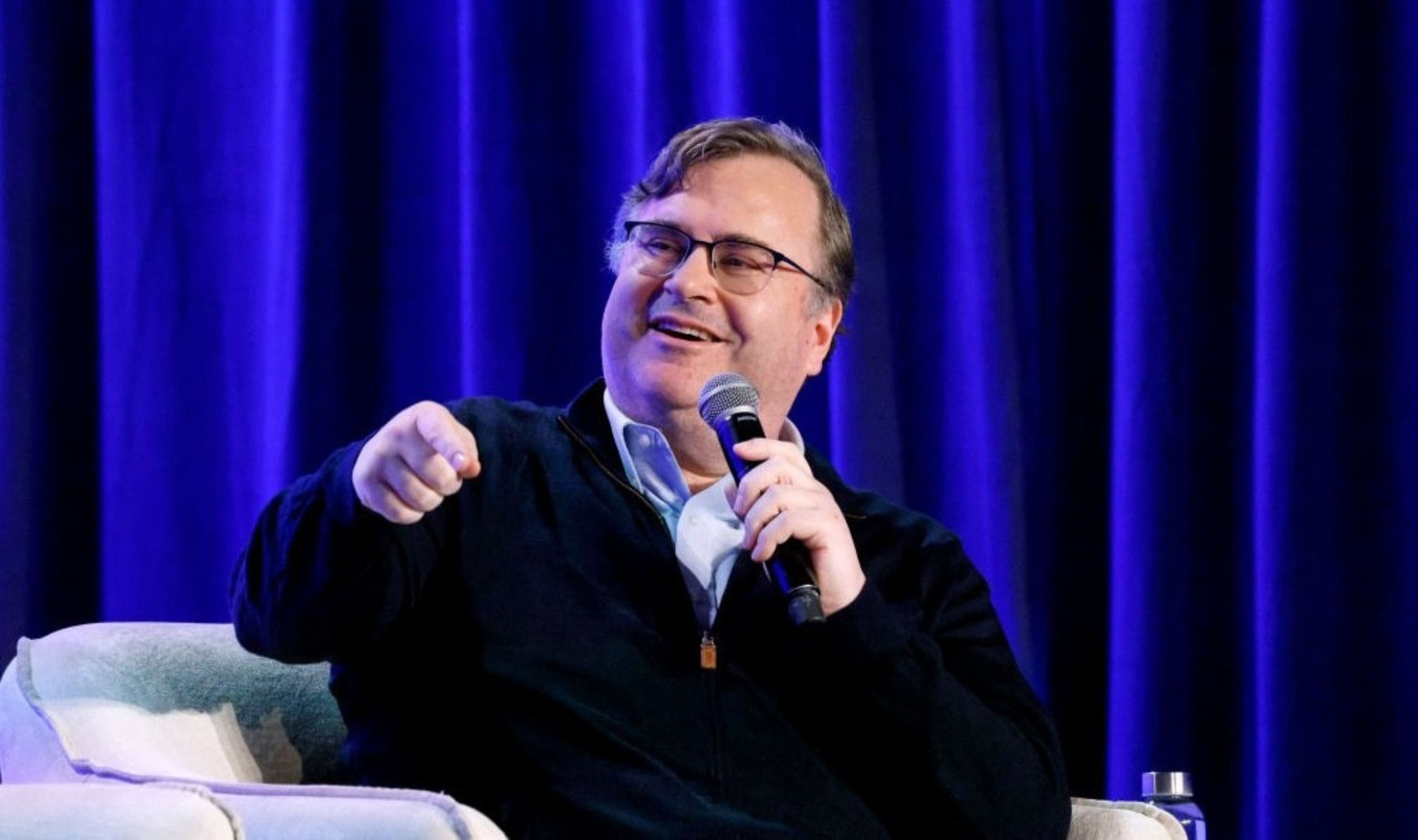
Reid Hoffman, the LinkedIn co-founder and longtime Microsoft board member who has invested in both OpenAI and Anthropic, offered his sharpest public critique yet of Elon Musk's AI ambitions during a conversation on Rana el Kaliouby's Pioneers of AI podcast. His assessment: SpaceX is "not an AI company," and xAI is "a complete train wreck."
"SpaceX isn't an AI company," Hoffman said. "XAI is, as Elon himself has described, it's a complete train wreck for its kind of building of foundational models and other kinds of things." He noted that all of xAI's original co-founders have left and the company is on its "third restart."
The numbers back him up. By May 2026, all 11 of xAI's original co-founders had departed, a cascade that started in February when Tony Wu, described as one of the most operationally central co-founders, resigned.
Musk restructured teams in response, but the exits kept coming. Grok, xAI's flagship model, has faced persistent criticism for lagging behind Anthropic and OpenAI on benchmarks.
Hoffman's SpaceX critique was equally pointed. The company went public on June 12 with AI central to its IPO narrative, then within days announced it was acquiring Cursor, the AI coding tool.
Hoffman's read: that's not proof of AI capability, but evidence of its absence.
"You could almost think of it as the IAC of AI," he said, invoking Barry Diller's serial-acquisition conglomerate. "Use the market cap to buy AI companies and try to buy your way into relevance."
His assessment of SpaceX's core compute business, which leases AI infrastructure, including to Anthropic, was withering. "You're a premium-priced CoreWeave," Hoffman said.
"I get it. Which is not an AI company."
The government crackdown that has Hoffman alarmed
Hoffman reserved his strongest language for the U.S. government's decision to force Anthropic to pull its Fable and Mythos models from the market. The directive, issued June 11 as an export control order, suspended all foreign national access to the two models.
The trigger, according to reporting from Fortune, was Amazon CEO Andy Jassy raising the alarm about a discovered jailbreak in the Fable 5 model, a vulnerability Anthropic was already working to fix. Cybersecurity experts widely criticized the government's response as disproportionate and poorly scoped.
"It doesn't look like there's anything that's a particular principled, here's-the-way-that-we're-dealing with-through-things, apply-kind-of-a-rule-of-law-and-predictability," Hoffman said. "It's more like, 'Hey, we kind of had some contentious interactions with this company anyway, so we're going to hit them with a stick.'"
He called the approach "autocratic willy-nilly" and "very sub-optimum." The asymmetry, Anthropic penalized while OpenAI was not, is what troubles him most. For a company preparing what is expected to be one of the largest IPOs in history, unpredictable regulatory intervention creates a new category of investor risk.
Room for both, but not for everyone
Hoffman, an investor in both OpenAI and Anthropic, pushed back on the zero-sum narrative. "We tend to want to tell these stories as cage matches," he said, but "there's a lot of room for both of them to win incredibly."
He sketched distinct lanes: Anthropic strong in code and expanding into design and legal; OpenAI and ChatGPT functioning more like a consumer search front-end, with its Codex coding product "insufficiently talked about" given its strength. The one pointed question he raised: whether Cursor, just acquired by SpaceX, had already peaked.
"Cursor seems to have had its bright star some number of months ago and seems to be fading over the horizon," he said.
Cursor has faced mounting pressure since early 2026 as Claude Code and Codex gained ground, with developers questioning whether a standalone coding IDE still commands a premium. Hoffman, of course, has a vested interest in arguing that position.
His anchor for the bullish case on OpenAI and Anthropic: If AI becomes as pervasive as electricity, these will be two of the primary utilities. Google's early theory of monetization was enterprise servers, and then came AdWords, "the best business model invented in human history."
The Microsoft chapter closes
Hoffman's departure from the Microsoft board, he chose not to stand for reelection and remains through year-end, closes a chapter that included enabling the LinkedIn acquisition, steering the GitHub purchase, and brokering trust between Microsoft and OpenAI in the early days of their partnership. He described the decision simply: he'd rather be a founder than a governance person.
What comes next is drug discovery. Manas AI, his company with co-founders Ujjwal and Sid, is generating small molecule proposals that computational chemists are calling genuinely promising.
The pitch deck describes Manas as "an AI drug discovery factory for creating monopolies", legally permissible, Hoffman notes, because pharmaceutical IP functions as a sanctioned monopoly by design. For the man who helped build the LinkedIn and Microsoft era of tech, it may be the longest-horizon bet he's ever made.