
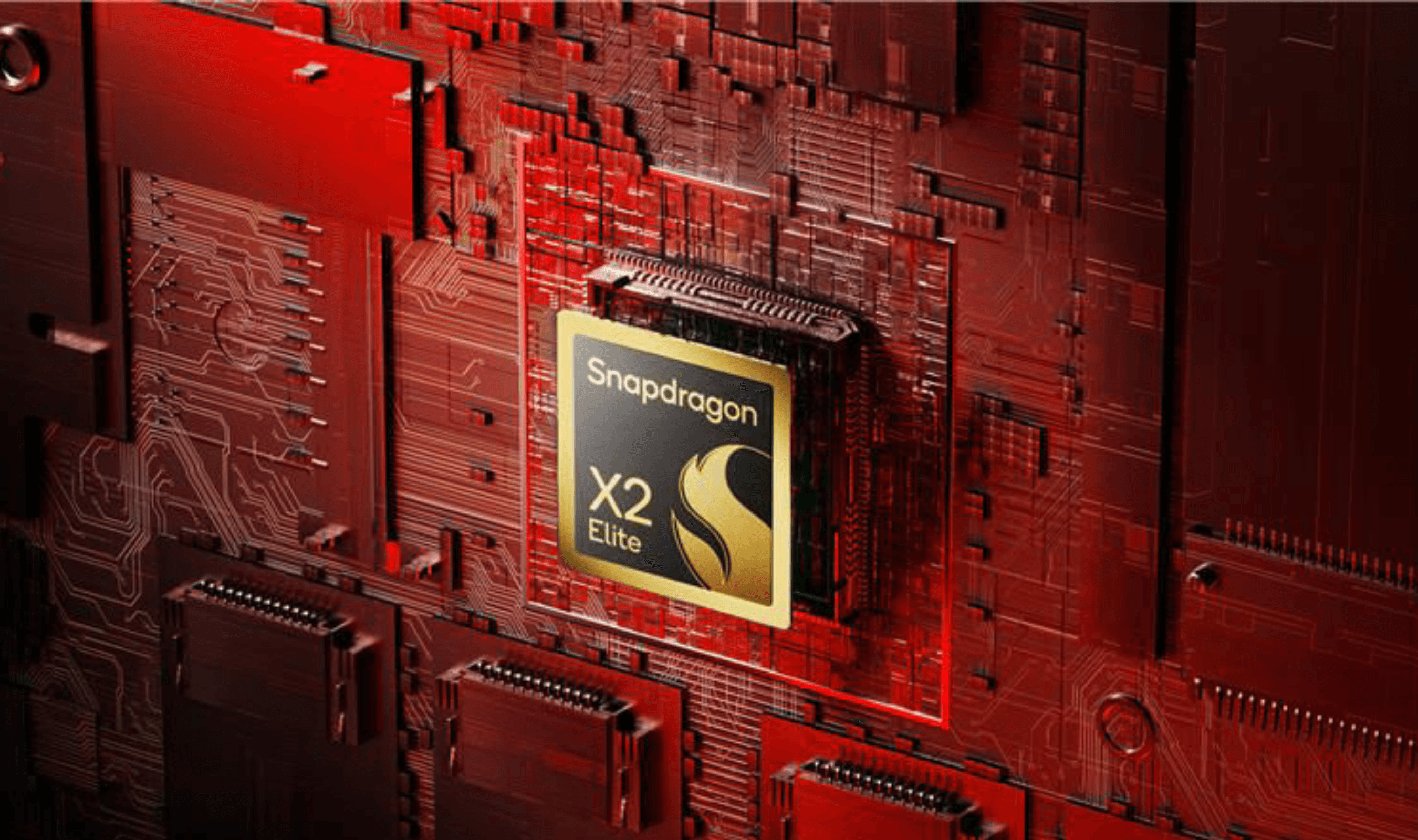
Qualcomm's Snapdragon X2 Elite processor delivers strong productivity performance but struggles against Intel's Panther Lake in gaming benchmarks, according to early testing by Hardware Canucks.
The YouTube channel tested a pre-production Asus Zenbook with the Snapdragon X2E-88-100 chip, running early firmware and drivers. In Cinebench 2024 multi-core tests, the 18-core Qualcomm processor scored 1,432 points, beating Apple's M5 (1,153) and Intel's Core Ultra X9 388H Panther Lake chip.
Productivity workloads show Qualcomm's strength. The X2 Elite completed a Blender render in 3 minutes 31 seconds, nearly two minutes faster than Apple's M5 at 5 minutes 33 seconds. Handbrake video encoding finished in 3 minutes 29 seconds versus the M5's 5 minutes 14 seconds.
Gaming performance tells a different story. Intel's Panther Lake chip delivered 189 fps average in Counter-Strike 2 at 1200p High settings, while the Snapdragon X2 managed 112 fps. Cyberpunk 2077 at 1200p Medium without ray tracing showed Panther Lake at 46 fps to Qualcomm's 40 fps.
Baldur's Gate 3 results followed the same pattern, with Intel's chip reaching 59 fps at 1200p Low settings compared to Qualcomm's 54 fps. The X2 Elite tested was not Qualcomm's fastest model, lacking the 192-bit memory bus of Extreme variants that could improve gaming performance.
Microsoft has added kernel-level anti-cheat support to Windows on Arm, enabling games like Fortnite to run on Snapdragon chips. However, compatibility concerns remain for x86 games running on Arm architecture, creating an additional hurdle beyond raw performance metrics.
The Snapdragon X2 Elite consumed 31W during testing, compared to 30W for AMD and Intel competitors and 26W for Apple's M5 Pro. Battery life data remains unavailable, with Hardware Canucks noting that future firmware updates will optimize power efficiency.
First laptops featuring Snapdragon X2 Elite chips are expected to launch in February and March 2026. Microsoft will release Windows 11 version 26H1 exclusively for Snapdragon X2 devices this spring, with the company stating 90% of users already employ apps natively compiled for Arm.
Qualcomm's second-generation Oryon cores represent a significant improvement over first-generation Snapdragon X Elite chips, with the X2 Elite showing 48-49% better performance in some benchmarks. The company claims 43% better efficiency than its predecessor.
Device makers including Lenovo, HP, and Asus have confirmed Snapdragon X2 devices launching in Q1 2026. This expanded hardware lineup contrasts with the limited first-generation options, giving consumers more choices for Windows on Arm systems.
Intel's upcoming Core Ultra Series 3 Panther Lake chips maintain the x86 ecosystem advantage that remains Qualcomm's primary obstacle in the corporate market. Analyst Olivier Blanchard from Futurum Group notes this could challenge Qualcomm's enterprise adoption.
The Snapdragon X2 Elite features an 18-core CPU, new Adreno X2-90 integrated GPU, and an 85 TOPS NPU for AI workloads. These specifications position it as a serious contender in the premium laptop market, particularly for productivity-focused users.
Windows on Arm performance remains consistent whether plugged in or running on battery, unlike x86 laptops that throttle performance on battery power.
"Early adopters like technology reviewer Rohit Kumar report positive experiences, describing his Surface Laptop 7 with Snapdragon X Plus as providing battery life 'without ever worrying about the battery running out.'"
Qualcomm's progress comes as the company reportedly approached Intel about a possible takeover in September 2024, according to CNBC. Intel shares initially rose about 3% on the news before closing, while Qualcomm shares fell about 3%.
The chipmaker has also hired Qualcomm executive Eric Demers to lead GPU engineering for data centers, focusing on AI chip development. Demers previously led Qualcomm's GPU efforts as senior vice president of engineering.
Qualcomm CEO Cristiano Amon stated in September 2025 that Intel Foundry "is not an option today" for manufacturing, adding "We would like Intel to be an option."
The company continues to source its low-power SoCs from TSMC and Samsung.
The Federal Circuit affirmed Patent Trial and Appeal Board decisions for Intel based on Qualcomm prosecution history in January 2025, resolving patent disputes between the two chipmakers.
Snapdragon X2 Plus chips for budget and mainstream systems launched at CES in Las Vegas earlier this year. Qualcomm claims these 3nm process chips provide 43% better power efficiency than their predecessors, enabling multi-day battery life in laptops.
The testing reveals Qualcomm has made substantial progress in closing the performance gap with Apple Silicon, particularly in multi-core workloads. However, gaming performance and software compatibility remain areas where Intel's x86 architecture maintains clear advantages, with Panther Lake delivering 189 fps in Counter-Strike 2 compared to the X2 Elite's 112 fps.