
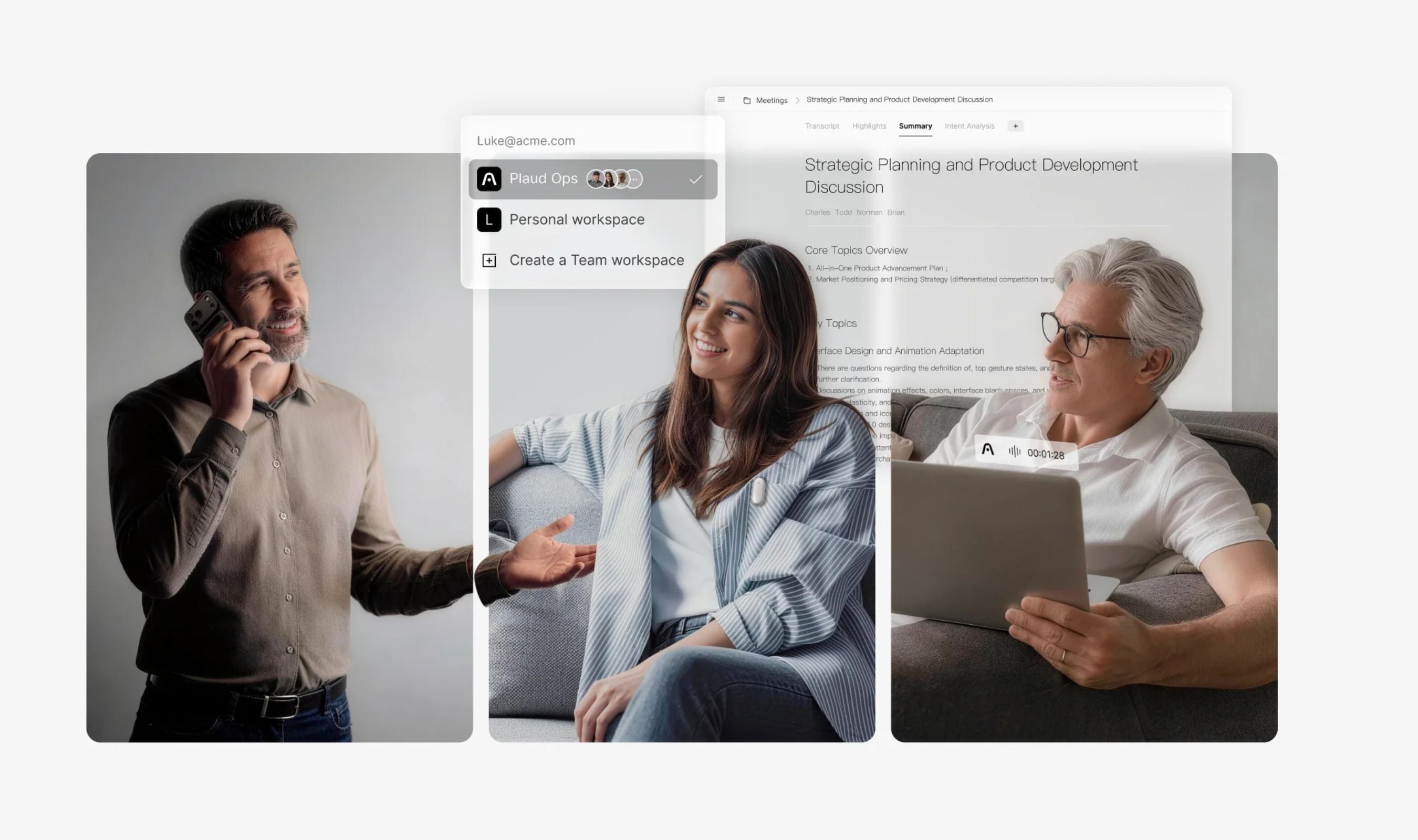
Plaud, the AI hardware company behind the world's best-selling dedicated note-taking device, today announced Plaud Team, an enterprise workspace built on top of a product already running inside more than two million employees' workflows. The launch is live in North America at 6:00 AM PT on May 12, and the company is pitching Team less as a new product than as the structural answer to a pattern its leadership has watched compound for two years: employees buying Plaud individually, then dragging the device into team workflows on their own.
The timing matters because the AI meeting-notes category has moved fast in 2026. Granola raised $125 million at a $1.5 billion valuation in March; Otter, Fireflies, Fellow, and the built-in tools inside Zoom and Microsoft Teams have all rolled out enterprise tiers; and bot-free capture has emerged as the differentiation axis nearly every player is fighting to own. Plaud's bet is that the wedge is hardware. The same dedicated device that put it on more than two million wrists, lanyards, and meeting tables is now the spine of a workspace designed for IT to deploy across a whole company.
From bottom-up adoption to a top-down workspace
The case Plaud is making for Team is that the demand was already there. In written responses to Technobezz ahead of the embargo, the company pointed to one customer pattern that recurred across early adopters.
"Organic adoption was the pattern we saw repeatedly. Kevin Sterneckert, a VP of Sales at a large tech consulting company, began using Plaud individually to keep accurate notes, stay present in customer meetings, and maintain a cleaner pipeline. He found so much value in Plaud as a 'second brain' that he gifted colleagues with device and subscription bundles during the holidays. Once his team each had their own devices, they began sharing summaries with each other, and even with their customers and partners, whether over email or by feeding insights into Slack and their CRM."
That story maps onto a wider corporate trend the industry has spent the past year naming as shadow AI. By April 2026, 82 percent of organizations had discovered at least one AI agent or workflow that IT did not know about, with meeting note-takers among the most-cited offenders. The argument Plaud is making with Team is that the answer to shadow adoption is not a ban; it is an admin layer over the tools employees are already using.
What ships at launch
Plaud Team opens with dedicated team workspaces, centralized billing, user and device management, and workspace controls. The personal-use experience stays intact underneath: capture happens on a Plaud device for in-person meetings and phone calls, and through the Plaud Desktop application for online meetings, with no bot joining the call. Notes are private by default unless a user actively shares them into a team space.
The compliance stack is the part the company is leaning on hardest for the enterprise buyer. Plaud Team ships certified against SOC 2 Type 2, HIPAA, GDPR, ISO 27001, ISO 27701, and EN 18031, with data encrypted in transit and at rest, zero data retention on AI workflows by default, and regional cloud hosting across the United States, Europe, Singapore, and Japan. That posture is what separates a workspace pitched at a CIO from one pitched at a knowledge worker, and Plaud has been building toward it since the product was still consumer-only.
"Most of the important thinking happens before anything gets written down," said Nathan Xu, co-founder and CEO of Plaud. "It happens in conversations, when people are testing ideas, making sense of problems, and figuring out what to do next. Plaud Team is built to help teams keep that context and build from it."
Consent and control inside the recording
The harder question for any meeting-capture product is not whether the audio can be transcribed; it is whether it should be captured at all. Plaud's framing of that question, in its written answers, treats consent as a product norm rather than a legal disclaimer.
"Consent is always the starting point we recommend, even where local regulations don't require it. A simple question, 'Do you mind if I capture this with my AI notetaker, for my own notes?', sets the right tone and reflects how we think about recording: transparently, and with the other person's awareness."
The framing places control with the user rather than the platform, which is consistent with the bot-free architecture: there is no third party joining the call to announce itself. That model cuts both ways. It avoids the disclosure-fatigue problem that bot-based competitors have created with meeting-invite clutter and announcement prompts, but it also puts the etiquette burden on the person carrying the device. Plaud Team's workspace controls are designed to make that policy enforceable across an organization rather than leaving it to individual judgment.
Hardware as the wedge against software-only incumbents
The competitive question Plaud has to answer is why a company would choose a dedicated device when Otter, Granola, Fireflies, and the built-in tools inside Zoom and Teams are already free or near-free for users with existing licenses. The company's argument is that software-only capture quietly degrades the conversation it is trying to record.
"Reaching for your phone or launching a recording app mid-conversation is a distraction. It signals to the room that you're managing a tool, not engaging with the people in front of you. Our end-to-end hardware and software integration, plus our proprietary transcription and diarization pipeline, let us identify speakers, distinguish the user, and handle background noise more accurately. If you capture the conversation incorrectly, everything downstream is built on the wrong context."
The argument extends past the boardroom. Plaud's strongest growth in 2025 came from professionals the software-only category struggles to serve: doctors moving between patient rooms, field reps on the road, technicians traveling site to site. The hallway conversation, the desk-side check-in, the unexpected client call between meetings, none of those happen inside Zoom, and none get captured by a Teams bot. That is the territory Plaud Team is selling into, and it is the one its incumbents are least equipped to defend.
Where Team sits in the product line
Plaud's current lineup runs from the NotePin and Plaud Note at $159, through the field-oriented NotePin S at $179, up to the flagship Plaud Note Pro at $189. Team layers on top of that hardware rather than replacing any of it. Devices bind to one workspace at a time, and an employee upgrading from a personal plan can either migrate an existing device into the team workspace or add a second device for work, keeping personal and professional context cleanly separated.
Plaud Team is available today in North America at plaud.ai/pages/business. Collaboration features that will let teams centralize conversation context across an organization are scheduled to ship later this year.