

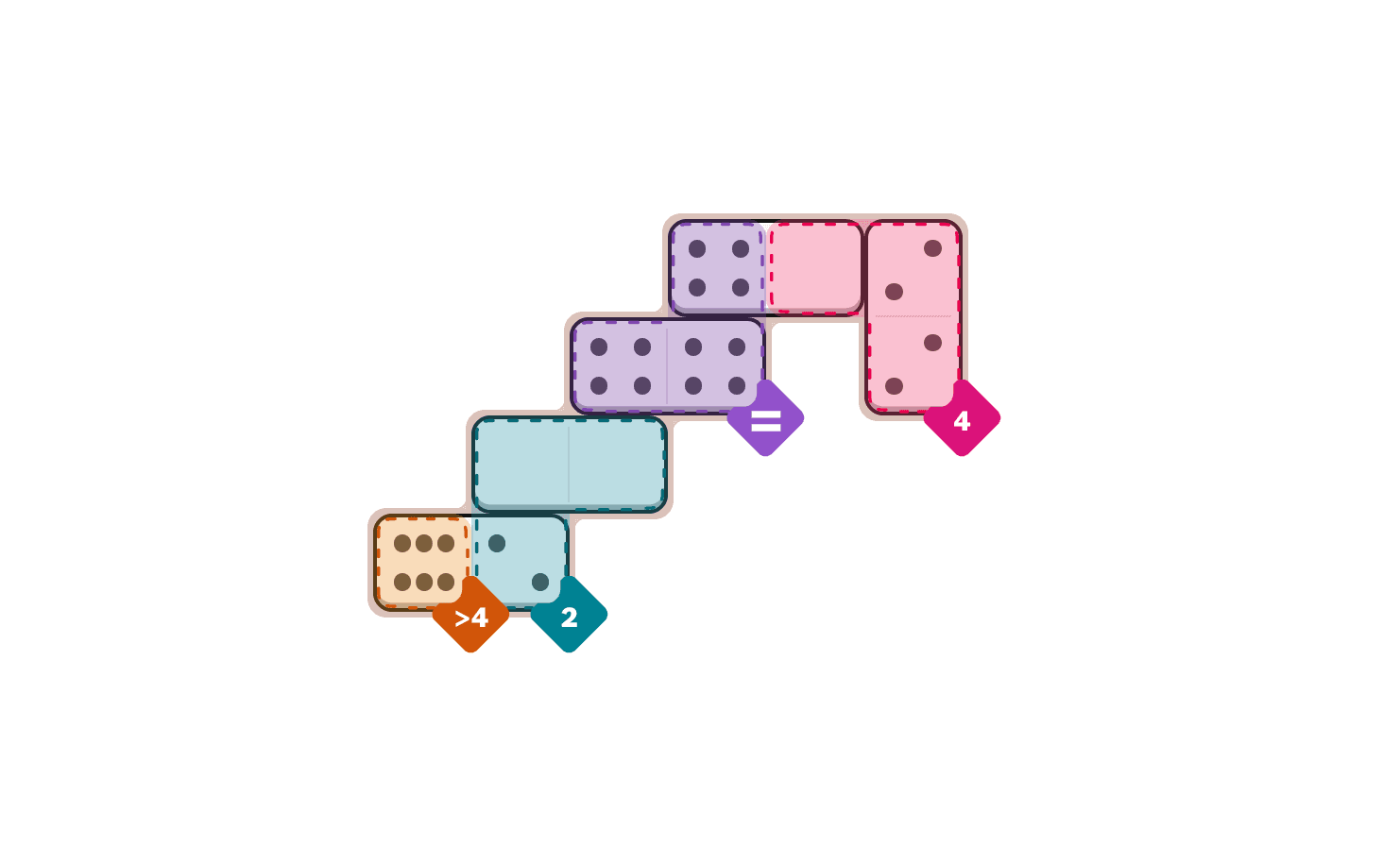
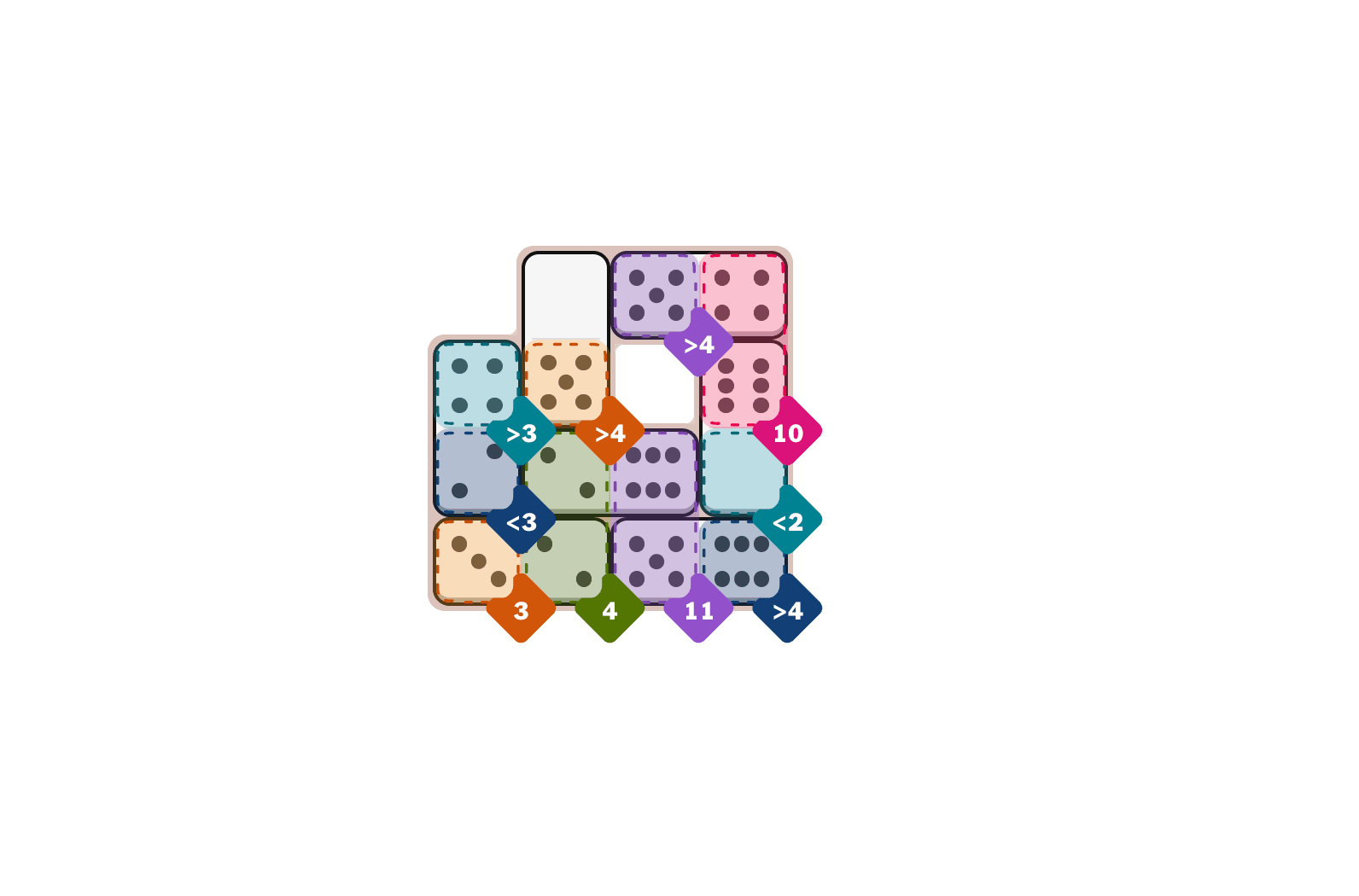
Tuesday brings a fresh set of NYT Pips puzzles. Today's lineup features a compact 10-domino grid with a mix of exact-number, inequality, and equal-condition zones. The orange (<3) and navy (>3, >2) conditions add a layer of constraint that rewards methodical placement. We've got hints, step-by-step walkthroughs, and full solutions for Easy, Medium, and Hard difficulty levels.
How to Play Pips
Pips is a domino placement puzzle where you fill a grid of color-coded zones. Each zone has a condition you must satisfy using the pip values on your dominoes. The twist: you must use every domino and meet every condition to win.
Zone Conditions:
- = All pips in this zone must equal the same number
- Not Equal All pips must be different numbers
- > Pips must be greater than the listed number
- < Pips must be less than the listed number
- Exact Number Pips must total that exact value
- No Color Free space, any domino value works
Click or tap dominoes to rotate them. Each puzzle has one or more valid solutions.
Today's Easy Pips
Today's Medium Pips
Today's Hard Pips
Quick Hints (No Spoilers)
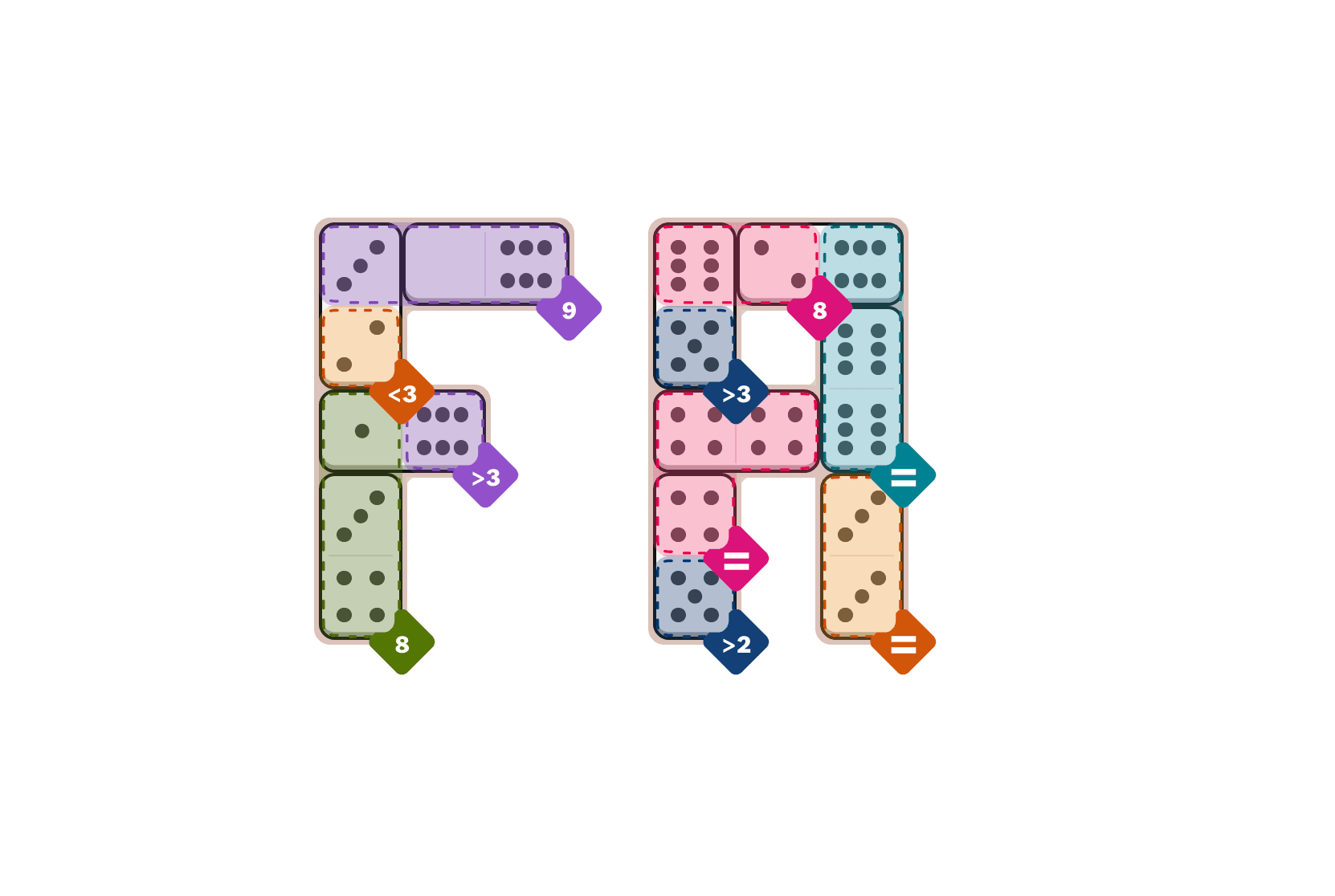
Starting Point: The exact-number zones with the highest totals -- purple (9) and green (8) -- are your most constrained entry points. They require specific combinations of domino halves to sum correctly.
Key Insight: The equal-condition zones (teal =, pink =, orange =) each need a double domino to establish their baseline value. Pink (=) locks in at 4 with the 4/4 double. Teal (=) locks in at 6 with the 6/6 double. Orange (=) locks in at 3 with the 3/3 double. Once these are placed, the rest of the grid falls into place.
Watch Out For: The navy zones have different inequality thresholds. Navy (>2) requires pips greater than 2. Navy (>3) requires pips greater than 3. A pip value of 3 works in navy (>2) but fails in navy (>3). Do not mix them up. Also, orange (<3) only accepts pip values of 0, 1, or 2 -- the 3/2 domino's 2 half is the only valid placement there.
Step-by-Step Walkthrough
- 1.Purple (9) needs a total of 9. Place the 0/6 domino horizontally in the purple (9) zone. This gives you a 0 and a 6, that's 6 toward the target, 3 more needed.
- 2.Orange (<3) only accepts pip values of 0, 1, or 2. The 3/2 domino has a 2 on one half, that's the only valid value for orange (<3). Place the 3/2 domino vertically so the 3 lands in purple (9) and the 2 lands in orange (<3). Purple now totals 0+6+3=9, done. Orange (<3) gets a 2, condition satisfied.
- 3.Green (8) needs a total of 8. Purple (>3) requires every pip to be greater than 3. Place the 1/6 domino horizontally across green (8) and purple (>3). Green gets a 1 (needs 7 more), purple (>3) gets a 6 (greater than 3, condition satisfied).
- 4.Green (8) still needs 7 more. Place the 3/4 domino vertically in the green (8) zone. Green now totals 1+3+4=8, condition satisfied.
- 5.Pink (=) requires all pips to be identical. Place the 4/4 double domino horizontally. This establishes 4 as the baseline value for the pink (=) zone. Every subsequent domino placed in pink (=) must carry a 4 on the pink side.
- 6.Navy (>2) requires all pips greater than 2. Place the 4/5 domino vertically across pink (=) and navy (>2). Pink (=) gets a 4 (matching the baseline), navy (>2) gets a 5 (greater than 2, condition satisfied).
- 7.Teal (=) requires all pips to be identical. Place the 6/6 double domino vertically. This establishes 6 as the baseline for the teal (=) zone. Every subsequent domino in teal (=) must carry a 6.
- 8.Pink (8) needs a total of 8. Teal (=) already has a 6 from the double. Place the 2/6 domino horizontally across pink (8) and teal (=). Pink gets a 2 (needs 6 more), teal (=) gets a 6 (matching the baseline of 6).
- 9.Pink (8) needs 6 more. Navy (>3) requires all pips greater than 3. Place the 6/5 domino vertically across pink (8) and navy (>3). Pink gets a 6 (now totals 2+6=8, done). Navy (>3) gets a 5 (greater than 3, condition satisfied).
- 10.Orange (=) requires all pips to be identical. Place the 3/3 double domino vertically. This establishes 3 as the baseline. All 10 dominoes placed, all conditions satisfied.
Hard Pips Solution
Last chance to solve independently
---
---
---
---
---
- 1.Place the 0/6 domino horizontally in the purple (9) zone
- 2.Place the 3/2 domino vertically in the purple (9) zone and orange (<3) zone
- 3.Place the 1/6 domino horizontally in the green (8) zone and purple (>3) zone
- 4.Place the 3/4 domino vertically in the green (8) zone
- 5.Place the 4/4 domino horizontally in the pink (=) zone
- 6.Place the 4/5 domino vertically in the pink (=) zone and navy (>2) zone
- 7.Place the 6/6 domino vertically in the teal (=) zone
- 8.Place the 2/6 domino horizontally in the pink (8) zone and teal (=) zone
- 9.Place the 6/5 domino vertically in the pink (8) zone and navy (>3) zone
- 10.Place the 3/3 domino vertically in the orange (=) zone
Puzzle Debrief
Overall Difficulty: Moderate. Today's set is compact at 10 dominoes, but the mix of exact-number sums, inequality thresholds, and equal-condition zones creates a satisfying logic puzzle that rewards careful pip counting.
Trickiest Puzzle: Hard - The inequality zones are the real trap. Navy (>2) and navy (>3) look similar but have different thresholds. Place a 3 in navy (>3) and you fail. The orange (<3) zone is equally unforgiving -- only pip values 0, 1, or 2 are valid. One wrong placement and the entire grid breaks.
Our Take: Today's set proves that smaller grids can still deliver a solid challenge. The three equal-condition zones (pink, teal, orange) each requiring a double domino to establish their baseline is a clever design choice -- it forces you to reserve those doubles for specific zones rather than using them as filler. Clean, tight, and satisfying.
Tomorrow's Pips drops at midnight. See you then.