

Sunday brings a fresh set of NYT Pips puzzles with a generous 16-domino grid that demands careful attention to zone conditions across all three difficulty levels. The equal-sign zones and exact-number requirements create satisfying logical chains. We've got hints, step-by-step walkthroughs, and full solutions for Easy, Medium, and Hard difficulty levels.
How to Play Pips
Pips is a domino placement puzzle where you fill a grid of color-coded zones. Each zone has a condition you must satisfy using the pip values on your dominoes. The twist: you must use every domino and meet every condition to win.
Zone Conditions:
- = All pips in this zone must equal the same number
- Not Equal All pips must be different numbers
- > Pips must be greater than the listed number
- < Pips must be less than the listed number
- Exact Number Pips must total that exact value
- No Color Free space, any domino value works
Click or tap dominoes to rotate them. Each puzzle has one or more valid solutions.
Today's Easy Pips
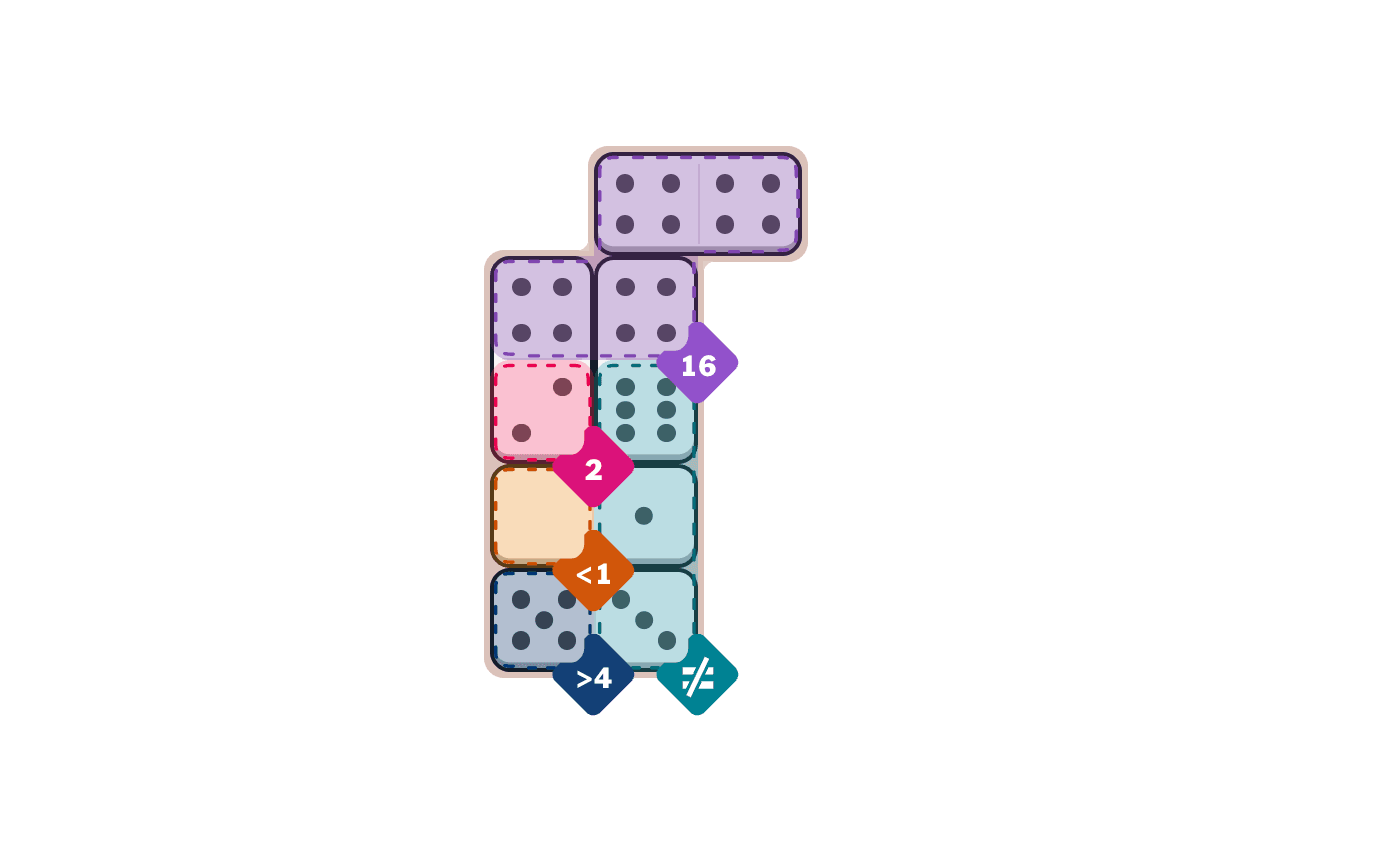
Today's Medium Pips
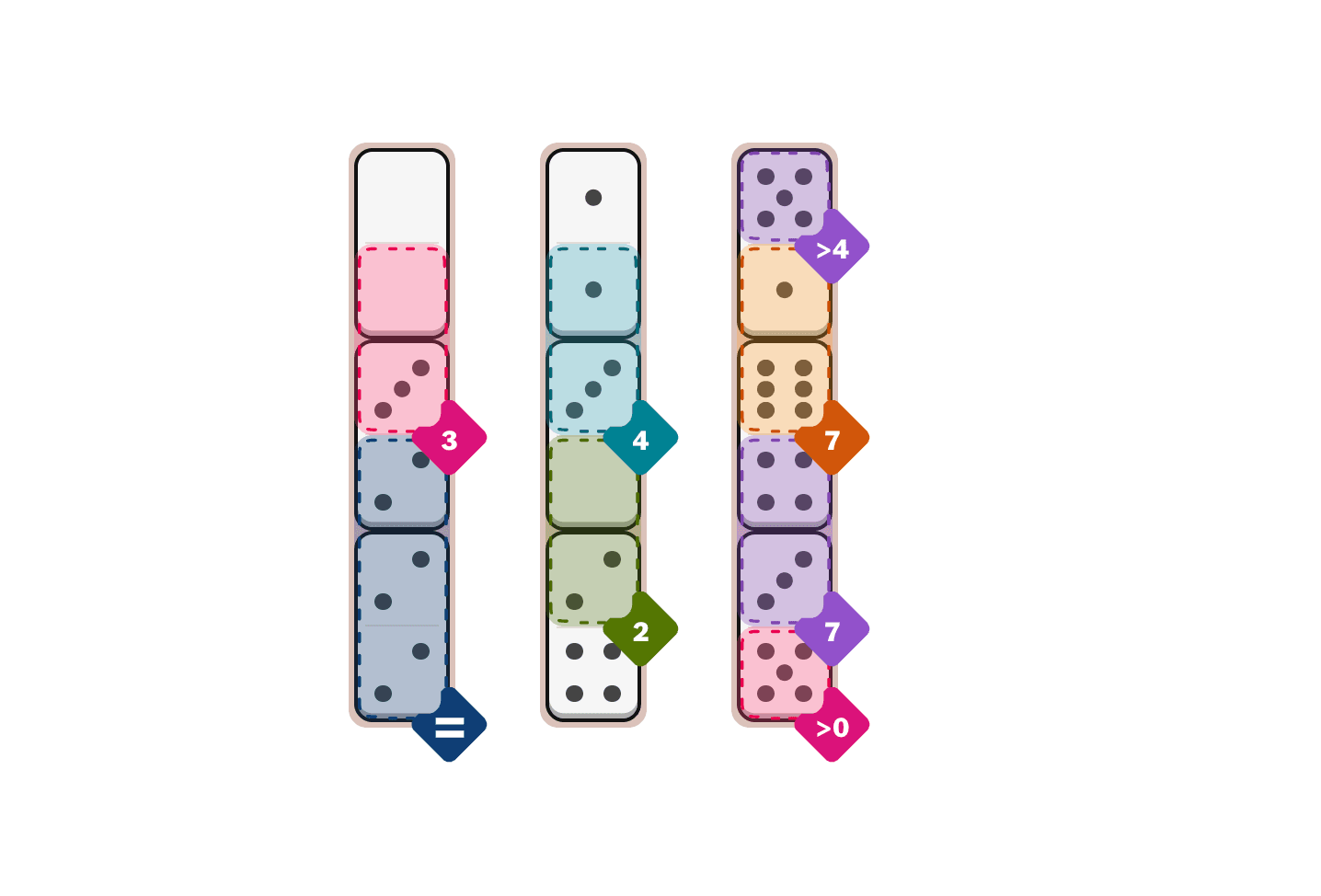
Today's Hard Pips
Quick Hints (No Spoilers)
Starting Point: The pink (<2) and orange (>4) zones are your most constrained spaces. Only dominoes with a 0 or 1 on one side can enter pink, and only dominoes with a 5 or 6 on one side can enter orange. Identify those dominoes first.
Key Insight: The equal-sign zones (green (=), navy (=), teal (=)) form a network that forces specific domino orientations. A domino crossing two equal-sign zones must have matching values on both ends, which severely limits your options to doubles like 5/5 or 2/2.
Watch Out For: The purple (10) zone sits alone and requires a domino totaling exactly 10. That could be 4/6, 5/5, or 3/7 -- but 5/5 is a double that might be needed elsewhere for an equal-sign zone. Don't waste it in purple (10) if you need it for navy (=) or green (=).
Step-by-Step Walkthrough
- 1.Survey the board. You have 16 dominoes to place across 17 zones with conditions including exact numbers, equal-sign, less-than, and greater-than constraints. The equal-sign zones are your high-leverage starting points because they force matching values.
- 2.Purple (6) and teal (4) share a border. Place 1/2 vertically so the 1 sits in purple (6) and the 2 sits in teal (4). This satisfies both exact totals with a single domino.
- 3.Place 5/4 horizontally across purple (6) and pink (4). The 5 completes purple (6)'s total of 6, and the 4 completes pink (4)'s total of 4. Two zones resolved.
- 4.Teal (4) and purple (8) are adjacent. Place 2/6 vertically so the 2 finishes teal (4) and the 6 goes into purple (8). Purple (8) now needs 2 more pips.
- 5.Place 2/0 horizontally across purple (8) and pink (0). The 2 completes purple (8), and the 0 completes pink (0). Clean and efficient.
- 6.Orange (8) is a standalone exact-number zone. Place 5/3 vertically inside it. 5+3=8, done.
- 7.Orange (0) borders green (=). Place 0/6 vertically so the 0 goes into orange (0) and the 6 goes into green (=). Since green (=) requires matching values, this domino must have 6 on both ends.
- 8.Orange (0) also borders navy (3). Place 0/3 horizontally so the 0 fills orange (0) and the 3 fills navy (3). Orange (0) is now complete.
- 9.Green (=) and navy (6) share a border. Place 6/1 vertically. The green (=) zone requires matching pips, so this domino must have both ends equal. The 6 goes toward navy (6).
- 10.Navy (6) and green (0) are adjacent. Place 5/0 horizontally. The 5 goes in navy (6), and the 0 goes in green (0). Navy (6) now has 5+1=6, complete.
- 11.Purple (10) is a standalone zone. Place 4/6 vertically inside it. 4+6=10, exact total satisfied.
- 12.Navy (=) and green (=) share a border. Place 5/2 horizontally. Both zones require matching pips, so this domino must have equal values on both ends. A double works here.
- 13.Green (=) and teal (=) are adjacent. Place 2/3 vertically. Again, both equal-sign zones require matching values on the domino.
- 14.Navy (=) has remaining space. Place 5/5 vertically inside it. A double-five is ideal for an equal-sign zone.
- 15.There is an uncolored (no condition) zone bordering teal (=). Place 4/3 horizontally. The uncolored side accepts any value, and the teal (=) side must have matching pips.
- 16.Navy (=) borders pink (<2). Place 5/1 vertically. Pink (<2) only accepts 0 or 1, so the 1 end must face pink. The navy (=) side must have matching pips.
- 17.Teal (=) borders orange (>4). Place 3/6 vertically. Orange (>4) only accepts 5 or 6, so the 6 end must face orange. The teal (=) side requires matching pips.
Hard Pips Solution
Last chance to solve independently
---
---
---
---
---
- 1.Place the 1/2 domino vertically in the purple (6) zone and teal (4) zone
- 2.Place the 5/4 domino horizontally in the purple (6) zone and pink (4) zone
- 3.Place the 2/6 domino vertically in the teal (4) zone and purple (8) zone
- 4.Place the 2/0 domino horizontally in the purple (8) zone and pink (0) zone
- 5.Place the 5/3 domino vertically in the orange (8) zone
- 6.Place the 0/6 domino vertically in the orange (0) zone and green (=) zone
- 7.Place the 0/3 domino horizontally in the orange (0) zone and navy (3) zone
- 8.Place the 6/1 domino vertically in the green (=) zone and navy (6) zone
- 9.Place the 5/0 domino horizontally in the navy (6) zone and green (0) zone
- 10.Place the 4/6 domino vertically in the purple (10) zone
- 11.Place the 5/2 domino horizontally in the navy (=) zone and green (=) zone
- 12.Place the 2/3 domino vertically in the green (=) zone and teal (=) zone
- 13.Place the 5/5 domino vertically in the navy (=) zone
- 14.Place the 4/3 domino horizontally in the uncolored (no condition) zone and teal (=) zone
- 15.Place the 5/1 domino vertically in the navy (=) zone and pink (<2) zone
- 16.Place the 3/6 domino vertically in the teal (=) zone and orange (>4) zone

Puzzle Debrief
Overall Difficulty: Moderate challenge. The zone layout is the same across all three difficulty levels in today's Sunday set, but the strategic approach differs based on which dominoes you prioritize and how you manage the equal-sign constraints.
Trickiest Puzzle: Hard - The combination of three equal-sign zones (green, navy, teal) alongside the restrictive pink (<2) and orange (>4) conditions creates a tight constraint network. One wrong domino orientation early in the green (=) zone can cascade into an unsolvable board.
Our Take: Today's Sunday Pips set rewards players who think in terms of zone adjacency rather than tackling each zone in isolation. The equal-sign zones act as the backbone of the solution, and the exact-number zones are your entry points. A solid Sunday challenge that won't waste your afternoon.
Tomorrow's Pips drops at midnight. See you then.