
The Friday edition of NYT Connections arrives with puzzle #1006, serving up a grid that rewards mathematical knowledge and linguistic dexterity. Today's challenge particularly favors number theorists and those who can spot sneaky homophones.
What Makes Connections Tick
For newcomers, NYT Connections presents 16 words that must be sorted into four thematic groups of four. The twist?
You're limited to four mistakes, and the color-coded difficulty system (yellow being easiest, purple being trickiest) means surface-level connections often mislead.
Since its June 2023 launch, Connections has carved out its niche in the Times' puzzle ecosystem, standing alongside Wordle and the crossword as a daily ritual for millions of players worldwide. The game's genius lies in its red herrings, words that could fit multiple categories but belong in only one.
Today's Grid at a Glance
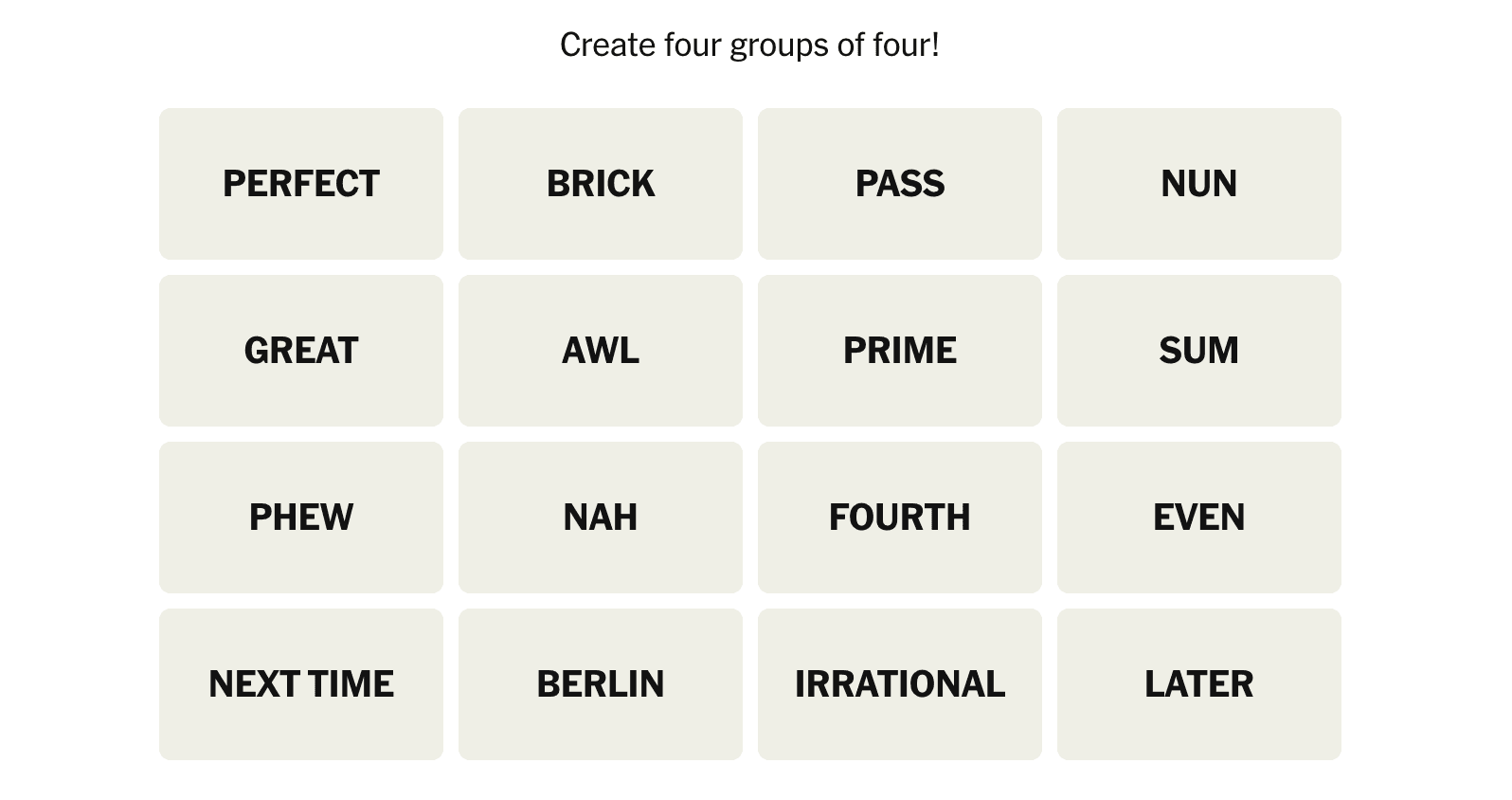
Here are the 16 words staring back at you in puzzle #1006:
PERFECT | BRICK | PASS | NUN
GREAT | AWL | PRIME | SUM
PHEW | NAH | FOURTH | EVEN
NEXT TIME | BERLIN | IRRATIONAL | LATER
A seemingly random collection that somehow connects into four perfect categories.
Strategic Hints (No Spoilers Yet)
Yellow Category Nudge: Think about polite ways to decline an invitation or opportunity.
Green Category Clue: These are classifications in mathematics that describe specific properties of numbers.
Blue Category Hint: Consider different types of barriers or structures that separate spaces.
Purple Category Teaser: These words sound like quantities or measurements but aren't actually numbers.
The Full Solutions
Last chance to solve independently: answers below
---
---
---
---
---
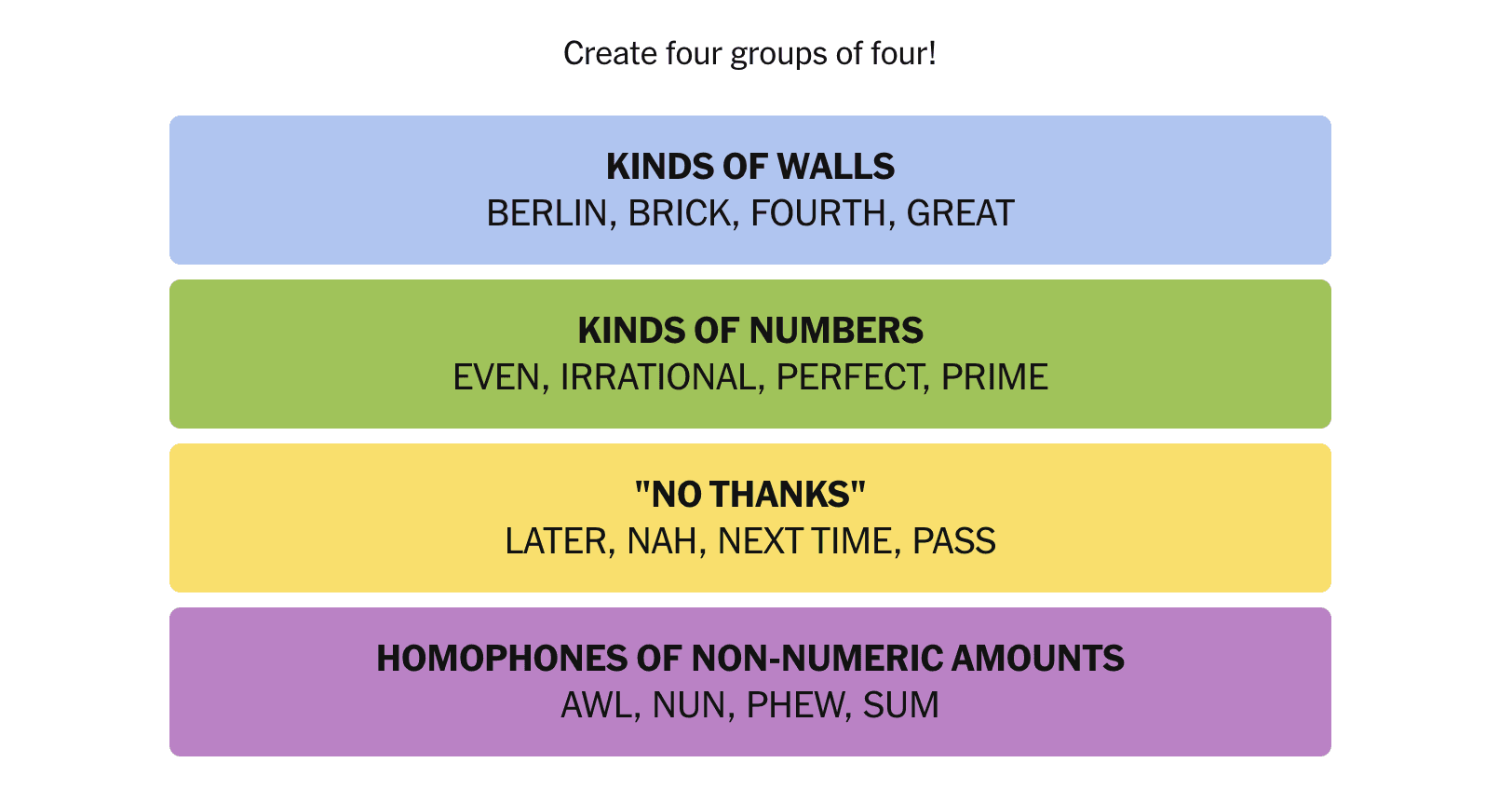
Yellow ("No Thanks"): LATER, NAH, NEXT TIME, PASS
This category collects casual ways to decline or postpone something. "Pass" and "Nah" are straightforward rejections, while "Later" and "Next Time" offer polite deferrals.
Green (Kinds of Numbers): EVEN, IRRATIONAL, PERFECT, PRIME
These are mathematical classifications for numbers with specific properties. Even numbers are divisible by two, irrational numbers can't be expressed as fractions, perfect numbers equal the sum of their proper divisors, and prime numbers have exactly two distinct positive divisors.
Blue (Kinds of Walls): BERLIN, BRICK, FOURTH, GREAT
This category references different types of walls, both literal and metaphorical. The Berlin Wall was a physical barrier, brick walls are construction materials, the Fourth Wall is a theatrical concept, and the Great Wall of China is a historical fortification.
Purple (Homophones of Non-Numeric Amounts): AWL, NUN, PHEW, SUM
These words sound like quantities but aren't numbers. "Awl" sounds like "all," "Nun" sounds like "none," "Phew" sounds like "few," and "Sum" sounds like "some" - each representing a non-specific amount.
The Verdict
Puzzle #1006 registers as moderate difficulty with a clever linguistic twist. Yellow falls quickly for anyone who recognizes polite declinations, while green requires mathematical literacy.
Blue separates history buffs from casual observers with its mix of literal and conceptual walls. Purple, predictably, is the streak-ender - that homophone trick won't reveal itself without serious lateral thinking.
The real trap lies in words like "Perfect" and "Prime" that could belong to multiple categories - "Perfect" could fit with "Great" as superlatives, while "Prime" could connect with "Great" as quality descriptors. "Sum" also creates misdirection by appearing mathematical when it's actually part of a wordplay category.
Reset and Repeat
Tomorrow's puzzle drops at midnight in your timezone. Until then, reflect on today's performance: did the mathematical categories stump you, or did you navigate the homophone challenge successfully?
The beauty lies not in perfection but in training your brain to spot these hidden patterns.
For now, puzzle #1006 is solved. See you at midnight for round #1007.