

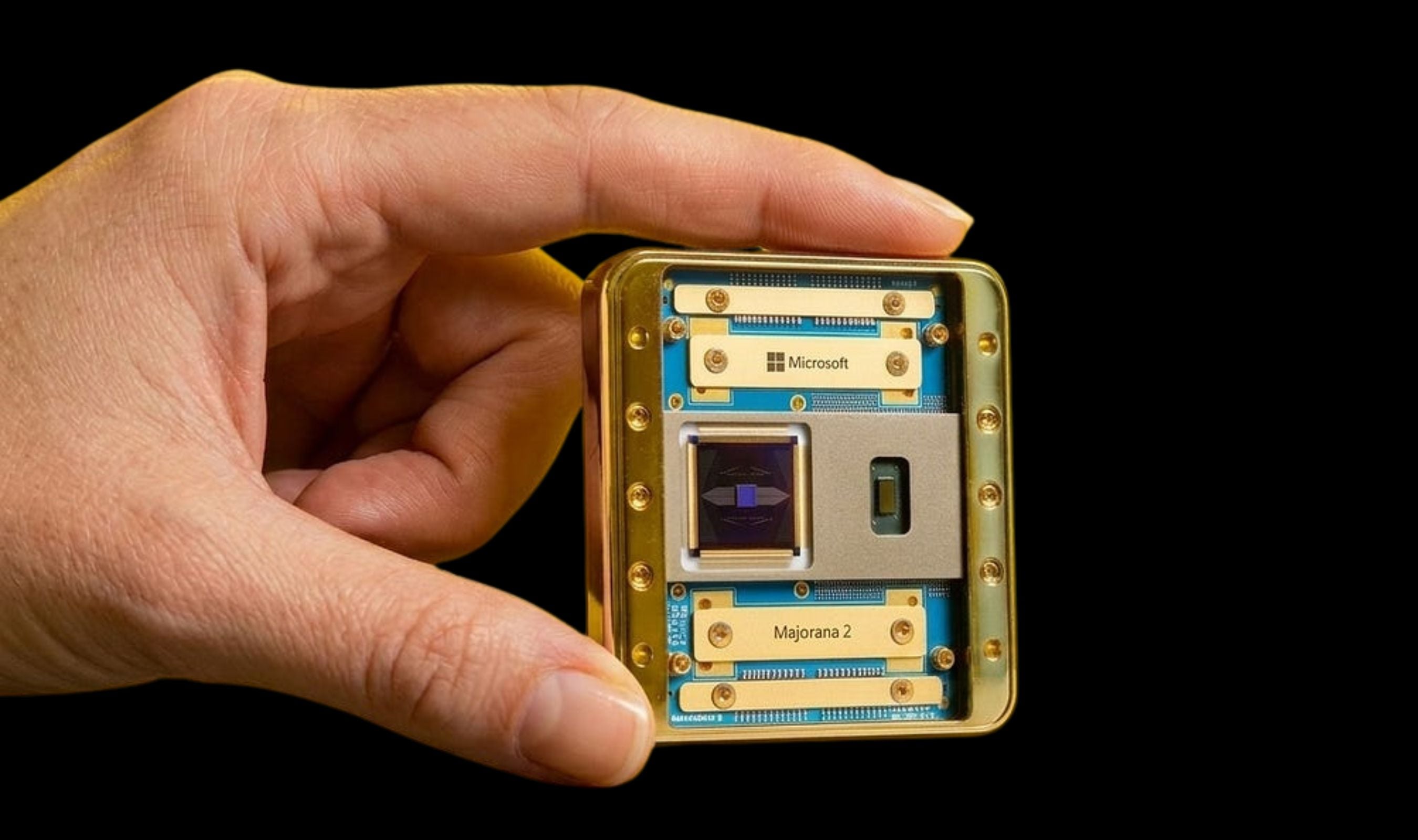
A peer-reviewed critique published in Nature on Wednesday accuses Microsoft of using flawed software to support its quantum computing claims. This marks the fifth time the company's research in the field has faced formal scientific challenge.
University of St. Andrews physicist Dr. Henry Legg, a long-term critic of Microsoft's quantum work, analyzed the software tool the company used to validate its February 2025 Nature paper. Legg found the tool "yielded inconsistent and misreported outcomes," and said a broader dataset Microsoft released separately showed random noise with no clear evidence of the gap the company claimed to find.
The gap matters because Microsoft's approach to building qubits (the fragile units at the core of quantum computers) relies on detecting a minute topological gap in a conductive wire. The company says identifying these stable gaps is key to creating qubits that hold their state longer than rival approaches.
Legg compared the analytical process to "finding an image of Jesus in toast by looking through an entire bakery's worth of loaves."
"If you're looking into something which is essentially just random physics, eventually you will find the Jesus in your toast," Legg said.
The critique cuts to the core of Microsoft's bet on Majorana-based quantum computing, a field in which the U.S. government has invested $2 billion.
Unlike rivals IBM and Quantinuum, which build machines on better-understood quantum technologies, Microsoft has spent nearly two decades trying to prove the existence and usefulness of the Majorana, a long-theorized subatomic particle it has not yet published in a peer-reviewed journal.
Microsoft defended its research in a formal reply also published in Nature, calling the software a "practical tuning tool" to find good locations on chips for placing qubits. Chetan Nayak, Technical Fellow and Corporate Vice President of Quantum Hardware at Microsoft, told Reuters the code works well enough that the company routinely uses it to set up chips now carrying out quantum operations.
"It's almost like arguing, is flight possible or not? And then you're standing next to an airplane," Nayak said.
"Well, why don't you hop in and take a ride?"
Two previous Microsoft-backed papers were retracted from Nature, and editors flagged possible research problems in two others, one in Nature and another in Science. Microsoft said the retracted papers were done outside its labs and it did not review the data before publication.
Sergey Frolov, a University of Pittsburgh physicist who has also criticized Microsoft's work, said the company lacks the foundational evidence supporting rival approaches.
"Neither Microsoft nor anyone else has laid a foundation where these (Majorana-based) advances are plausible, through a series of reliable experiments," Frolov said. "But we have a series of papers that keep being challenged at the very basic level, by different people."
Microsoft has since released a second generation of its Majorana chip, which it says is 1,000 times more reliable than the previous one. The company is sharing its data with the US defense agency Darpa for independent arbitration but has withheld some data from public release, citing commercial sensitivity.
The Trump administration this week set goals for a scientific quantum system by 2028 and has invested $2 billion in the field. Microsoft says it will have a working quantum system by 2029.
Legg's critique questions whether the company's entire roadmap rests on software that, according to his analysis, cannot reliably find what it claims to.