
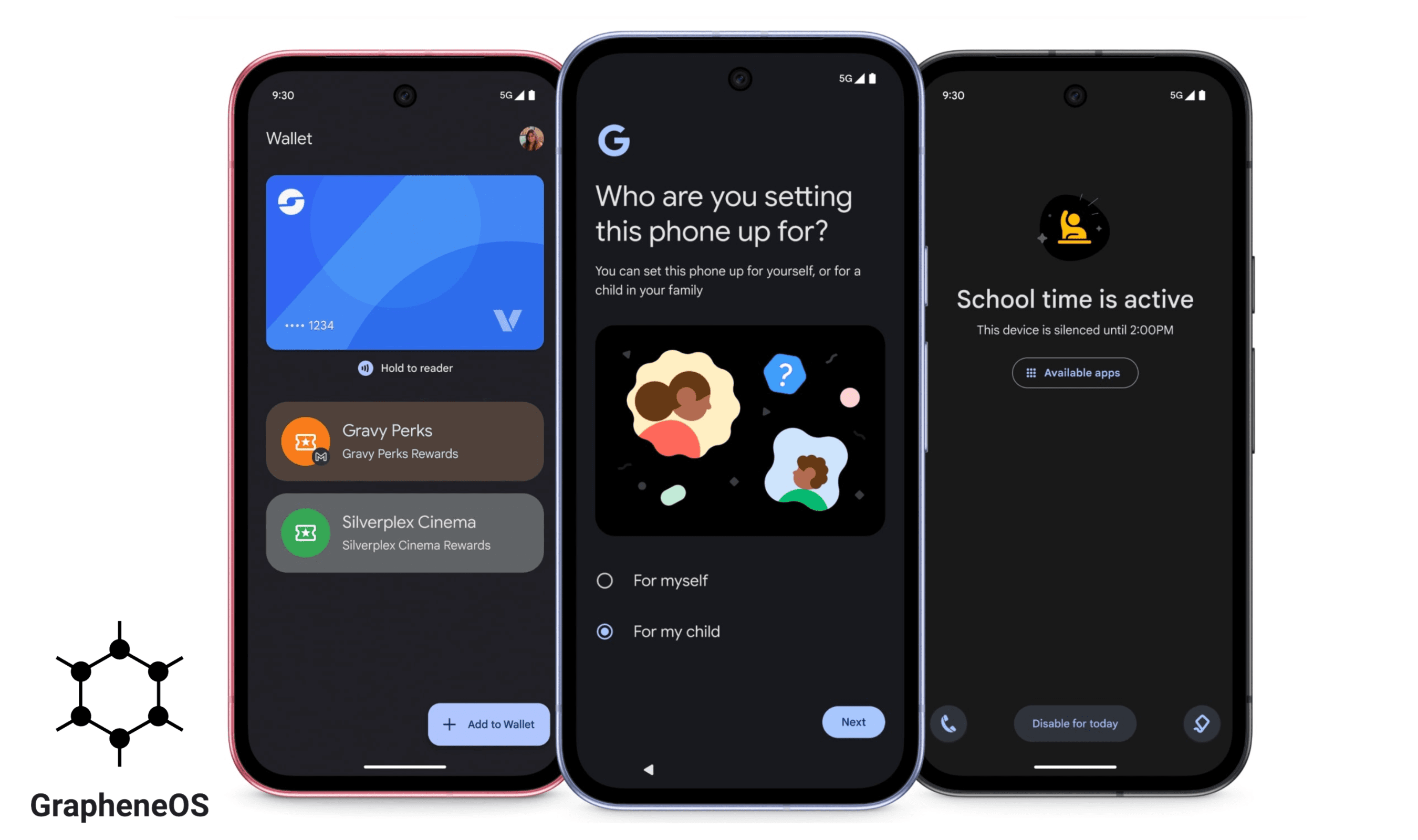
A former Apple loyalist has documented his complete escape from major tech ecosystems, switching to the privacy-focused GrapheneOS on a Google Pixel device that represents just 1% of the global smartphone market.
Tomasz Dunia spent years deep in Apple's walled garden with iPhone, MacBook, Apple Watch, and cloud services before breaking free earlier this year. His journey started with renting a Samsung Galaxy Z Fold 6 for six months, then progressed to installing GrapheneOS on a Pixel 9a purchased specifically for the experiment.
GrapheneOS strips Google services from Android while maintaining compatibility through sandboxed environments. The open-source operating system runs Google Play Services in isolated containers, allowing users to run popular applications without granting broad system permissions.
Dunia uses Obtainium as his primary app store for open-source software and Aurora Store to download proprietary apps directly from Google's servers without requiring Google Mobile Services.
"On GrapheneOS, Obtainium is my primary aggregator for obtaining .apk installation files and automating app updates," Dunia wrote in his detailed guide published this week. "It's like the Google Play Store, but privacy-respecting and for open-source applications."
The system currently supports only Google Pixel devices despite its mission to break free from Google's ecosystem. This irony isn't lost on users: the most privacy-focused Android variant runs exclusively on hardware from the company whose services it aims to avoid.
Supported devices include Pixel models from the 6 through 10 series, with Pixel 9a offering seven years of security updates.
Dunia's setup involves multiple user profiles and private spaces to compartmentalize applications requiring Google services. He maintains a separate profile with minimal Google integration solely for banking apps that demand NFC functionality for contactless payments, while keeping his daily digital life isolated in another profile that can be quickly deleted if needed.
This personal rebellion against tech giant dominance coincides with regulatory pressure forcing platform openness. The UK Competition and Markets Authority announced this month that Apple and Google must make their app stores fairer, following similar EU mandates.
Both companies will now review submitted apps "in a fair, objective and transparent way" according to the CMA's requirements.
Simultaneously, Apple and Google have collaborated to make switching between iOS and Android easier than ever. iOS 26.3 includes a "Transfer to Android" option that migrates photos, messages, contacts and other data directly between devices using Bluetooth and WiFi connections.
Google's hardware platform remains minuscule in market terms despite these developments. Counterpoint Research data shows Pixel devices hold approximately 1% of the global active smartphone market, roughly 20-40 million units compared to over one billion each for Apple and Samsung.
Nearly one in four active smartphones worldwide runs iOS, while Samsung commands just under 20% market share.
"GrapheneOS is really one big compromise between convenience and privacy," he notes. "While this same rule applies to everything belonging to the digital world, it's only in this case that you'll truly notice it."
The European Union's Revised Payment Services Directive (PSD2) regulations complicate banking without mainstream platforms by requiring "strong customer authentication" that typically involves banking apps with biometric verification. This regulatory environment creates tension between privacy goals and financial service accessibility.
Hacker News discussions about GrapheneOS reveal ongoing debates about practical implementation. Some users question whether multi-profile setups provide meaningful security benefits or merely create inconvenience.
Others highlight banking app dependencies that force continued engagement with Google services despite privacy intentions.
Dunia concludes his guide by encouraging support for the GrapheneOS project developers. His three-month experience with the OS, which runs exclusively on Pixel devices, has convinced him to continue using it long-term.