
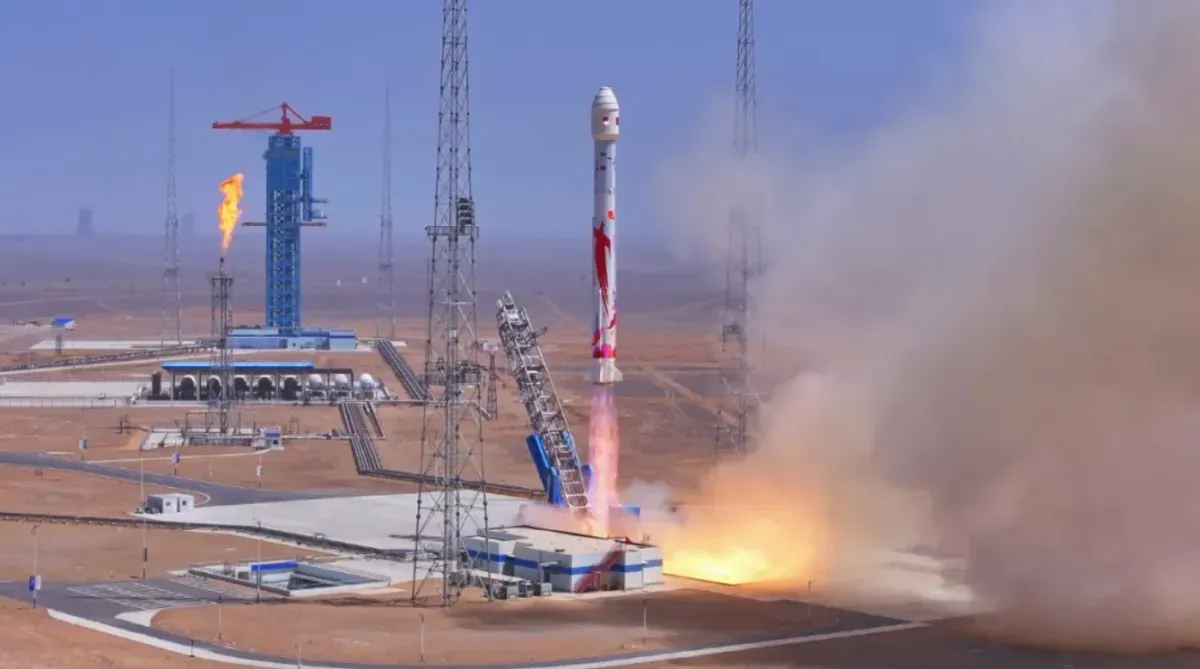
Beijing-based rocket startup LandSpace conducted China's first reusable rocket test earlier this month, marking a direct challenge to Elon Musk's SpaceX. The Zhuque-3 test ended in failure but signals a paradigm shift in China's historically risk-averse space industry.
LandSpace now prepares for an initial public offering to fund development, mirroring SpaceX's own IPO considerations. The company aims to become the second-largest reusable rocket provider globally after SpaceX, according to Reuters reporting.
The December test saw Zhuque-3's booster fail to activate its landing burn 3 kilometers above ground, causing a crash instead of controlled recovery. Despite the failure, state media coverage of the attempt represents a cultural departure from China's traditional aversion to public launch failures.
SpaceX founder Elon Musk commented on Zhuque-3's design in October, noting the Chinese rocket combines Starship features with Falcon 9 architecture. "They have added aspects of Starship, such as use of stainless steel and methalox, to a Falcon 9 architecture," Musk said on X.
Zhuque-3 chief designer Dai Zheng left China's main state-owned rocket developer in 2016 to join LandSpace, motivated by SpaceX's focus on reusability. "SpaceX can push products to the edge and even into failure, quickly identifying limits and iterating," Dai told state broadcaster CCTV.
LandSpace opened its engine factory floor to Reuters this month, allowing foreign media access to core assets for the first time. The transparency contrasts with China's traditionally secretive space program.
The startup's low-cost launch ambitions align with Beijing's plans to deploy up to 10,000 satellite constellations in coming decades. LandSpace aims to provide services similar to SpaceX's Falcon 9, which has demonstrated reusability through multiple successful missions.
China opened its space sector to private investment in 2014, spawning several startups including LandSpace. Beijing now facilitates IPOs for leading commercial space companies, recognizing the capital requirements for ambitious testing regimes.
"For us, we're not yet able to do that," Dai said regarding SpaceX's ability to absorb heavy losses during Starship testing. "I believe our country has recognized this, allowing capital markets to support companies in areas like commercial space flight."
LandSpace deputy chief designer Dong Kai emphasized the company's approach as learning rather than imitation. "Falcon 9 is a successful configuration that has been tested by engineering," Dong said in a podcast interview. "After studying it, we recognize its rationality."
The company prepares for another launch attempt following December's failure, drawing parallels to SpaceX's early Falcon development. SpaceX achieved its first successful Falcon booster landing in 2015 after two failed attempts.
LandSpace's emergence reflects broader changes in China's space industry, where state-owned firms now face competition from agile private companies. The shift could accelerate China's commercial space capabilities and reduce launch costs for satellite deployments.
Musk acknowledged LandSpace's potential while maintaining Starship's technological lead. "But Starship is in another league," he added in his October comments about the Chinese rocket's design.
The startup's IPO plans and reusable rocket development position it as China's most direct competitor to SpaceX in the commercial launch market. Success could provide Beijing with domestic alternatives to Western launch providers for its satellite constellation ambitions.