
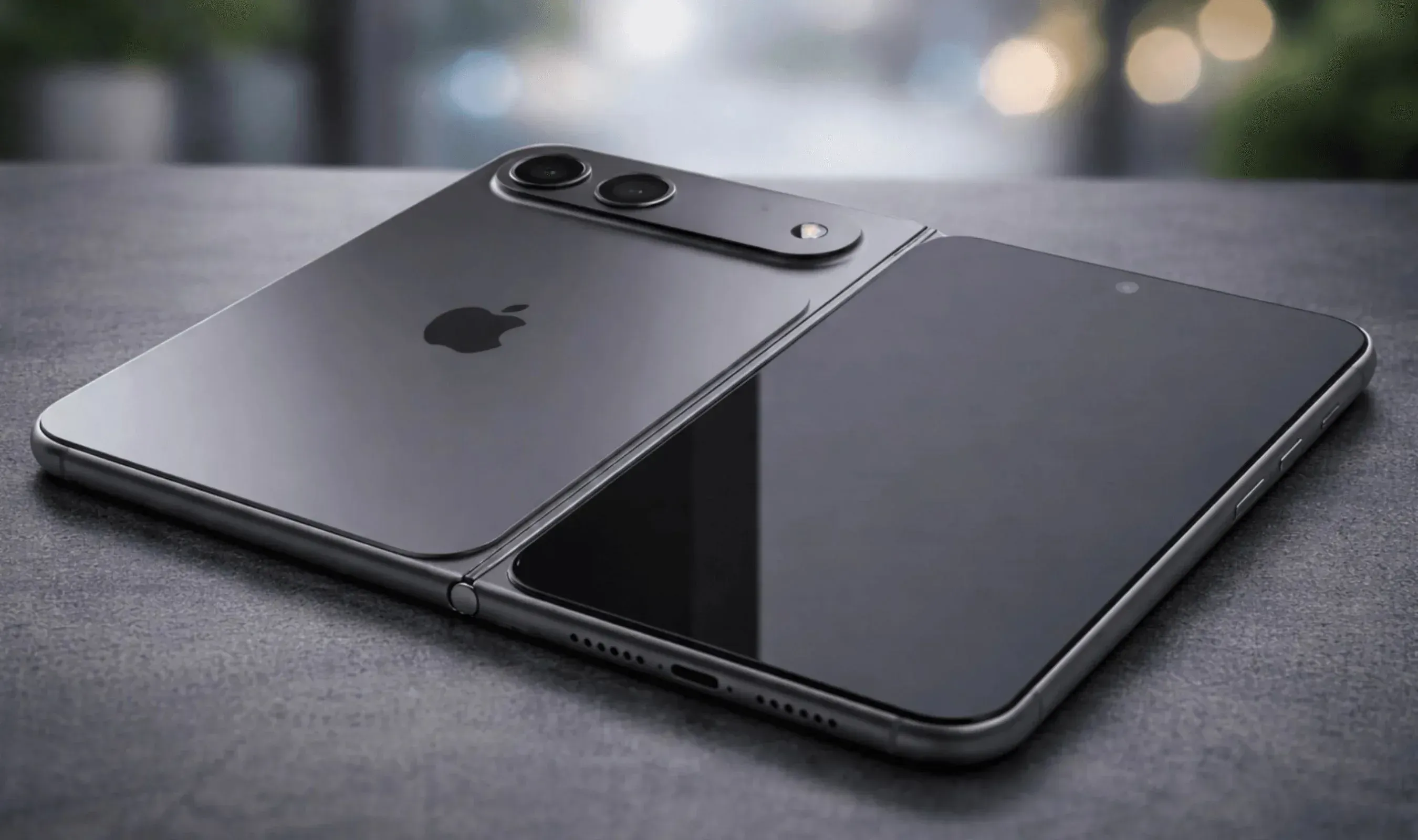
The foldable iPhone Ultra's 7.8-inch display doesn't just rival other foldables. It directly threatens Apple's own iPad Mini.
Apple's first foldable, expected to launch alongside the iPhone 18 lineup this September, reportedly uses a 4:3 aspect ratio, the same proportions as an iPad. When unfolded, the inner screen measures roughly 7.8 inches with a resolution of 2,713 x 1,920, while the outer display comes in at 5.5 inches with 2,088 x 1,422 resolution, per MacRumors. That unfolded real estate puts it in direct competition with the iPad Mini's 8.3-inch display, albeit in a device that folds to half the thickness.
The internal screen is just 4.5mm thick when open, thinner than the 13-inch iPad Pro's 5.1mm chassis, making it Apple's thinnest device ever. Closed, it measures 9mm to 9.5mm. To achieve that profile, Apple made a controversial tradeoff.
The foldable iPhone reportedly skips Face ID on the inner display entirely, replacing it with Touch ID built into the power button. The TrueDepth camera system that powers facial recognition simply doesn't fit in the 4.5mm chassis, according to leaked dummy models. It's a regression that Apple hasn't accepted on any flagship iPhone since the iPhone X introduced Face ID in 2017.
Apple is betting the display quality offsets the compromise. The company has spent years trying to eliminate the visible crease that plagues every foldable on the market, pursuing a solution "regardless of cost," sources suggest.
The result is a crease depth under 0.15mm with a fold angle under 2.5 degrees, shallow enough to be nearly invisible to the eye and imperceptible to the touch. Apple developed a new optically clear adhesive formulation that flows into microscopic irregularities during bending, reducing light scattering at the fold line.
Samsung Display is supplying the panels, using a custom process Apple trademarked that integrates touch sensors directly into the display, cutting thickness by about 19 percent. The hinge uses liquid metal, an amorphous alloy tougher than titanium, sourced from Taiwanese and American suppliers who 3D-print the components. The software side is catching up, too. iOS 27 beta includes new "foldState" and "angleDegrees" APIs that let apps switch interfaces based on the hinge angle, enabling true split-screen multitasking that mirrors macOS window management.
That's the feature that turns the iPhone Ultra into an iPad replacement rather than just a bigger phone.
Analyst Ming-Chi Kuo from TFI Securities drew parallels to the iPhone X launch strategy: announced in September alongside the iPhone 18 lineup, but with pre-orders and shipping delayed until later in the year due to limited early production. Apple has instructed suppliers to prepare 10 million units, per Nikkei, an increase over earlier forecasts.
The price will test how badly buyers want an iPad in their pocket. Bloomberg's Mark Gurman says the foldable will "cross the $2,000 threshold," putting it nearly $1,000 above the iPhone 17 Pro and well past the iPad Mini's $499 starting point.
Apple CEO Tim Cook told the Wall Street Journal the company has been trying to shield customers from component price increases driven by AI data center demand, but called the situation "unsustainable."