
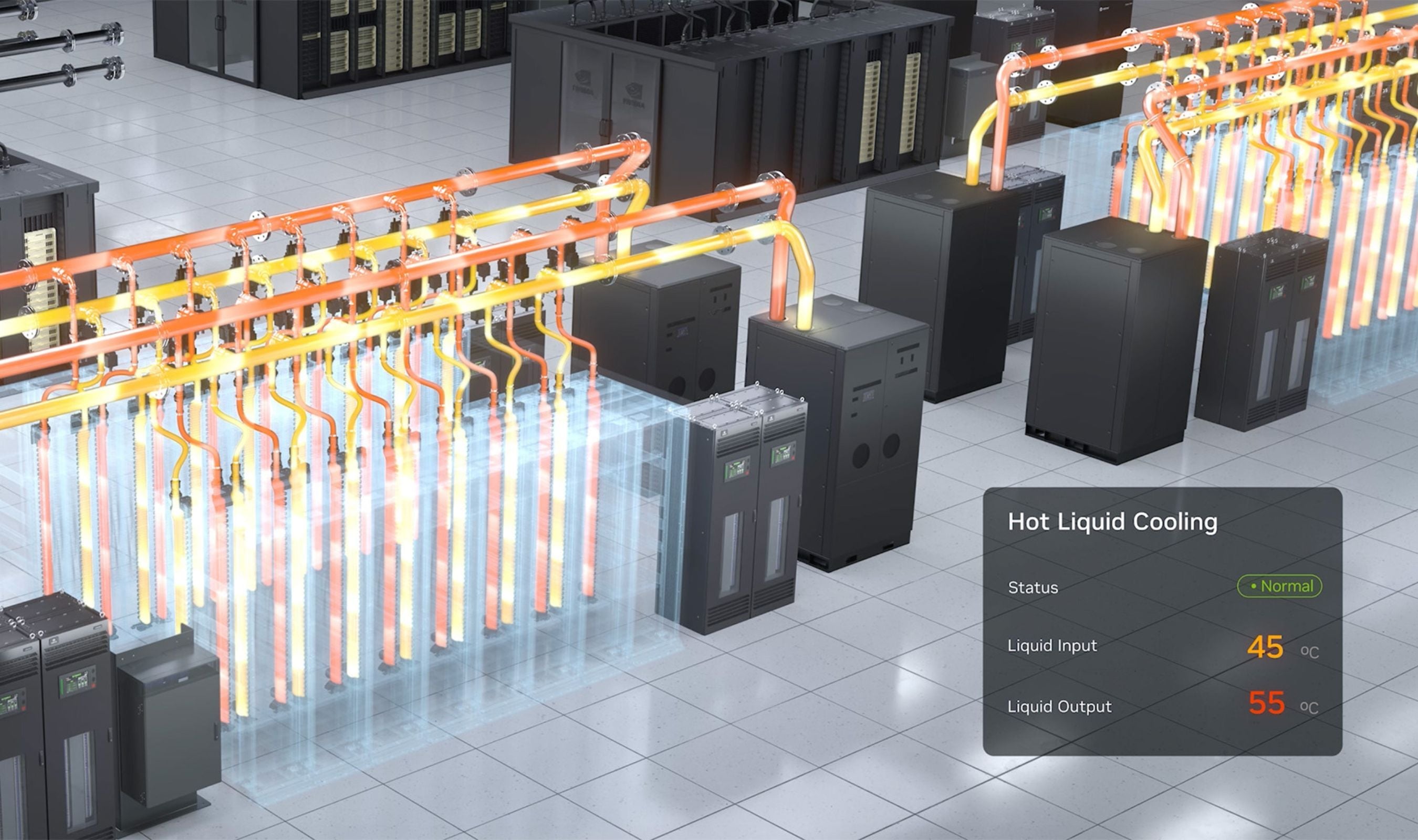
Nvidia's liquid cooling claims a 100% water use reduction inside data centers. The problem is what happens outside them.
Josh Parker, Nvidia's chief sustainability officer, declared at London Climate Week on Monday that "the water consumption challenge for data centers is largely solved." The company's warm-water direct-to-chip cooling system runs coolant at 113 degrees Fahrenheit, warm enough that most facilities can ditch chillers entirely, cutting on-site water use to near zero.
Nvidia's GB200 NVL72 rack system, part of the Blackwell platform, achieves 300x water efficiency over conventional air-cooled architectures. The upcoming Vera Rubin platform pushes inlet water temperatures up to 45 degrees Celsius, eliminating the need for massive industrial chillers that account for 30% to 40% of a facility's total energy consumption.
Data center cooling-water use can drop from roughly 2.6 million gallons per megawatt each year to nearly zero, the company said in a post on X.
Microsoft's own two-year study backs up the trend. Liquid-based cooling systems reduced water consumption by 31% to 52%, energy use by 15% to 20%, and greenhouse gas emissions by 15% to 21% compared with traditional air cooling, the research found.
Microsoft's Fairwater data centers use closed-loop liquid cooling and consume water annually at a rate comparable to a single restaurant. But Nvidia's solution only counts what happens inside the data center walls. The coolant runs in a closed loop, filled once and recirculated for the life of the facility, meaning no new water is consumed to cool the chips.
In favorable climates, that's a 100% reduction in on-site water use. The problem: water use outside the data center can double or triple the total footprint.
Fossil fuel power plants consume 2.7 billion gallons of water per day in the US alone, most of it for evaporative cooling, according to the US Geological Survey. Natural gas plants use 1.17 liters of water per kilowatt-hour.
Coal plants use 2.2 liters. And fossil fuels still generate about half of all data center power today, per the IEA.
Hydropower dams, supplying around 10% of data center electricity, lose 6.8 liters per kilowatt-hour through reservoir evaporation. The IEA projects that natural gas and coal will provide more than 40% of new electricity needed to meet data center demand through 2030. Without major changes, data centers will consume large amounts of water regardless of what Nvidia achieves inside its facilities.
There are climate caveats too. In hot regions like Arizona and Nevada, where outdoor temperatures approach 115 degrees Fahrenheit, additional cooling resources are still needed.
Nvidia acknowledged in its blog post that "a data center in the Scottish Highlands and one in Phoenix, Arizona, face very different realities," though it said even in warmer climates the shift moves operators "significantly closer to that chiller-less ideal."
Steve Solomon, Microsoft's vice president of data center engineering, said the technology could eliminate the need for mechanical chillers "in most climates most of the time", even in hot places such as Arizona. The new systems will take years to spread across the industry, and Nvidia declined to discuss costs. The pace of adoption depends on the economics of facilities designed for fully liquid-cooled infrastructure, though Nvidia says operators will save on cooling costs.
Parker was explicit that the efficiency gains are meant to enable more growth, not less. "AI workloads are not getting lighter," he wrote in a blog post.
Without those improvements, the energy needed to run AI would keep rising alongside demand.